
Two Tactile Pads With No Wrist Camera Beat the Wrist Camera on 3 of 3 Contact Tasks. Adding the Camera Back Did Not Help.
A Toyota Research Institute study (arXiv:2611.10490, 7 November 2026) ran 1,000 real rollouts of ACT policies with wrist cameras and FlexiTac tactile pads switched on and off. Pooled over bag retrieval, plug insertion and whiteboard wiping, vision alone scored 19.4%, adding a wrist camera 43.3%, adding touch instead 66.7%, and adding both 62.2%. On visible placement tasks touch added 0 to 13 points and none of it was significant.
On three contact-rich real-robot tasks, an ACT policy with two low-cost tactile pads and no wrist camera succeeded on 120 of 180 rollouts (66.7%). The same policy class with a wrist camera and no touch succeeded on 78 of 180 (43.3%). Touch without the wrist camera scored higher on all three tasks, significantly on two. The study is arXiv:2611.10490 from Toyota Research Institute, posted 7 November 2026.
Putting the wrist camera back on top of touch gave 112 of 180 (62.2%). The pooled figures are our sums of the paper's per-task counts.
A 2 x 2 sensor ablation with everything else frozen
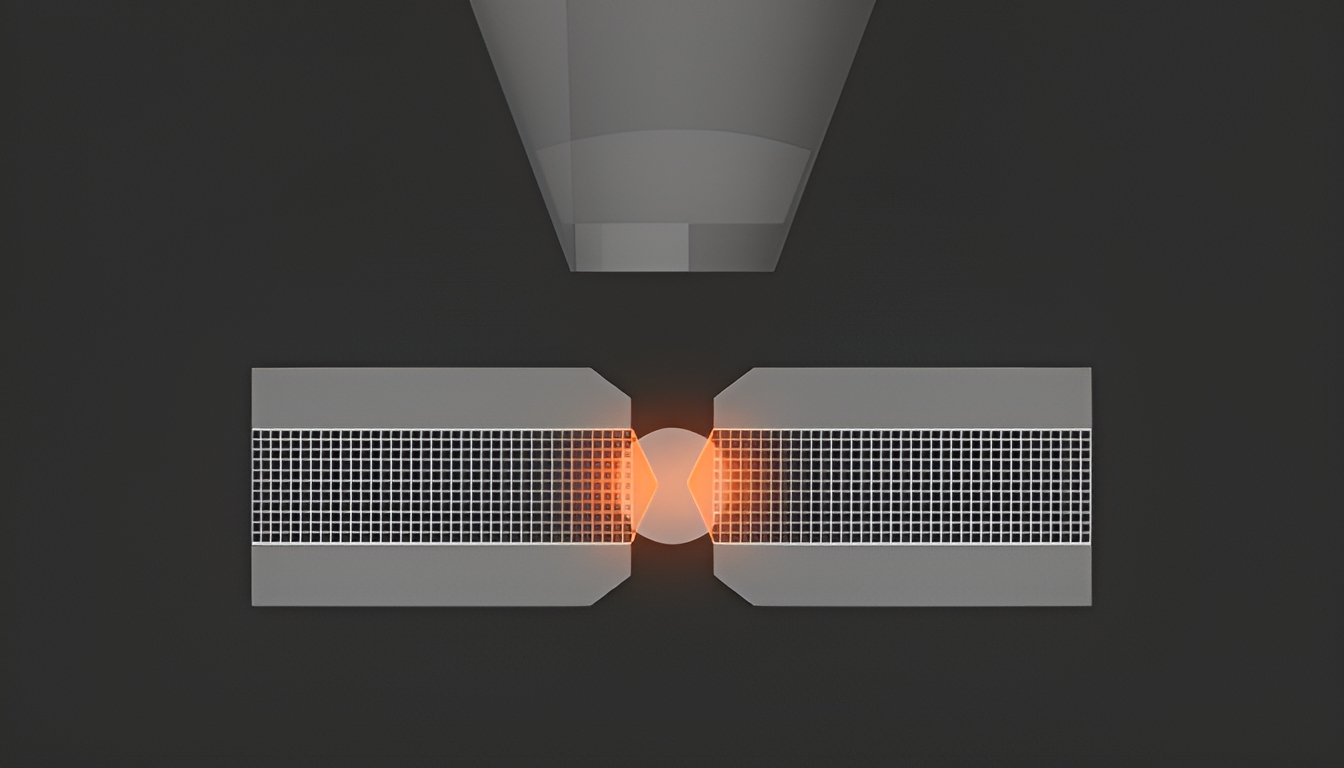
'Tactile Sensors Are an Effective Substitute for Wrist Cameras in Contact-Rich or Occluded Manipulation' is by Aijia Yang, Arsh Tangri, Sergey Zakharov and Krishna Murthy Jatavallabhula. The platform is a YAM arm run through the Raiden toolkit, with scene, egocentric and wrist RGB cameras and two FlexiTac piezoresistive arrays (arXiv:2604.28156) on the inner faces of TPU fingers. Touch is logged at about 99 Hz and RGB at about 30 Hz on a shared clock.
Each 32 x 16 tactile map is replicated to three channels, resized to 224 x 224 and pushed through the same ImageNet-pretrained ResNet-18 as the cameras. Touch enters ACT as two more images. Demonstrations, architecture, action space (19-step chunks of 7-DoF joint positions) and optimisation are identical across conditions; only the observation set changes. 'Without wrist' always keeps the scene and egocentric views.
Training data: 1,396 recorded demonstration episodes across six task datasets, of which the 1,258 successful ones were kept. Evaluation: 1,000 rollouts over 20 task-and-observation conditions from matched initial conditions.
Every condition, with counts
Successes over rollouts are the paper's. Pooled rows are our addition.
| Task | Wrist cam | Vision only | Vision + touch | Touch gain | Source |
|---|---|---|---|---|---|
| T1 tight-clearance block | on | 15/30 (50.0%) | 19/30 (63.3%) | +13.3 pts | arXiv:2611.10490 v1, Table 1 |
| T2a rigid block | on | 15/25 (60.0%) | 15/25 (60.0%) | 0.0 pts | Table 1 |
| T2b sponge | on | 19/25 (76.0%) | 22/25 (88.0%) | +12.0 pts | Table 1 |
| T3 straw insertion | on | 26/60 (43.3%) | 39/60 (65.0%) | +21.7 pts | Table 1 |
| T4 opaque-bag retrieval | off | 13/60 (21.7%) | 49/60 (81.7%) | +60.0 pts | Table 1 |
| T4 opaque-bag retrieval | on | 30/60 (50.0%) | 43/60 (71.7%) | +21.7 pts | Table 1 |
| T5 plug insertion | off | 9/60 (15.0%) | 28/60 (46.7%) | +31.7 pts | Table 1 |
| T5 plug insertion | on | 20/60 (33.3%) | 30/60 (50.0%) | +16.7 pts | Table 1 |
| T6 whiteboard wiping | off | 13/60 (21.7%) | 43/60 (71.7%) | +50.0 pts | Table 1 |
| T6 whiteboard wiping | on | 28/60 (46.7%) | 39/60 (65.0%) | +18.3 pts | Table 1 |
| T4 to T6 pooled (derived) | off | 35/180 (19.4%) | 120/180 (66.7%) | +47.2 pts | Our sum of Table 1 counts |
| T4 to T6 pooled (derived) | on | 78/180 (43.3%) | 112/180 (62.2%) | +18.9 pts | Our sum of Table 1 counts |
Touch bought twice what the wrist camera bought
Starting from scene and egocentric vision alone, the wrist camera added 28.3, 18.3 and 25.0 points on T4, T5 and T6. Touch added 60.0, 31.7 and 50.0. Pooled over the 180 rollouts per condition, that is 23.9 points for the camera and 47.2 for touch. Head to head, touch without the wrist camera beat the wrist camera without touch 81.7% to 50.0% on bag retrieval, 46.7% to 33.3% on plug insertion and 71.7% to 46.7% on wiping, a pooled gap of 23.3 points.
Once touch was in, the wrist camera stopped paying
With touch already present, switching the wrist camera on moved success from 81.7% to 71.7% on T4, 46.7% to 50.0% on T5 and 71.7% to 65.0% on T6. Pooled, that is minus 4.4 points. The paper does not call this a real decline: the wrist-on and wrist-off touch policies are statistically indistinguishable on T4 and T6, and it has one training seed.
The appendix shows where the lost rollouts went. On T4 the drop sits in one starting position: far-right trials went from 15/20 to 9/20 with the wrist camera on, while the other four positions gave 34/40 either way. On T6 it is in the pickup: 48/60 eraser pickups without the wrist camera against 42/60 with it, and the bottom start position alone fell from 15/20 to 9/20. Once the eraser was in hand, completion was 43/48 and 39/42. The authors label these post hoc and decline to assign a cause.
Where touch did little: tasks you can already see
On the three placement variants, touch added 13.3, 0.0 and 12.0 points with the wrist camera on, none significant after correction. Straw insertion gained 21.7 points even though the target is in plain view, so fine alignment benefits without occlusion.
The wiping task separates two jobs. Without the wrist camera, vision-only policies picked up the eraser on 23/60 rollouts and finished the wipe on 13 of those 23. With touch, pickups rose to 48/60 and 43 of those 48 finished. Touch helped find the grasp and then helped hold the contact.
What it means for a capture rig or a sensor budget
For contact-rich work, this is evidence that a finger-mounted pressure array is a better second sensor than a wrist camera, not only a complement to one. That matters for handheld and glove-style capture, where a wrist camera adds mass, a cable and a field of view the hand keeps blocking.
The data cost runs the other way from the benefit. Uncompressed, one 384 x 384 RGB wrist stream at 30 Hz is 13,271,040 values per second. Two 32 x 16 pads at 99 Hz are 101,376. That is a ratio of about 131 to 1 before any video codec, and the pads were the stream that carried more task information on T4 to T6. The ratio is our arithmetic from the paper's stated resolutions and rates.
It is not an argument for dropping cameras. Every condition kept two RGB views, and the authors' own summary is that vision guides the robot toward contact and touch resolves what cameras cannot see. It is also not an argument that more sensors are free: the camera-plus-touch policy did not beat touch alone, and nothing in the design tells us whether that is noise, a single seed or a policy that weighs redundant inputs badly.
Caveats that bound the claim: one robot, one sensor type, one policy class, random seed 42 only. The T5 checkpoint was picked with 10 physical development rollouts per condition instead of validation loss, the same way for all four conditions. FlexiTac pads showed baseline variation after replacement. Absolute success tops out at 81.7%, and plug insertion stays at or below 50.0% in every condition.
Check it yourself
Open https://arxiv.org/html/2611.10490v1. Table 1 has all 20 conditions; Tables 6, 7 and 8 in Appendix D have per-position counts for T4, T5 and T6, including the 9/20 against 15/20 far-right cell and the T6 (pickups, successes) pairs.
Reproduce the pooled rows and the rollout total: python3 -c "v0,t0,v1,t1=13+9+13,49+28+43,30+20+28,43+30+39; print(v0,t0,v1,t1,[round(100*x/180,1) for x in (v0,t0,v1,t1)], round(100*(t1-t0)/180,1), 2*30+4*25+2*60+12*60)" prints 35 120 78 112 [19.4, 66.7, 43.3, 62.2] -4.4 1000.
Data-rate arithmetic: python3 -c "print(384*384*3*30, 2*32*16*99, round(384*384*3*30/(2*32*16*99)))" prints 13271040 101376 131. The sensor design is in the FlexiTac paper, arXiv:2604.28156. The project page is https://annieyaj.github.io/tactile-vs-vision/.
What would prove this wrong
If, by 30 June 2027, a replication with at least three training seeds per condition, on a different arm or a different policy class, finds wrist-camera vision matching or beating touch-without-wrist-camera on two of three occluded or sustained-contact tasks, the substitution result is specific to this ACT and YAM setup.
The camera-plus-touch result has its own test. If a multi-seed rerun of T4 and T6 shows the combined policy at least 5 points above touch alone, the minus 4.4 here was seed noise and the two sensors are complementary after all.
Sources
- Yang, Tangri, Zakharov and Jatavallabhula, Tactile Sensors Are an Effective Substitute for Wrist Cameras in Contact-Rich or Occluded Manipulation, arXiv:2611.10490 (7 Nov 2026)
- arXiv:2611.10490 v1, HTML full text with per-position appendix tables
- Project page: tactile vs vision
- Huang and Li, FlexiTac: a low-cost, open-source, scalable tactile sensing solution for robotic systems, arXiv:2604.28156
- BLO LAB, PanoTac: dense tactile fingertip, vision-only 45.0% to 91.7%
- BLO LAB, ForceBench: six force-integration designs, 63% vs 40% baseline
- BLO LAB, Tactile and force sensor registry
Building or training robots?
We license manipulation datasets and run custom capture programs. Get in touch to see what fits.

A Closed-Form Weight Edit Took pi0.5 From 27 to 106 of 128 on a Misread Instruction, but Only When Written Into the VLM

V-JEPA 2's Predictor Adds 0.04 Top-1 Over Copying the Present on 27,000 Egocentric Trials. By Horizon, It Runs From Minus 0.05 at 1 s to Plus 0.16 at 3.5 s.
