
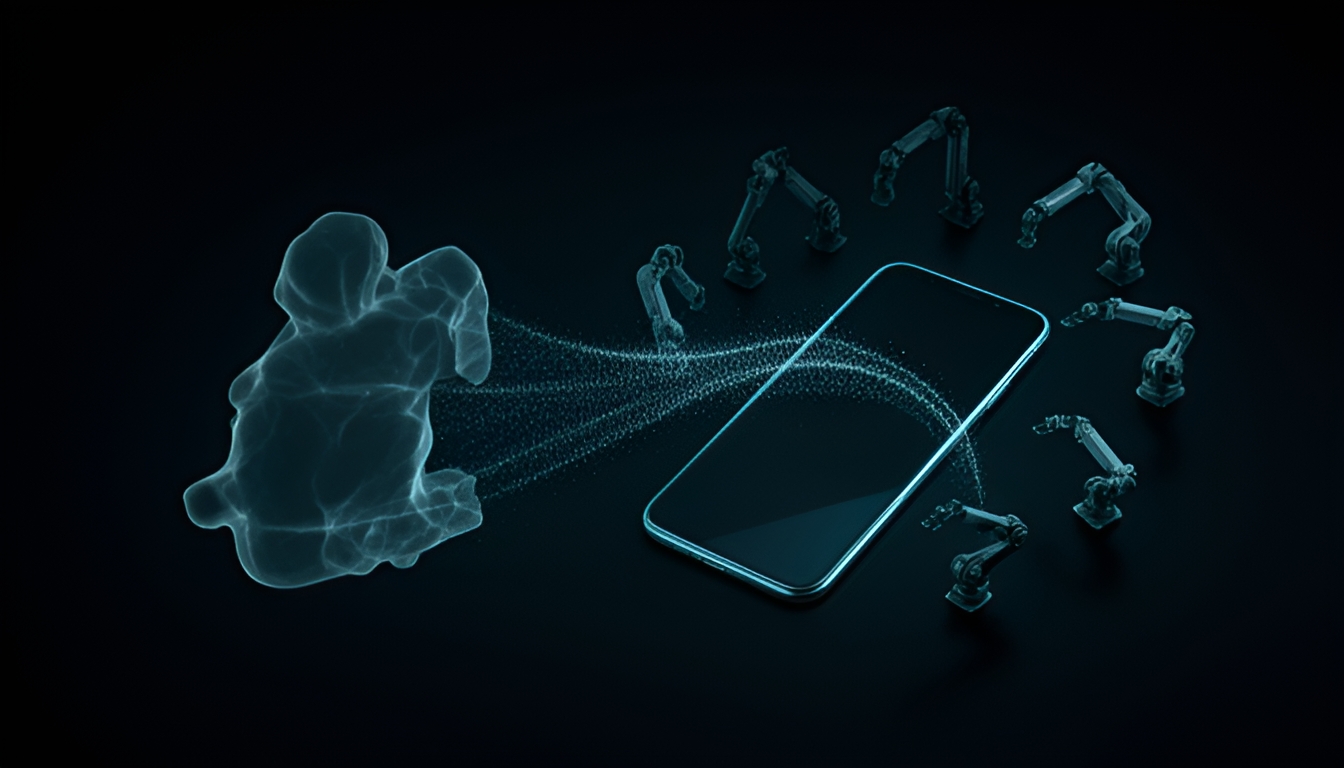
A Benchmark Retargets the Object a Phone Video Captured, Not the Hand That Moved It, Onto 8 Robots. 157 Robot-Episode Pairs Score 31.2% Pass, 52.2% Fail, 14.0% Refused Before Any Motion Ran.
A single-author benchmark (arXiv:2610.20351, no institutional affiliation listed, 14 October 2026) turns a phone-recorded human demonstration into a body-free record of the object's own motion, then checks whether 8 robots across 4 body classes can reproduce that object path. Across 157 robot-episode pairs: 31.2% pass, 52.2% fail, 14.0% are refused before any motion runs, and 2.5% are unauditable. No policy has yet been trained on the resulting record.
A new benchmark retargets the object's motion captured in a phone video, not the hand that moved it, then checks whether each of 8 robots can reproduce that object path closely enough to count as a pass (arXiv:2610.20351, single author Nagasrikanth Kallakuri, no institutional affiliation listed on arXiv, submitted 14 October 2026). Across 157 robot-episode pairs the corpus scores 31.2% pass, 52.2% fail, 14.0% refused before any motion was attempted, and 2.5% unauditable.
No policy has yet been trained on the resulting record. This is a measurement paper about which human demonstrations a given robot body can plausibly reproduce, not yet a training result.
What changed: retarget the object, check the robot before it moves
Most demonstration-to-robot pipelines retarget the human hand: map finger and wrist poses onto a gripper or dexterous hand, then measure how well the robot's end effector tracks that mapped trajectory. This paper retargets the object instead. Each phone capture is converted into a body-free record: the object's 6-DoF pose over time, its contact intervals with the hand, and a reconstructed 3D mesh of the object. That record carries no information about the human body at all, which is the point: it can be checked against any robot, described only by a URDF file and a short text descriptor.
For each robot-episode pair, the method first decides whether to attempt the episode at all. A refusal, built from a fixed vocabulary of seven reasons (object not rigid, no closing joint, no candidate grasps, stroke against object width, object against arm clearance, no feasible stance, sweep against reach), is issued before any motion is simulated. If the pair is not refused, the robot is solved against the object record in simulation and its reproduced object path is scored against the demonstrated one at a 50mm position and 15-degree orientation tolerance. Each pair ends in one of four outcomes: pass, a named failure (collision, a dropped object, or a grasp that never closed), refusal, or unauditable.
The worked corpus covers 8 robots across 4 body classes: fixed arms (Franka Panda, myCobot 280, UR5e, Fanuc LR Mate 200iD), a mobile manipulator (PR2), humanoids (Unitree G1, Apptronik Apollo), and a low-cost 5-DoF arm (SO-101), drawn from 42 phone captures.
The per-robot breakdown (Table 5) is where the aggregate numbers come apart:
| Robot | Body class | Pairs | Passed | Refused | Failed or unauditable |
|---|---|---|---|---|---|
| Franka Panda | fixed arm | 45 | 18 (40.0%) | 5 (11.1%) | 22 (48.9%) |
| PR2 | mobile manipulator | 20 | 8 (40.0%) | 1 (5.0%) | 11 (55.0%) |
| myCobot 280 | fixed arm | 19 | 2 (10.5%) | 3 (15.8%) | 14 (73.7%) |
| Unitree G1 | humanoid | 19 | 3 (15.8%) | 0 (0.0%) | 16 (84.2%) |
| UR5e | fixed arm | 19 | 7 (36.8%) | 1 (5.3%) | 11 (57.9%) |
| Apptronik Apollo | humanoid | 17 | 0 (0.0%) | 11 (64.7%) | 6 (35.3%) |
| Fanuc LR Mate 200iD | fixed arm | 17 | 11 (64.7%) | 1 (5.9%) | 5 (29.4%) |
| SO-101 | low-cost 5-DoF | 1 | 0 (0.0%) | 0 (0.0%) | 1 (100.0%) |
Franka Panda and PR2 both pass exactly 40.0% of their pairs. Apptronik Apollo and Fanuc LR Mate 200iD sit at nearly identical pair counts, 17 each, but at opposite ends of the outcome spectrum.
The mechanism: a body-free record, checked before it is trusted
The pipeline keeps the human body out of the record entirely, which is what lets one capture be checked against eight structurally different robots instead of one.
The refusal step is the paper's central design choice: deciding before any motion whether a robot can plausibly reproduce a given object path, using grasp selection by sweep coverage and a handful of geometric checks against the robot's own description file. 5 of the 7 defined refusal reasons were actually triggered in this corpus. When the authors forced motion to run anyway on episodes the method had flagged for refusal, all 13 of those forced attempts failed, and 5 of the 13 were on Apptronik Apollo, whose public URDF model welds the hand shut.
A second experiment asks whether the robot's description file alone, without running the simulation, can predict pass or fail. The best model the paper tests reaches 0.56 balanced accuracy on held-out robots, against 0.50 for always guessing the majority outcome, with a 0.43 to 0.65 range across the six robots that have both passes and fails in their data. Reading a spec sheet gets you almost nothing beyond a coin flip; the simulated solve is doing essentially all of the discriminating work.
What it means for teams sourcing human demonstrations
A capture that works for one robot body does not transfer by assumption. Franka Panda and PR2 pass 40.0% of their pairs; myCobot 280 and Unitree G1 pass 10.5% and 15.8% on the same style of captures. Any team buying or collecting phone-recorded demonstrations for a fleet with mixed robot bodies should expect that pass rate, not just data volume, to vary sharply by body, and should budget for refusal and failure as the majority outcome rather than the exception: only 31.2% of pairs in this corpus pass.
Refusal before motion is cheap and, on this evidence, accurate where it fires: the one robot with a structurally incompatible hand gets refused at 64.7%, far above the corpus average of 14.0%. That argues for running an equivalent screen before spending simulation or real-robot time on a new body, rather than discovering the incompatibility after a failed rollout.
The headline result is a measurement, not a demonstrated capability. No policy has been trained on the passing subset of this record yet, so whatever downstream value the retargeted object paths have for actually training a manipulation policy is still unverified. Treat this as a candidate filtering and evaluation layer upstream of data collection, not as evidence that retargeted human video trains working policies.
Check it yourself
Table 5 (per-robot outcomes) and Table 3 (the refusal vocabulary) are in the paper's HTML build at https://arxiv.org/html/2610.20351v1. The corpus shares check out: python3 -c "print(round(49/157*100,1), round(82/157*100,1), round(22/157*100,1), round(4/157*100,1))" prints 31.2 52.2 14.0 2.5, matching the paper's reported pass, fail, refused and unauditable shares.
The description-file baseline is in Section 6.4: 0.56 balanced accuracy on held-out robots against a 0.50 majority-guess floor. As of 15 October 2026 we found no code repository, dataset release, or project page linked from the abstract; the 56-page supplement is listed only as an ancillary file on arXiv.
What would prove this wrong
Our claim: checking a robot's ability to reproduce a demonstrated object path, before training anything, surfaces real structural incompatibilities (like a welded hand) that a description file alone cannot, and the resulting pass/fail record varies enough by robot body (10.5% to 64.7% pass rate across 8 robots) that treating human demonstration data as body-agnostic is a mistake.
It is wrong if, by 31 December 2027, a policy trained on this record's passing subset performs no better than one trained on the same robot's full, unfiltered retargeted demonstrations, which would mean the pass/fail label the method assigns does not predict anything a training run actually needs. It is also wrong if a larger held-out robot set pushes the description-file baseline's balanced accuracy above roughly 0.65, which would mean the simulated solve adds less than this corpus of 8 robots suggests.
Sources
- Kallakuri, Human Demonstrations as Post-Training Data for Any Robot Body: Retargeting the Object, Not the Hand, arXiv:2610.20351, 14 October 2026
- arXiv HTML build: Table 5 (per-robot outcomes), Table 3 (refusal vocabulary), Section 6.4 (description-file baseline)
- BLO LAB, PACT: hand-and-retargeter co-design cut retargeting error from 12.8mm to 3.9mm
Building or training robots?
We license manipulation datasets and run custom capture programs. Get in touch to see what fits.

A Closed-Form Weight Edit Took pi0.5 From 27 to 106 of 128 on a Misread Instruction, but Only When Written Into the VLM

V-JEPA 2's Predictor Adds 0.04 Top-1 Over Copying the Present on 27,000 Egocentric Trials. By Horizon, It Runs From Minus 0.05 at 1 s to Plus 0.16 at 3.5 s.
