
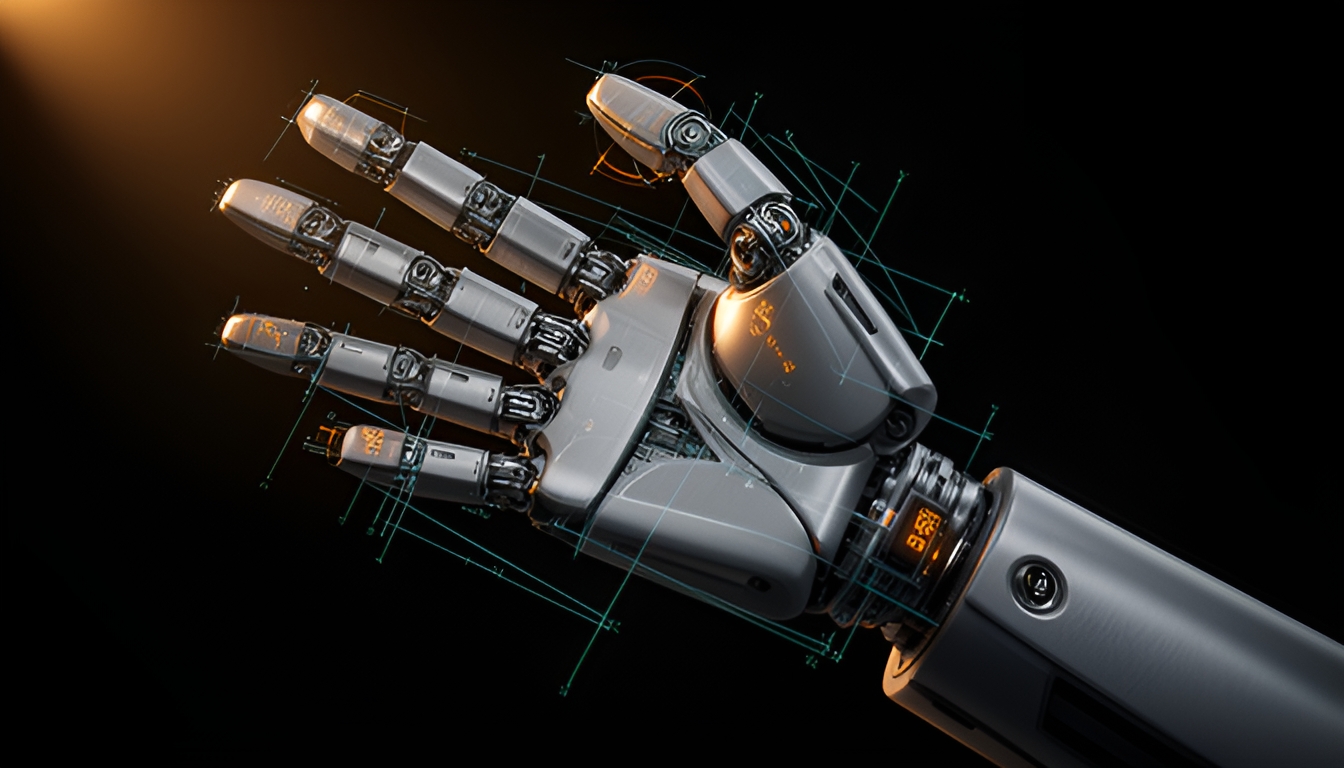
PACT Redesigned a Robot Hand Around Human Grasp Data Instead of the Other Way Around. Retargeting Error Fell from 12.82mm to 3.90mm, and Grasping Success Rose from 64% to 86% on the Same 50 Trials.
PACT (arXiv:2610.18443, Waseda University, 13 October 2026, submitted to ICRA 2027) optimizes a 17-servo hand's geometry jointly with the retargeter that maps human grasps onto it. Against the 16-servo LEAP Hand, the paired design cut all-keypoint RMSE from 12.82mm to 3.90mm, lifted YCB grasping success from 64% to 86%, and doubled payload under a matched torque cap.
PACT (Posture-Aligned Co-design Technique) treats a robot hand's link lengths, joint offsets and mounting angles as variables to optimize against real human grasp poses, rather than fixing a hand design first and tuning the retargeter after. Against the 16-servo LEAP Hand, the resulting 17-servo PACT Hand cut all-keypoint retargeting RMSE from 12.82mm to 3.90mm on 1,788 training poses from DexYCB, and grasping success on 50 YCB-object trials rose from 64% (32/50) to 86% (43/50) under an identical current-based torque cap (arXiv:2610.18443, Waseda University, submitted 13 October 2026 to IEEE ICRA 2027).
The same comparison holds on poses the optimization never saw: 277 held-out test poses put PACT at 3.88mm and LEAP at 13.09mm, and 1,421 grasps of 12 unseen YCB objects put PACT at 4.06mm against LEAP's 11.16mm. The gap is not an artifact of overfitting the training set.
What changed: the hand and the retargeter are one optimization, not two
The authors are Koyo Sasazaki, Satoshi Funabashi, Pranav Ponnivalavan, Alexander Schmitz, Tetsuya Ogata and Shigeki Sugano, all at Waseda University, Tokyo. PACT jointly solves for a mechanism theta (link lengths, joint offsets, mounting angles, base placement) and a retargeter rho, a linear human-to-robot joint map with per-keypoint IK weights and damping. The objective is the residual of the same damped-least-squares posture IK that runs at deployment time, evaluated against MCP, PIP, DIP and fingertip keypoints on every finger, so the hardware is scored by the exact error metric it will be judged on later, not a proxy.
Human grasp poses come from DexYCB: 234 sequences across 10 subjects and 8 objects, sampled at stride 3, with any pose whose MANO fit residual exceeded 8mm discarded. That left 5,117 poses, farthest-point-sampled down to 1,788 for training and 277 for a near-duplicate-filtered test set. The optimization itself runs in six staged phases (S0 to S6) that add servo-housing clearance, flat-palm protrusion, assembly tolerance and a 20-degree fingertip-pad orientation limit one at a time, with a 10% accuracy guard from S1 onward. The paper states that imposing all constraints simultaneously, rather than staged, frequently failed to converge; no numerical table is given for that comparison.
The built hand has four digits: index, middle and ring each carry four actuators, the thumb carries five, for 17 servos total. LEAP Hand, the comparison baseline, has 16. Teleoperation runs from a single RGB camera through WiLoR, which regresses MANO hand parameters that the saved retargeter converts to joint targets at roughly 23Hz, with no per-user calibration.
Table I isolates how much of the gain comes from geometry versus the retargeter. A tip-only variant, optimized to match fingertip position alone, reaches near-zero tip error but lets the intermediate joints drift badly, which is the clearest evidence that the two have to be solved together.
| Hand (servos) | Set | n | All-keypoint RMSE | Tip RMSE | MCP/PIP RMSE | HPCR (tips within 10mm) |
|---|---|---|---|---|---|---|
| PACT (17) | train | 1,788 | 3.90mm | 1.84mm | 4.39mm | 100.0% |
| PACT (17) | test | 277 | 3.88mm | 1.66mm | not reported | 100.0% |
| LEAP Hand (16) | train | 1,788 | 12.82mm | 13.45mm | 14.13mm | 21.6% |
| LEAP Hand (16) | test | 277 | 13.09mm | 13.59mm | not reported | 7.9% |
| Tip-only (16) | train | 1,788 | 23.66mm | 2.46mm | 26.33mm | 99.5% |
| Tip-only (16) | test | 277 | 22.79mm | <0.01mm | not reported | 100.0% |
The pipeline runs geometry and control as one loop: the same IK residual scores every candidate hand design, and the hand that wins that scoring is the one that gets built and teleoperated.
What the error gap costs downstream: payload, deformation and grasp success
Under a matched current-based torque cap of 0.167 N*m, PACT holds a 2,000g payload while LEAP and the tip-only variant both saturate near 1,000g regardless of the cap. At 1,300g specifically, PACT succeeded 5 of 5 trials; LEAP failed all 6 of its attempts, and tip-only failed all 5.
Grip gentleness moved the same direction. Holding a paper cup and scoring its circularity (1.000 is a perfect, undeformed circle), PACT averaged 0.9847 (SD 0.0020) against a bare human hand's 0.9777 (SD 0.0089), while LEAP averaged 0.8752 (SD 0.0120) and tip-only 0.8272 (SD 0.0304), across 75 total trials, 25 per hand, all of which held the cup. The paper's text says PACT deforms the cup 7 times less than LEAP; computing the ratio from the rounded published circularity values, (1-0.8752)/(1-0.9847), gives 8.2x, a discrepancy we could not resolve from the numbers given in the paper and flag rather than silently round away.
On the headline grasping test, 50 trials across YCB household objects under the same torque cap, PACT succeeded 43 times (86%), LEAP 32 times (64%) and tip-only 16 times (32%). Average teleoperation time per successful trial tracked the same ranking: 10.6 seconds for PACT, 21.8 for LEAP, 43.5 for tip-only, a 4.1x spread between the best and worst hand on time alone.
Three metrics, one ranking. The hand with the lowest retargeting error is also the fastest to operate and the most successful.
What this means for anyone building or buying teleoperation hardware
A capture rig's hand is not a neutral conduit for human demonstration data. The same human grasp, teleoperated through a geometry mismatch, produces systematically worse training examples: slower to collect (43.5s versus 10.6s per success here), less likely to succeed at all (32% versus 86%), and rougher on whatever the robot is holding. A dataset built on the wrong hand geometry is not just smaller for a given collection budget, it is lower quality per demonstration that does get through.
The tip-only ablation is the sharper point for anyone designing a capture rig under a deadline: optimizing only the metric you can see easily, fingertip position, produces a hand that looks accurate on a fingertip-tracking benchmark and is the worst performer on every task metric that follows. Intermediate joint accuracy (the MCP/PIP/DIP chain) is not a cosmetic detail; it is 26.33mm of drift that apparently costs the hand both payload and grasp success. An imitation-learning policy (ACT) trained on 54 PACT-collected pick-and-place demonstrations reached 94% (17/18) at taught placements and 75% (9/12) at held-out ones, numbers that assume the hardware generating those 54 demonstrations was already accurate; the paper does not report the same ACT experiment on LEAP or tip-only hardware, so the downstream policy comparison stops at teleoperation, not learned policy performance.
Check it yourself
Tables I and II, Figures 2 through 6, and the staged-optimization description are in the HTML build at https://arxiv.org/html/2610.18443v1. The PDF is at https://arxiv.org/pdf/2610.18443. The circularity-ratio discrepancy noted above: `python3 -c "print(round((1-0.8752)/(1-0.9847),1))"` prints 8.2, not the paper's stated 7x; the paper likely computed the ratio from unrounded internal values we do not have access to.
The YCB grasping tally, `python3 -c "print(43/50, 32/50, 16/50)"`, prints 0.86, 0.64 and 0.32, matching the 86%, 64% and 32% figures in Section V-B. DexYCB itself is at https://dex-ycb.github.io/, and the LEAP Hand comparison baseline's own design files are at https://leap-hand.github.io/.
What would prove this wrong
Our claim: jointly optimizing a hand's mechanical geometry and its retargeter against a shared IK objective produces a measurable, multi-metric advantage (accuracy, speed, payload, grasp success) over fixing the hardware first and tuning control after, and that advantage is not an artifact of the DexYCB training distribution, since it holds on 1,421 unseen-object grasps.
It is wrong if, by 31 December 2027, an independent replication on a different base hand or a different human-grasp dataset shows the co-designed hand's advantage collapsing to noise once evaluated outside DexYCB-style tabletop grasps, or shows a hand tuned only for fingertip accuracy matching PACT on payload or imitation-learning success once given equivalent training data volume.
Sources
- Sasazaki, Funabashi, Ponnivalavan, Schmitz, Ogata, Sugano, PACT: Posture-Aligned Co-Design Technique for Hand Configuration and Retargeting in Multi-Finger Imitation Learning, arXiv:2610.18443, 13 October 2026 (submitted to IEEE ICRA 2027)
- arXiv HTML: Tables I, II; Sections III to V
- DexYCB: A Benchmark for Capturing Hand Grasping of Objects
- LEAP Hand: Low-Cost, Efficient, and Anthropomorphic Hand for Robot Learning, arXiv:2309.06440
- BLO LAB, End-to-End Robot Training: the data wall and the shift to human video
- BLO LAB, Touch2Robot: a tactile glove and VR headset replace blind teleoperation
Building or training robots?
We license manipulation datasets and run custom capture programs. Get in touch to see what fits.

A Closed-Form Weight Edit Took pi0.5 From 27 to 106 of 128 on a Misread Instruction, but Only When Written Into the VLM

V-JEPA 2's Predictor Adds 0.04 Top-1 Over Copying the Present on 27,000 Egocentric Trials. By Horizon, It Runs From Minus 0.05 at 1 s to Plus 0.16 at 3.5 s.
