
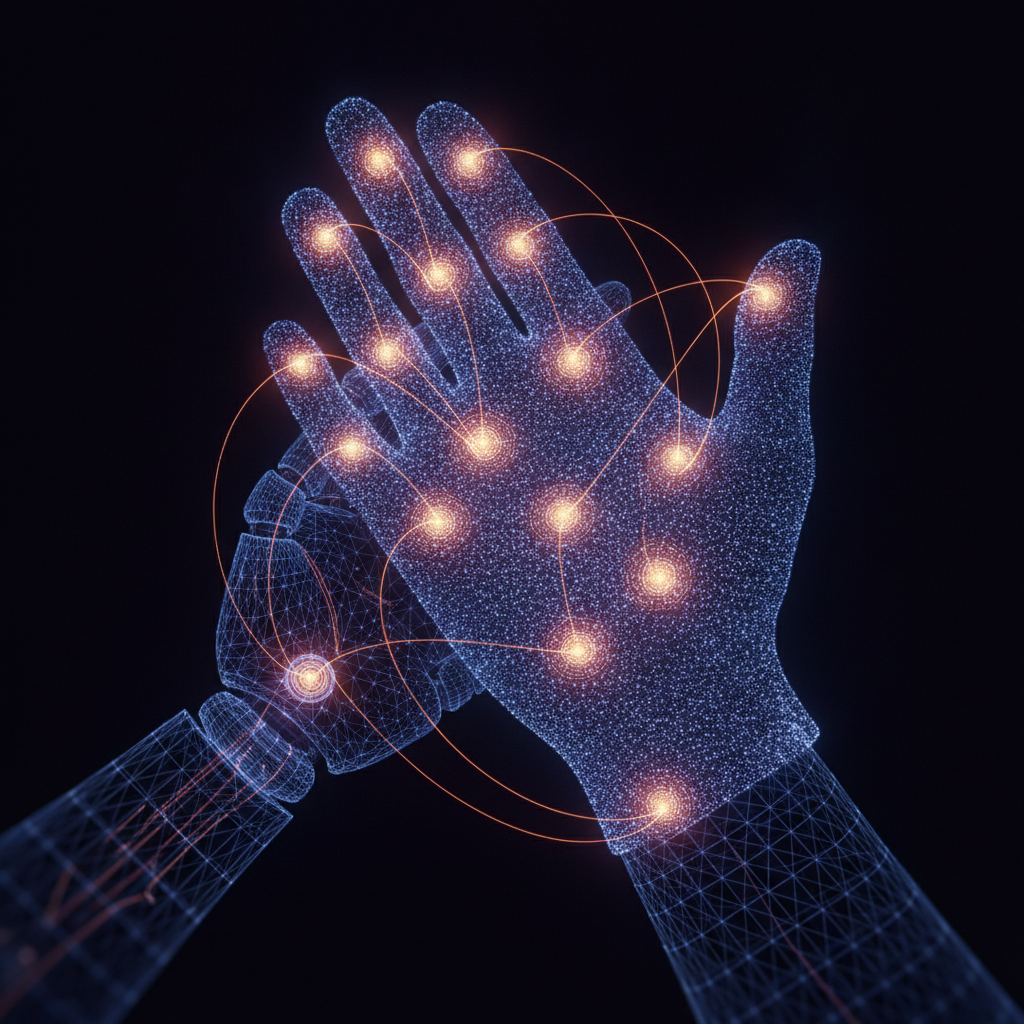
Showing the Glove Wearer the Robot's Contacts Cut Time per Usable Demo From 58.6 s to 18.2 s
Touch2Robot, from BIGAI, ShanghaiTech, Shanghai Jiao Tong and Beihang, puts a simulated robot hand's contacts in a VR headset while a person demonstrates with a tactile glove. Replay completion on a real LEAP Hand rose from 37.9% to 72.1% and collection time per replay-successful demo fell 3.2x, even though the contacts shown scored only 44% F1 against the real hand's sensors. The glove's 256 taxels were reduced to 8 bits along the way.
When demonstrators wearing a tactile glove could see, in a headset, where a simulated LEAP Hand would touch the object, the human time needed to produce one demonstration that also succeeded on the real robot fell from 58.6 seconds to 18.2 seconds, and average real-robot replay completion rose from 37.9% to 72.1%. Diffusion policies trained on those demonstrations averaged 62.0% completion, against 32.9% for the same data collected with visual-only feedback. The paper is Touch2Robot, arXiv:2609.24660, posted 21 September 2026.
The contacts the demonstrators were shown matched the real robot's tactile sensors at 44.19% F1. Imperfect feedback, given during capture, was worth more than a better retargeter applied afterwards.
What the system does, and what it runs on
Touch2Robot comes from the Beijing Institute for General Artificial Intelligence, ShanghaiTech, Shanghai Jiao Tong University and Beihang University. The human rig is a MANUS glove for hand motion, a Juqiao tactile glove for touch, calibrated RGB cameras with FoundationPose for the object's 6-D pose, and a Meta Quest 3. The robot is an xArm6 with a LEAP Hand fitted with TwinTac fingertip sensors and binary FSRs on the linkages. No robot moves during collection.
The retargeter is built in three steps. Per-object PPO teachers learn to reproduce the demonstrated object motion in MuJoCo while matching the human's contact pattern, with a curriculum that hands the object over from scripted reference to free physics. Their rollouts, 30 teacher trajectories per task augmented to 400, are distilled into one causal Transformer conditioned on a PointNet encoding of the object. At collection time that model predicts the robot hand's configuration from the live human stream, the simulator places the hand against the tracked object, and any region with more than 0.5 N of simulated force lights up in the headset at 30 Hz with 122 ms end-to-end latency.
The glove's contribution is narrower than its spec sheet. Its 256 taxels are grouped into semantic regions and binarised with per-recording thresholds, and only 8 regions survive the mapping to the LEAP Hand: four fingertips and four palm areas. The fifth human fingertip has no counterpart on a four-fingered hand and is dropped from the contact comparison.
Large gains on every task except Drawer, and more false contacts
| Measurement | Offline retarget | Visual feedback | Touch2Robot | Source |
|---|---|---|---|---|
| Replay completion, average of 4 tasks | 28.3% | 37.9% | 72.1% | arXiv:2609.24660 Table I |
| Human time per replay-successful demo | 66.0 s | 58.6 s | 18.2 s | arXiv:2609.24660 Table I |
| Replay completion, Rotate | 0.0% | 0.0% | 59.0% | arXiv:2609.24660 Table I |
| Replay completion, Drawer | 73.0% | 75.0% | 77.0% | arXiv:2609.24660 Table I |
| Diffusion Policy completion, average | 23.3% | 32.9% | 62.0% | arXiv:2609.24660 Table II |
| Diffusion Policy completion, Rotate | 0.0% | 0.0% | 43.5% | arXiv:2609.24660 Table II |
| Contact F1 vs real robot tactile | ConTrack 23.77%, DexMachina 24.71% | not applicable | 44.19% | arXiv:2609.24660 Table III |
| Contact false-positive rate vs real robot | ConTrack 4.10%, DexMachina 4.74% | not applicable | 6.38% | arXiv:2609.24660 Table III |
| User-rated contact awareness (Likert rescaled) | not tested | 18.3% | 86.7% | arXiv:2609.24660 Table V |
Where the gain actually is
Split the 72.1% by task and it concentrates. Drawer opening barely moves: 73.0%, 75.0% and 77.0% across the three interfaces, with standard deviations above 25 points. Pulling a handle does not need a contact decision the demonstrator can get wrong. Rotation is the opposite case. Neither offline retargeting nor visual feedback produced a single rotation demo with any replay completion, 0.0% for both, and Touch2Robot produced 59.0%. Policies trained on those demos reached 43.5% on Rotate where both baselines stayed at zero.
That zero has a consequence for the headline. If visual feedback yielded no successful Rotate replays, its time per replay-successful demo on Rotate is undefined. The 58.6-second figure can only be a pooled number, total time over total successes, or an average over the other three tasks. The paper does not say which, and it defines collection time against a replay that succeeds while reporting replay as a continuous completion score without stating the success threshold. The direction of the result is not in doubt. The 3.2x is the least well specified number in the paper.
A contact signal at 44% F1 was still worth a 3.2x yield gain
Table III scores the displayed contacts against what the real LEAP Hand's tactile sensors registered when the same trajectory was replayed. Touch2Robot reaches 44.19% F1 with 857.4 ms onset error. ConTrack reaches 23.77% and 1,383.3 ms, DexMachina 24.71% and 1,785.9 ms, and the same model without the tactile reward 24.58%. The price is false positives: 6.38%, the highest of the four.
So the demonstrators were adapting to a contact signal scoring below 50% F1 against the real hand, and the demonstrations still became much more executable. Our reading, a judgement: the feedback does not have to be accurate, it has to be early and roughly right about which region matters, because what it changes is the human's next motion, not the stored label. That also means the value is created at capture time and is not recoverable afterwards by reprocessing the same recordings. Offline retargeting, which had all the same data, scored 28.3%.
What it means if you collect or sell glove data
First, price yield, not hours. Seconds of human time per demonstration that succeeds on the target robot is the number this paper moved, by 3.2x, and it is the number a buyer's cost model depends on. A glove dataset quoted by the hour hides the difference between 18 and 59 seconds per usable demo.
Second, the tactile resolution you capture is not the resolution anyone used. 256 taxels became 8 bits per frame, one human region was discarded, and the threshold that set each bit was chosen per recording. A seller advertising taxel count is advertising a number this pipeline threw away. What mattered was region-level contact timing that lines up with the target hand's sensor layout, which is a mapping problem, not a density one.
Third, the feedback loop requires the target hand's model, object meshes and trained teachers before collection starts. The retargeter here was distilled from teachers on the same four tasks it was evaluated on, and cross-hand use is shown only qualitatively in Figure 9. A collection operation that wants this yield has to be told which robot hand the buyer deploys, and has to rebuild the loop when that changes.
Check it yourself
Every number above is in Tables I to V of the HTML render. To pull Table I with its caption:
curl -s https://arxiv.org/html/2609.24660v1 | sed 's/<[^>]*>/ /g' | tr '\n' ' ' | tr -s ' ' | grep -o 'Human adaptation and demonstration quality.\{0,700\}'
The collection protocol, 10 attempts per task per interface with no filtering, is in Section IV-B. The glove-to-hand region mapping and the 0.5 N simulated contact threshold are in Appendix A-A. The teacher-to-student distillation set, 30 trajectories per task augmented to 400 rollouts, is in Appendix A-C. The project page is touch2robot.github.io, and the LEAP Hand design files are linked from leap-hand.github.io.
The one thing you cannot check from the paper is how the 58.6-second and 18.2-second averages were computed across tasks with zero successes. Ask the authors before you put either number in a cost model.
What would prove this wrong
Our reading is that the gain comes from showing contact during capture, and that it will survive on objects the teachers never saw. Both halves are testable.
With a date: by 30 June 2027, if a replication on at least four objects outside the teacher set reports Touch2Robot's replay completion within 10 points of visual feedback, the result was a property of per-object teachers rather than of contact feedback, and the collection-yield argument above does not transfer to a real catalogue of objects. If the gap stays above 20 points, contact feedback is a general collection tool.
Second: if a version that shows the demonstrator the human glove's own contacts, with no robot simulation at all, recovers most of the gain, then the value was in making touch visible, not in the robot model, and the expensive part of this pipeline is optional.
Sources
- Luo, Chen, Ying, Zhou, Jiang, Guo, Li, Jiao, Xiao, Touch2Robot: Robot Touch in the Human Demonstration Loop, arXiv:2609.24660, 21 September 2026
- arXiv HTML render: Tables I to VI, Sections III-C and IV, Appendices A-A to A-D
- Touch2Robot project page
- LEAP Hand: Low-Cost, Efficient, and Anthropomorphic Hand for Robot Learning, arXiv:2309.06440
- LEAP Hand project page
- BLO LAB, fingertip force is a better signal than pose
Building or training robots?
We license manipulation datasets and run custom capture programs. Get in touch to see what fits.

A Closed-Form Weight Edit Took pi0.5 From 27 to 106 of 128 on a Misread Instruction, but Only When Written Into the VLM

V-JEPA 2's Predictor Adds 0.04 Top-1 Over Copying the Present on 27,000 Egocentric Trials. By Horizon, It Runs From Minus 0.05 at 1 s to Plus 0.16 at 3.5 s.
