
A Band With No View of the Hand Read Per-Finger Contact Force at R2 0.57. Handing It a Pose From Vision Took That to 0.75.
Beyond Gestures (arXiv:2609.16518, 15 September 2026, Meta Reality Labs Research) puts 720 capacitive pressure taxels around the distal forearm and recovers 20 finger joint angles, 3 wrist angles and 65 channels of contact force from the resulting signal. Per-finger force across four people manipulating everyday objects reaches R2 0.57 and 0.59 N mean absolute error. Supplying an externally measured hand pose as an input, not as a second output, takes that to R2 0.75 and 0.45 N, a 24 percent error reduction that neither joint prediction nor the model's own pose estimate reproduces.
A strap of 720 capacitive pressure taxels worn where a watch goes, with no line of sight to the hand and no electrical contact with the skin, estimated per-finger contact force at R2 0.57 across four people manipulating everyday objects. Hand that same model a hand pose measured somewhere else and the figure goes to 0.75, with mean absolute error falling from 0.59 N to 0.45 N. Both numbers are from Beyond Gestures, arXiv:2609.16518, posted 15 September 2026 by Svetoslav Kolev, Lingni Ma, Michael Goesele, Renzo De Nardi, Jakob Engel and Richard Newcombe at Meta Reality Labs Research.
The paper is written for interactive computing and VR, and it names robot learning in its first sentence: high-fidelity tactile demonstrations. What it actually publishes is a price list for the force channel on a human hand. The band alone is a force sensor. The band next to a camera is a better one, and the paper isolates exactly why.
What is in the band, and what it was measured against
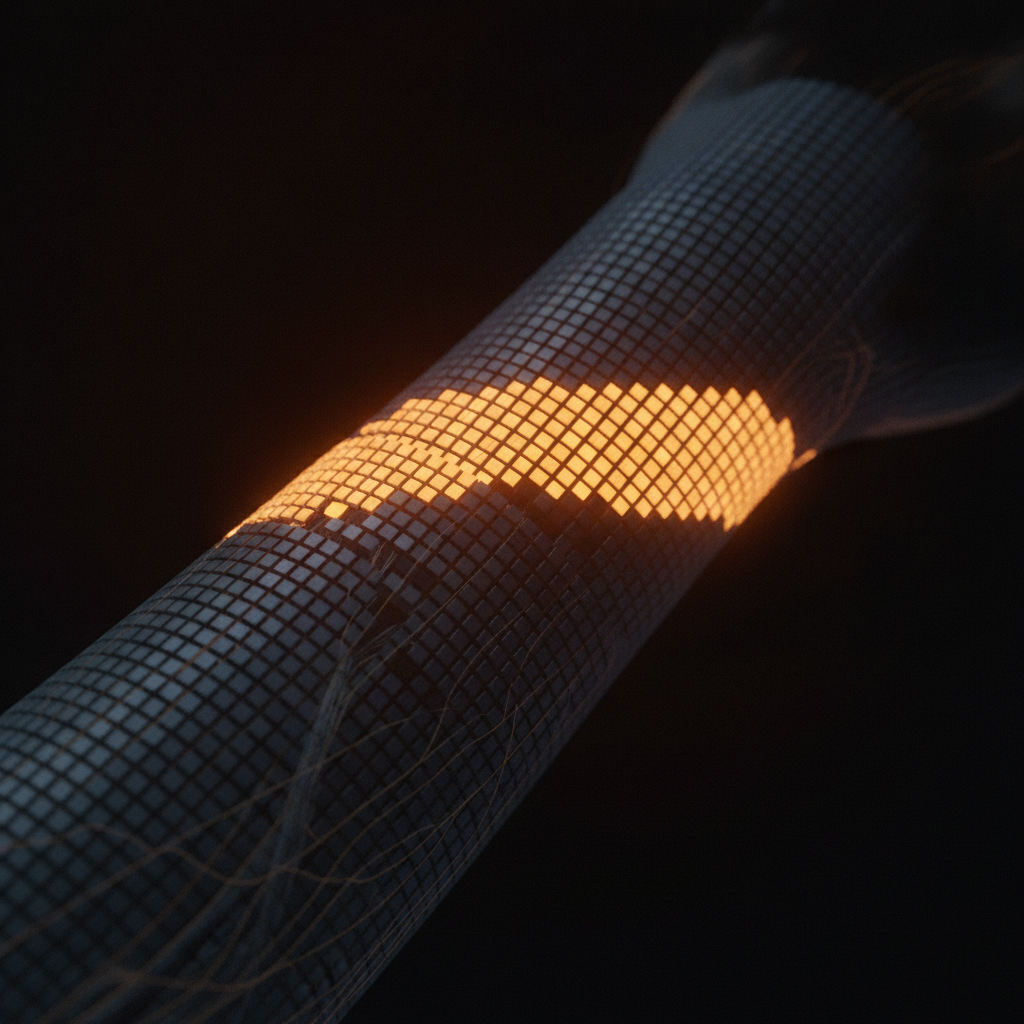
The sensing element is an off-the-shelf Pressure Profile Systems #6863 capacitive array: 39 x 68 mm, a 30 x 56 mm active area, a 10 x 18 grid of roughly 3 x 3 mm taxels. Three of them make a small band of 540 taxels streaming at about 50 Hz; four make a large band of 720 taxels at about 45 Hz. The arrays sit in fabric pockets on a tapered, buckled strap. A row-to-row baseline difference in the array shows up as horizontal banding in the raw heatmap and is left uncorrected, on the reasoning that the model should absorb it.
The physical claim underneath is that the extrinsic muscles and tendons that actuate the fingers run through the distal forearm, so any change in pose or grip force changes the local stiffness and contour under the band. The band measures that deformation mechanically rather than through an electrode-skin interface, which is what separates it from the surface EMG work it is compared against.
Supervision is where the cost sits. Hand pose comes from an OptiTrack rig of 50 infrared cameras in a 4 x 4 x 3 m volume, tracking 19 reflective markers on a thin glove plus a rigid marker tree on the proximal forearm to recover wrist rotation relative to the elbow. Contact force comes from a PPS tactile glove with 65 taxels streaming at 100 Hz over Bluetooth, which carries about 35 ms of fixed latency and a random-walk clock drift accumulating up to roughly 1 second over a 10-minute recording. The authors correct it by pressing the glove against the band and aligning peak-force events, then tracking the glove clock continuously.
The corpus is 32 hours, and only four people are in it
Every recording is a separate donning session: the band goes on at the start and comes off at the end, so placement and strap tension differ between recordings. Evaluation is leave-one-recording-out, which makes every reported figure a cross-session number rather than a within-session one.
| Dataset | Pose ground truth | Force ground truth | People | Sessions | Duration (min) | Source |
|---|---|---|---|---|---|---|
| HP (hand pose) | yes | none | 1 | 20 | 415 | Table 2 |
| FF (fingertip force) | none | fingertip only | 1 | 18 | 348 | Table 2 |
| HOM (hand-object manipulation) | yes | full hand, 65 taxels | 4 | 55 | 1,160 | Table 2 |
| HOM-P1 | yes | full hand | 1 | 19 | 366 | Table 2 |
| HOM-P2 | yes | full hand | 1 | 11 | 285 | Table 2 |
| HOM-P3 | yes | full hand | 1 | 15 | 271 | Table 2 |
| HOM-P4 | yes | full hand | 1 | 10 | 238 | Table 2 |
| All three, summed | - | - | 4 distinct | 93 | 1,923 (32.1 h) | our sum of the rows above |
The 24 percent only arrives when the pose comes from somewhere else
Two configurations are compared on HOM. Force+Pose predicts the 23 pose values and the 65 force values from pressure together. Pose Input predicts force from pressure with a measured pose concatenated to the input. The second wins, and the paper is careful about which nearby variants do not.
Predicting pose and force jointly does not help force. Conditioning force on the model's own pressure-derived pose estimate does not help force. Only an independently sourced pose does, which is why the authors read the gain as informational access rather than a multi-task or representation effect. For anyone building a capture rig, that distinction is the whole result: it says a second device earns its place, and it says a smarter single-device architecture will not substitute for one.
| Granularity | User | Ground-truth SD | Wristband only: MAE | Wristband only: R2 | With external pose: MAE | With external pose: R2 | Source |
|---|---|---|---|---|---|---|---|
| Per finger (N) | P1 | 2.86 | 0.83 | 0.42 | 0.57 (-31%) | 0.70 | Table 4 |
| Per finger (N) | P2 | 2.16 | 0.52 | 0.67 | 0.45 (-13%) | 0.76 | Table 4 |
| Per finger (N) | P3 | 1.83 | 0.60 | 0.64 | 0.44 (-27%) | 0.79 | Table 4 |
| Per finger (N) | P4 | 1.62 | 0.31 | 0.77 | 0.28 (-10%) | 0.81 | Table 4 |
| Per finger (N) | Mean | 2.12 | 0.59 | 0.57 | 0.45 (-24%) | 0.75 | Table 4 |
| Per taxel (PSI) | Mean | 2.15 | 0.43 | 0.44 | 0.35 (-19%) | 0.61 | Table 4 |
| Per finger (N), FF set | P4 | 1.28 | 0.33 | 0.70 | not run | not run | Table 4 |
Pose estimation, on the single-user HP set, lands at 4.56 degrees mean finger-joint MAE with R2 0.859, and 4.75 degrees across the three wrist angles with R2 0.863. Fingertip position error is 10.7 mm with the ground-truth wrist as the root and 20.0 mm end to end. In the paper's own cross-modality table the entry for this system reads 7.2 mm and 0.59 N against 720 channels, which is the only row that reports both.
Where the signal runs out
The thumb scores R2 0.802 against a 0.859 finger average, and the authors give the anatomical reason: thumb motion leans on intrinsic and thenar muscles inside the hand, which are largely invisible above the wrist. That bound applies to any forearm-worn modality, EMG included, not just to this band.
Below about 0.3 N the error curves run along the y = x line. Neither the band nor the reference glove separates barely-touching from not-touching, so the floor there is a property of the modality and its reference together, not a model deficiency. Between about 0.3 and 5 N the error grows sub-linearly, roughly constant relative accuracy, and pose conditioning helps throughout. Above about 5 N the curves steepen and the spread between users widens as the tail thins out.
Cross-user transfer did not appear. With four participants, one of whom wears a different-sized band, the only available split is train on two and test on one, and under it pre-training on the other users helped neither directly nor as an initialization for per-user adaptation. The authors read that as a small, hardware-mixed cohort rather than a property of the modality. We would read it the same way, and note that it is unresolved either way until someone runs it with a matched band across a large cohort.
What this changes if you are capturing human demonstrations
The force channel does not need a glove on the fingers at deployment, but it needs one at training time. That asymmetry is the practical shape of this result. The 65-taxel reference glove and the 50-camera volume are the expensive part of the pipeline, and they are needed once per person rather than once per recording.
Per-person calibration is cheap and does not saturate. A single recording of about 20 minutes leaves validation loss at roughly 1.5 to 1.8 times the full-training run; two recordings recover most of that gap; on HP, about four to five recordings, roughly 100 minutes, gets within about 5 percent of full training. The curves are still falling at the largest budget in the paper, so nobody has found the ceiling.
Our read, marked as a judgement: this is the first published number that lets a capture programme price the head camera against the hand sensor instead of arguing about them. A vision pipeline recovers pose that pressure recovers worse. Pressure recovers force that vision cannot observe at all, because force is internal to the body. The measured interaction between the two is 0.18 of R2 and 0.14 N. A rig that carries both is not a redundancy, and the paper's negative controls say a cleverer single-sensor model does not close the gap.
One caution about reading these figures across papers: the comparison table in the paper mixes metrics and protocols across sources, and the authors say so. A 0.59 N here and a 0.21 N somewhere else are not the same measurement of the same thing.
Check it yourself
Every figure above is in the arXiv HTML render, which needs no PDF parsing. Table 2 is the corpus, Table 3 the pose results, Table 4 the force results, Table 1 the cross-modality comparison.
`curl -sL -A 'Mozilla/5.0' https://arxiv.org/html/2609.16518v1 -o 16518.html`, then search that file for `Summary of collected datasets` (Table 2, the corpus), `Joint-angle and position errors` (Table 3, pose) and `Force prediction error across model configurations` (Table 4, every force number above).
The submission date and the cs.HC primary category come from the API: `curl -s -A 'Mozilla/5.0' 'https://export.arxiv.org/api/query?id_list=2609.16518'`. The plain-HTTP arXiv API returns zero bytes without a browser user agent, so use https and set one.
The sensor is purchasable and its geometry is checkable: Pressure Profile Systems array #6863, and the PPS tactile glove with its 65-taxel layout. The hand model is UmeTrack, 20 joint angles plus 3 wrist angles.
What would prove this wrong
Our falsifiable claim, dated: by 31 March 2027, a wrist-worn pressure or force-myography system evaluated on at least 20 participants with a single hardware configuration will report cross-user per-finger force R2 at or above 0.57 without per-user fine-tuning. If that number comes back below 0.40, the per-user scope in this paper is a property of the modality rather than of a four-person cohort, and a band is a personal instrument rather than a fleet one, which changes the unit economics of any capture programme built on it.
The second thing that would overturn the reading above: if a single-device model that conditions force on its own predicted pose ever matches the external-pose configuration, the gain is representational after all and the second device is optional. The paper tested that variant and it did not.
Sources
- Kolev, Ma, Goesele, De Nardi, Engel, Newcombe, Beyond Gestures: Estimating Full Hand Pose and Contact Forces from Wrist-Worn Pressure Sensor Array, arXiv:2609.16518, 15 September 2026
- arXiv HTML render, tables 1 to 4
- Project Aria, the egocentric camera the paper names as the companion device
- Pressure Profile Systems, maker of the #6863 array and the 65-taxel tactile glove
- Blomega Lab, force and contact capture on the human hand
Building or training robots?
We license manipulation datasets and run custom capture programs. Get in touch to see what fits.

A Closed-Form Weight Edit Took pi0.5 From 27 to 106 of 128 on a Misread Instruction, but Only When Written Into the VLM

V-JEPA 2's Predictor Adds 0.04 Top-1 Over Copying the Present on 27,000 Egocentric Trials. By Horizon, It Runs From Minus 0.05 at 1 s to Plus 0.16 at 3.5 s.
