
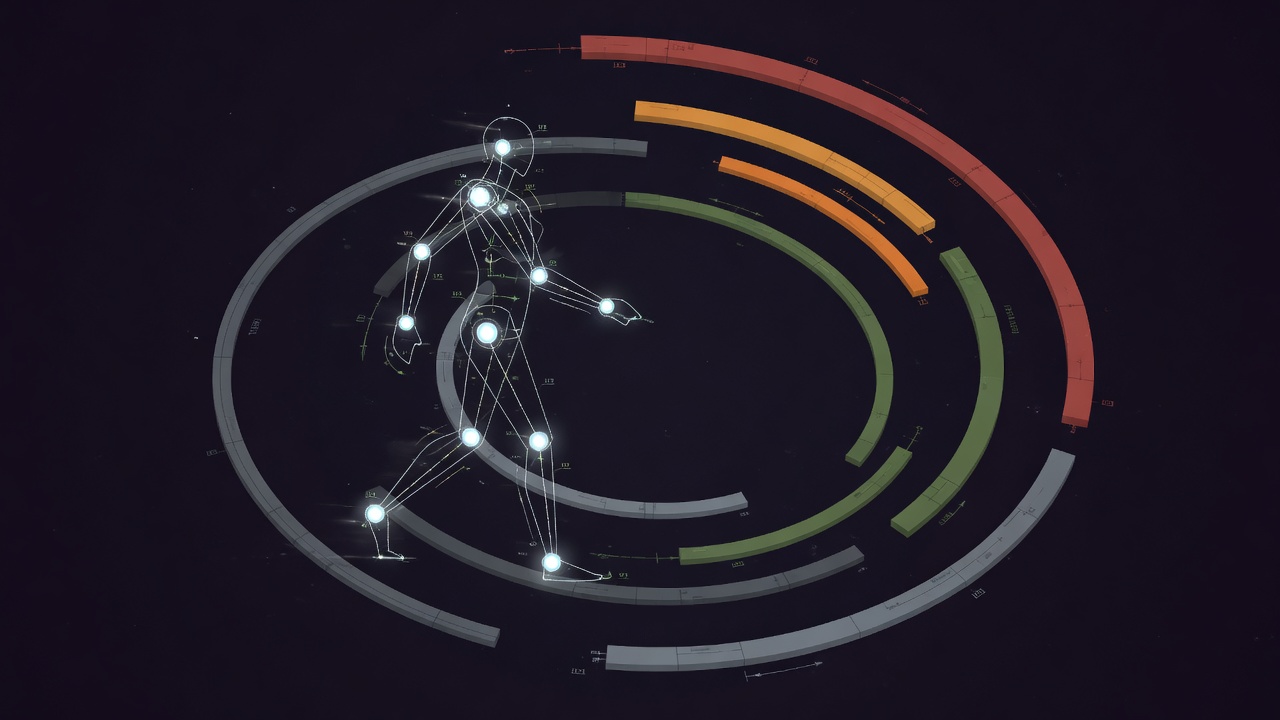
WB-WAM: 22 Hours of PICO Human Motion Let 30 Robot Demos Match 100, at 59 vs 52 of 80. 61.2% of Its 1,880-Hour Pretraining Mix Is Licensed Non-Commercial Only.
WB-WAM (arXiv:2609.34199, Tsinghua IIIS, Xiong'an Institute of AI and Melbourne, v3 2 October 2026) mid-trains a humanoid world action model on 22 hours of PICO egocentric human motion. With 30 robot demos per task it scored 59 of 80 trials against 52 of 80 for 100 robot demos, a tie at p = 0.30, and 39 of 80 without the human stage. Its 1,880.2-hour pretraining set is 61.2% non-commercial sources by stated licence; v3 added the attribution line BONES-SEED's licence requires.
WB-WAM, arXiv:2609.34199, trained a Unitree G1 with Wuji hands on 30 robot demonstrations per task after a mid-training stage on 22 hours of PICO egocentric human motion. It succeeded in 59 of 80 trials across four tasks. The same model with about 100 robot demonstrations per task and no human stage: 52 of 80. With 30 and no human stage: 39 of 80.
The human stage clearly helped at a fixed robot budget (p = 0.002 by our count). The paper's stronger line, that it 'reduces the number of robot demonstrations by 70% while improving mean success', rests on 59 vs 52 of 80, p = 0.30: equal success, not higher. Separately, by the licences its sources state, 61.2% of the 1,880.2-hour pretraining set is non-commercial only, and another 14.6% is free only to academics and small startups.
What changed between v1 on 28 September and v3 on 2 October
Chuan Qin, Shaoting Zhu and co-authors at Tsinghua's IIIS, the Xiong'an Institute of Artificial Intelligence and the University of Melbourne posted v1 on 28 September 2026, v2 on 30 September and v3 on 2 October. We diffed the v1 and v3 HTML renders. The text, numbers and tables are otherwise identical, and all three versions are listed at 3,359 KB. v3 adds one author (Shanaka Baduge, Melbourne) and one sentence in the acknowledgements: 'This work uses BONES-SEED motion data for heterogeneous pre-training. Motion Data by Bones Studio.'
That sentence is the attribution format the BONES-SEED licence prescribes for publications. Its appearance in v3 is the only public sign in the paper that the pretraining mix was reviewed against source licences. The project page, wb-wam.github.io, linked no code, weights or data on 5 October 2026.
Where WB-WAM's data comes from, stage by stage
Stage I learns from 1,880.2 hours drawn from nine external sources: egocentric video with hand labels (EgoDex), video with body and hand (Xperience-10M, HIW-500, Unitree and PSI collections, Humanoid Everyday, GR00T teleop) and motion-only capture (MotionMillion, BONES-SEED). Human data is retargeted to the G1 body and Wuji hand joints, and missing channels are masked.
Stage II is the group's own PICO collection: each collector wears a PICO 4 Ultra headset plus five trackers on hands, feet and waist, recording egocentric RGB and SMPL body motion at 20 Hz. Body motion is retargeted to the G1 with GMR and constrained inverse kinematics; hand poses are reconstructed from the video and retargeted to Wuji joints. The set is 22 hours, 13,396 episodes over 73 tasks, about 150 per evaluated task.
Stage III uses SONIC whole-body teleoperation (PICO headset for body, MANUS gloves for the hands): 1,011 robot episodes, 242,668 frames at 20 Hz, 3.37 hours. Mean episode length works out to about 5.9 seconds for PICO and 12.0 seconds for robot data. At those averages, the roughly 150 task-aligned PICO demos per task are about 15 minutes of human time, and the 70 robot demos they stood in for are about 14 minutes of teleoperation, so the exchange is close to one minute for one minute; the human minutes need no robot.
How big the human-data effect is in Table III
Table III runs three configurations on four tasks at 20 trials each: close the curtain, push the cart, wipe the table and checkout. Final success: 39, 52 and 59 of 80. Per task, PICO mid-training with 30 robot demos against direct post-training with 100: curtain 16 vs 13, cart 16 vs 16, wipe 18 vs 15, checkout 9 vs 8. Every task moves the same way, but no single gap is larger than three trials.
Two controls are missing. No configuration adds an extra training stage on PICO data from unrelated tasks, and none adds one on more robot data, so task-aligned human motion and one more stage of training are not separated. Each configuration is one run. The abstract's comparison, 84.0% against OpenWAM's 80.0% on five tasks without PICO, is 84 vs 80 of 100 trials.
The pretraining mix, by stated licence
Figure 3 gives each source's share of the 1,880.2 hours. We converted shares to hours and checked each source's licence where it is published. Nothing here says the authors breached a licence: research use is what most of these terms permit. The question is what a company could do with the same recipe.
| Source | Share of 1,880.2 h | Licence as stated by the source | Where checked (5 October 2026) |
|---|---|---|---|
| EgoDex | 34.5% (~648.7 h) | CC BY-NC-ND 4.0 | github.com/apple/ml-egodex README |
| Xperience-10M (Ropedia) | 19.1% (~359.1 h) | HF gate: access 'limited to approved non-commercial use' | huggingface.co/datasets/ropedia-ai/xperience-10m |
| HIW-500 (BitRobot, Unitree, Hugging Face) | 17.7% (~332.8 h) | CC BY 4.0 | HIW-500 project page; HF card BitRobot/HIW-500 |
| BONES-SEED (Bones Studio) | 14.6% (~274.5 h) | Free to academic users and startups under $1M revenue; others need a commercial licence; attribution required | bones.studio/info/seed-license |
| MotionMillion | 7.6% (~142.9 h) | CC BY-NC-SA 4.0 (InternRobotics HF gate); a separate OpenRobotLab card says Apache-2.0 | HF InternRobotics/MotionMillion, OpenRobotLab/MotionMillion |
| Unitree UniforRL | 5.1% (~95.9 h) | not reported: no link in the paper, release not identified | arXiv:2609.34199 Sec. IV-A |
| Humanoid Everyday G1 | 0.9% (~16.9 h) | no licence on the G1 card; parent repo Apache-2.0 | HF USC-PSI-Lab/Humanoid-Everyday-G1 |
| PSI-Real | 0.4% (~7.5 h) | not reported: no link in the paper, release not identified | arXiv:2609.34199 Sec. IV-A |
| GR00T-Teleop-G1 (NVIDIA) | 0.1% (~1.9 h) | CC BY 4.0 | HF nvidia/PhysicalAI-Robotics-GR00T-Teleop-G1 |
What the licence split means for anyone reusing the recipe
Three sources carrying 61.2% of the hours, about 1,150.7, exclude commercial use outright: EgoDex under CC BY-NC-ND 4.0, Xperience-10M behind a gate that says access is 'limited to approved non-commercial use', and MotionMillion under CC BY-NC-SA 4.0. BONES-SEED, 14.6%, grants rights only to academic users and to startups under $1M in annual revenue and defines trained models as Results subject to its terms. Counting it with the non-commercial three, 75.8% of the hours, about 1,425.2, need a separate agreement for any company with $1M or more in annual revenue. Only HIW-500 and NVIDIA's GR00T teleop set, 17.8% together, carry CC BY 4.0.
For a research group this is a non-issue. For a company that wants WB-WAM's Stage I, the CC BY 4.0 portion is about 334.7 hours plus whatever the unidentified Unitree and PSI collections turn out to be. Judgement: the paper's evidence does not tell you how much of Stage I's value sits in the non-commercial 61.2%, because there is no ablation by source. EgoDex alone is 34.5% of the hours and is the only video-hand source. A commercial rebuild would replace it, not drop it.
The MotionMillion conflict is worth a note. The InternRobotics Hugging Face repository gates access behind a CC BY-NC-SA 4.0 notice. A second repository under OpenRobotLab carries an Apache-2.0 card with no other text. A buyer should treat the stricter notice as binding until the authors say otherwise.
The PICO stage is the part a company can own outright. It is 22 hours that the group collected itself, task-aligned, with a fixed rig. On Table III that stage was worth 20 successes out of 80 at a fixed 30-demo robot budget. That is the clearest argument in the paper for collecting rights-cleared, task-aligned human motion rather than inheriting a pretraining mix. BLO LAB covered a similar wearable result last week: λ0's HumanVerse-500 body data carried its gain, while public egocentric sets could not be separated.
Check it yourself
Table III is in Section V-E of https://arxiv.org/html/2609.34199v3. The final-success column for each task is the last 'S' column under it. Sum the four S values per row: 12+11+11+5 = 39, 13+16+15+8 = 52, 16+16+18+9 = 59.
The p-values: python3 -c 'from scipy.stats import fisher_exact as f; print(f([[59,21],[52,28]])[1], f([[59,21],[39,41]])[1])' prints about 0.30 and 0.002.
The data sizes (1,880.2 h, 22 h, 13,396 episodes, 73 tasks, 1,011 episodes, 3.37 h) are in Section IV. Figure 3, the source shares, is https://arxiv.org/html/2609.34199v3/datasets_overview.png. To see the v3 change, compare the acknowledgements of https://arxiv.org/html/2609.34199v1 and https://arxiv.org/html/2609.34199v3.
Licences: curl -s https://huggingface.co/api/datasets/bones-studio/seed returns license_link https://bones.studio/info/seed-license; curl -s https://huggingface.co/api/datasets/InternRobotics/MotionMillion shows the CC BY-NC-SA 4.0 gate text; curl -s https://huggingface.co/api/datasets/BitRobot/HIW-500 returns cc-by-4.0; the EgoDex terms are in the License section of https://github.com/apple/ml-egodex.
What would prove this wrong
Our claim: on WB-WAM's evidence, task-aligned human motion lets 30 robot demonstrations per task match about 100, not beat them, and most of its pretraining hours cannot be reused commercially as published.
It is wrong if, by 30 June 2027, the authors or another group report the PICO configuration against about 100 robot demos with at least two runs or 40 trials per task, and the PICO arm wins by 10 points or more with p under 0.05; or if EgoDex, Xperience-10M or MotionMillion publish terms that permit commercial model training. We will update this article if either appears.
Sources
- Qin, Zhu et al., WB-WAM: Heterogeneous Body-Hand Pre-training for Humanoid Loco-Manipulation, arXiv:2609.34199, v1 28 September, v3 2 October 2026
- arXiv HTML v3: Sections IV, V-E, Tables II and III, acknowledgements
- Figure 3, Stage I data composition
- WB-WAM project page (checked 5 October 2026)
- BONES-SEED licence, Bones Studio
- EgoDex repository and licence statement, Apple
- Xperience-10M dataset card and access terms, Ropedia
- MotionMillion dataset card, InternRobotics
- HIW-500 project page, BitRobot
- GR00T-Teleop-G1 dataset card, NVIDIA
- BLO LAB, HumanVerse-500 wearable body data carried λ0
Building or training robots?
We license manipulation datasets and run custom capture programs. Get in touch to see what fits.

A Closed-Form Weight Edit Took pi0.5 From 27 to 106 of 128 on a Misread Instruction, but Only When Written Into the VLM

V-JEPA 2's Predictor Adds 0.04 Top-1 Over Copying the Present on 27,000 Egocentric Trials. By Horizon, It Runs From Minus 0.05 at 1 s to Plus 0.16 at 3.5 s.
