
A $150 Gripper's Task Success Rose 36 Points When Grasp Force Got Its Own Policy, and 2 Points Without Tactile Input
TF-Gripper (arXiv:2602.10013, 10 February 2026, University of Virginia and Columbia) is a $150, 3D-printed gripper sensing 0.45 to 45 N. Recomputed directly from the paper's five per-task cells, switching its control from position to a dedicated force policy (RETAF) raised five-task average success from 24% to 60%. The identical switch on a tactile-blind baseline moved success only from 10% to 12%. Tactile sensing without a force-dedicated policy bought almost nothing on its own.
In TF-Gripper's own five-task evaluation, giving grasp force a dedicated prediction policy, RETAF, instead of controlling the gripper by position alone raised average task success from 24% to 60%, recomputed directly from the paper's five per-task cells. The paper's own printed average for the position condition is 28%; summing and dividing its own five listed cells gives 24%, a four-point discrepancy flagged below rather than silently resolved either way.
Run the identical position-to-force switch on a policy with no tactile sensing at all and average success moves only from 10% to 12%. The hardware behind both numbers, a parallel-jaw gripper sensing 0.45 to 45 N, costs about $150 to build.
What changed, and when
The paper is arXiv:2602.10013, 'Learning Force-Regulated Manipulation with a Low-Cost Tactile-Force-Controlled Gripper,' by Xuhui Kang, Tongxuan Tian, Sung-Wook Lee and Yen-Ling Kuo (University of Virginia) with Binghao Huang and Yunzhu Li (Columbia University), submitted 10 February 2026. A v2 revision on 6 October 2026 renamed the title to add 'Robotic' and expanded the evaluation to six real-world tasks; the numbers in this piece are from v1's five-task Table II, the version we verified cell by cell, and v2's additional task was not retrieved here.
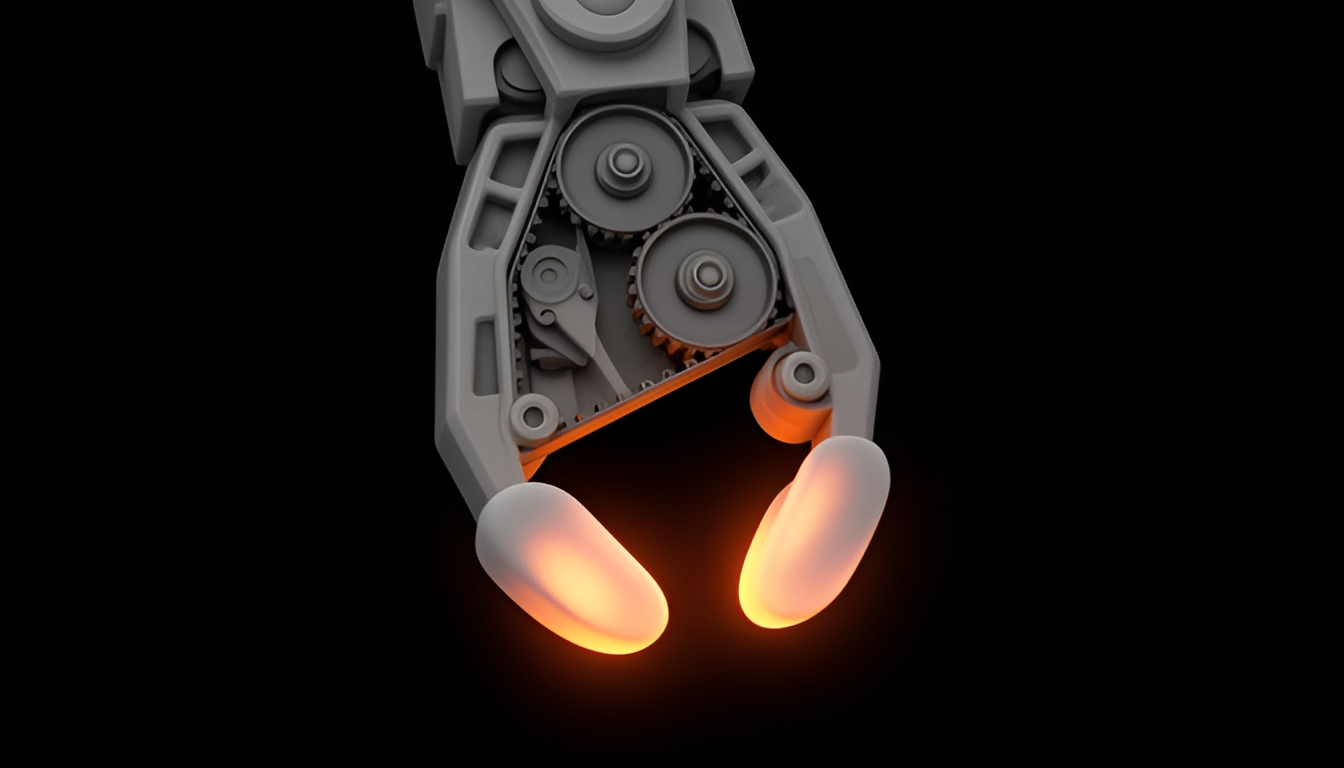
The hardware, TF-Gripper, is a parallel-jaw gripper with a fully 3D-printed frame, two Dynamixel XL430-W250-T motors driving the fingertips through a pulley and timing belt, and FlexiTac piezo-resistive tactile pads (borrowed from the UMI capture rig) on the fingertips. Its sensed force range is about 0.45 to 45 N at roughly 0.2 N resolution, with 95 mm of travel. A companion teleoperation rig, under $100, uses a VR controller for pose and a motor-resisted finger ring to record the operator's own grasp force through motor current.
Five tasks, recomputed from the paper's own cells
Table II reports Reach, Stable Grasp and Task Success for eight policy/action-space combinations across five real tasks, 10 rollouts per cell, on a Franka Research 3. The Task Success column for RETAF under the two gripper-action modes gives the clearest before/after comparison.
| Task | RETAF, position control (success) | RETAF, dedicated force policy (success) | Gain | Source |
|---|---|---|---|---|
| Cherry Tomato Picking | 50% | 80% | +30 | arXiv:2602.10013 v1, Table II |
| Tofu Grasping | 30% | 80% | +50 | arXiv:2602.10013 v1, Table II |
| Chip Picking | 20% | 50% | +30 | arXiv:2602.10013 v1, Table II |
| Cherry Tomato Harvest | 10% | 30% | +20 | arXiv:2602.10013 v1, Table II |
| Liquid Transfer | 10% | 60% | +50 | arXiv:2602.10013 v1, Table II |
What $150 buys, next to six commercial grippers
TF-Gripper's sensed range, 0.45 to 45 N, sits inside the range of several commercial force/tactile grippers and below others. The paper only claims cost, not capability beyond that range.
The architecture: a separate policy only for grasp force
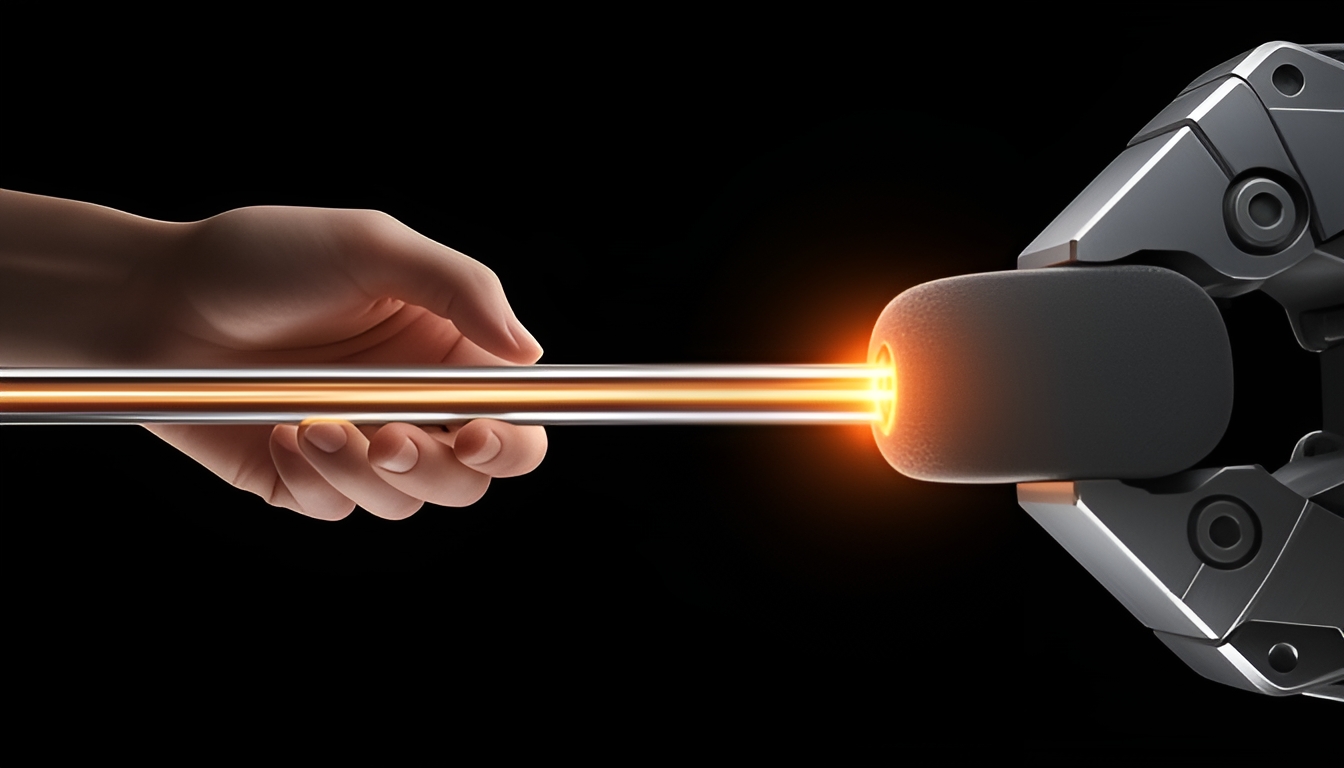
RETAF splits decision-making in two, rather than adding tactile input to a single policy that already predicts pose.
Tactile sensing alone bought almost nothing; a force-dedicated policy bought the most
Table II compares four policy designs, each under both position and force control, letting the effect of switching control modes be isolated from the effect of adding tactile sensing in the first place. Recomputed from the same five per-task cells used above (methodology applied uniformly across all four rows), the gain from switching position to force rises step by step with how much the architecture is built to use tactile input: +2 points with no tactile sensing at all, +6 points with tactile input bolted onto an otherwise unchanged policy (DP), +10 points with a tactile-pretrained encoder (ViTac-MAE), and +36 points once force gets a dedicated policy (RETAF).
What it means for teams building cheap capture rigs
Having a tactile sensor on the hardware is not the thing that produced the 36-point gain. The policy with tactile input but no dedicated force-prediction head (DP, with tactile) gained only 6 points from the same position-to-force switch. The architecture decision, routing force through its own policy trained on recorded human grasp force, accounts for most of the difference between a sensor that is present and a sensor that is used.
The cost claim is real and separate from the performance claim: TF-Gripper is reported at about $150 against $2,000 to $6,000 for six commercial comparators in the same paper's own table, roughly 13x to 40x cheaper. But its sensed range, 45 N at the top end, sits below five of those six units and only edges past OnRobot RG2's 40 N ceiling. A team choosing this hardware for a task needing more than about 45 N of controlled grip force is choosing outside its tested envelope.
The sample size is small: 10 rollouts per cell, 50 demonstrations per task, five tasks, one robot platform (Franka Research 3). The paper's own Average column does not reconcile with a plain mean of the per-task cells it lists for one of its eight rows, a four-point gap we flag rather than silently use. Treat the direction of the finding, force-dedicated control beats tactile-blind or tactile-bolted-on control, as well-supported; treat the exact magnitude as provisional until a larger run or the v2 six-task revision is independently checked.
Check it yourself
The paper: arXiv.org/abs/2602.10013 (abstract, with the v2 revision metadata) and arxiv.org/html/2602.10013v1 (the five-task version measured here, including Table I's cost comparison and Table II's per-task results).
The recomputed averages: `python3 -c "print(sum([50,30,20,10,10])/5, sum([80,80,50,30,60])/5)"` prints 24.0 and 60.0, matching the position and force means used above and differing from the paper's own printed 28%/60% average row by 4 points on the position side.
The project page, force-gripper.github.io, hosts an intro video and teleoperation-demo clips; as of 9 November 2026 no YouTube mirror of that footage could be found or verified, so no embed is included here.
The v2 revision (6 October 2026) retitled the paper to add 'Robotic' and expanded to six real-world tasks; pull the current PDF to see whether the sixth task changes the per-policy averages before citing this piece's numbers as current.
What would prove this wrong
Our claim: on this hardware and these five tasks, routing grasp force through a policy dedicated to predicting it, rather than adding tactile sensing to an otherwise unchanged position-control policy, is the change that drives most of the measured success gain.
It is wrong if an independent replication, using TF-Gripper's public design or an equivalent low-cost tactile-force gripper, finds that a tactile-sensing policy without a dedicated force head (the DP, with-tactile condition here) closes most of the gap to a dedicated force policy's success rate, on a task set of comparable difficulty, by 1 January 2028. A replication where DP-with-tactile gains more than 20 points from the same position-to-force switch would undercut the architecture claim made here.
Sources
Retrieved 9 November 2026.
Building or training robots?
We license manipulation datasets and run custom capture programs. Get in touch to see what fits.

A Closed-Form Weight Edit Took pi0.5 From 27 to 106 of 128 on a Misread Instruction, but Only When Written Into the VLM

V-JEPA 2's Predictor Adds 0.04 Top-1 Over Copying the Present on 27,000 Egocentric Trials. By Horizon, It Runs From Minus 0.05 at 1 s to Plus 0.16 at 3.5 s.
