
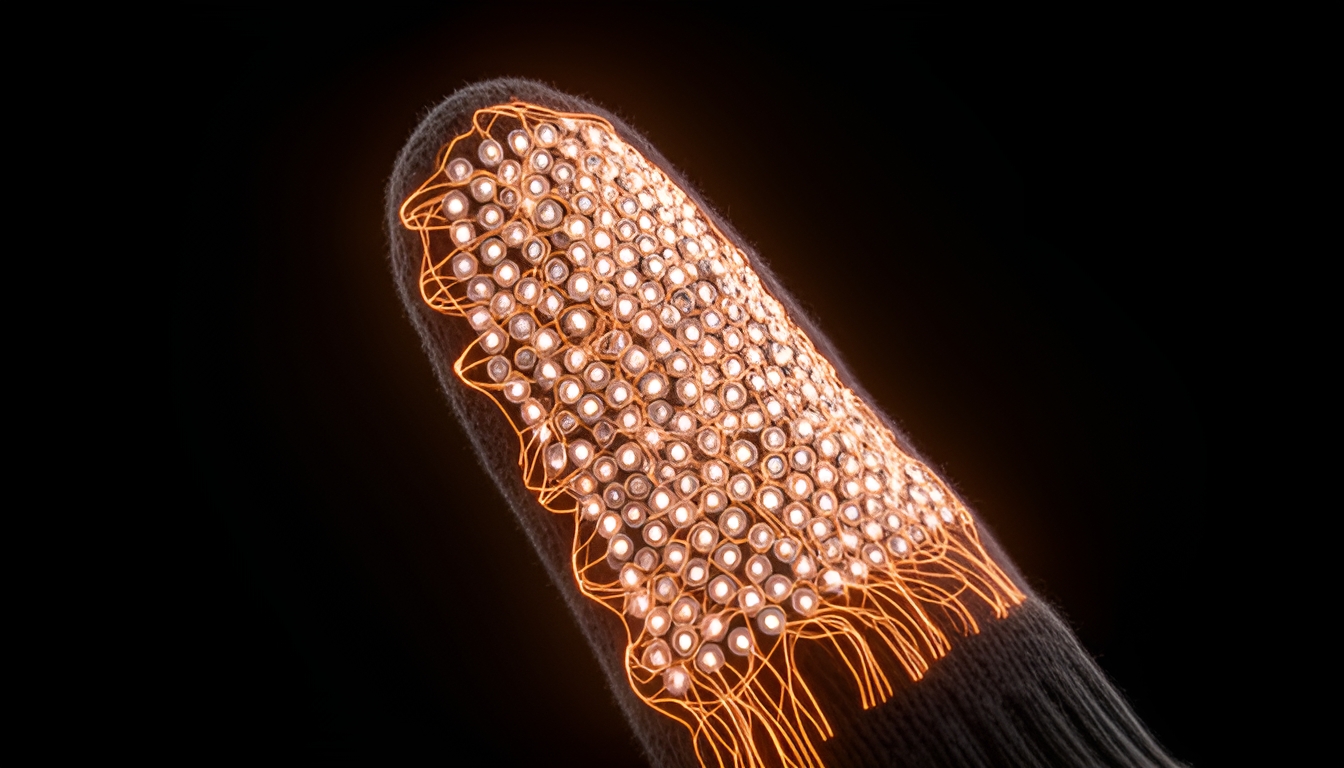
Tactus Resolves Force Down to 0.59 N, 1.6 to 2.7x Finer Than Two Commercial Gloves, While Holding Pose Error to 11.0 mm Under Full Occlusion
Tactus (arXiv:2610.39076, Meta Reality Labs Research, submitted 29 October 2026, revised 4 November 2026) is a textile glove combining calibrated fingertip force with occlusion-resilient pose tracking. In the first quantitative cross-platform comparison of its kind, it resolves a minimum detectable force of 0.59 N, 1.6 to 2.7x finer than two commercial gloves the paper calls PPS and JQ, and sustains 11.0 mm fingertip keypoint error during the heaviest hand-object occlusion.
Tactus is a textile-integrated sensing glove that pairs calibrated fingertip force with occlusion-resilient hand pose tracking, and in the first quantitative cross-platform comparison of its kind, it beats two commercial tactile gloves on every metric Meta Reality Labs Research tested (arXiv:2610.39076, led by Li Guan with a large team at Meta Reality Labs Research, submitted 29 October 2026, revised 4 November 2026). Its minimum detectable force at 95% confidence is 0.59 N, against 1.58 N and 0.94 N for the two commercial gloves the paper labels PPS and JQ, a 1.6 to 2.7x improvement in sensitivity.
The same glove sustains 11.0 mm of fingertip keypoint error during the heaviest hand-object occlusion, the condition where manipulation data is hardest to capture and most valuable to have.
What changed: a glove built around calibration, not just sensors
No existing wearable platform, the paper argues, offers both calibrated fingertip force sensing and occlusion-resilient hand tracking in a form factor that does not interfere with how a hand actually manipulates objects. Tactus co-optimizes three things at once: a thin, conformal 3D-knit form factor with a 1.5 mm fingertip stackup, capacitive tactile sensors placed at manipulation-relevant regions identified by the team's own contact studies, and IMU-fused pose tracking tuned to hold up specifically through the occlusions that happen when a hand grips an object.
The team also built standardized benchmarking protocols for tactile force regression and hand pose estimation, then ran two commercial gloves, PPS and JQ in the paper's citations, through the same protocols for the first head-to-head comparison of its kind. Calibration method turns out to matter as much as hardware: a documented pipeline compares factory calibration against per-session online calibration, and per-session calibration cuts median full-glove force RMSE from a 2.50 to 5.22 N range down to 1.46 to 1.82 N, moving relative error from 40.6 to 98.1% down to 27.7 to 40.9%.
Three metrics beyond raw force sensitivity separate the gloves: fingertip force error, cross-participant consistency, and a Pose-Related Artifact (PRA) ratio, how much a sensor's signal changes from hand strain alone rather than from real contact force. Lower is better on every column but cross-subject consistency.
| Metric | PPS | JQ | Tactus |
|---|---|---|---|
| Minimum detectable force at 95% (N), lower is better | 1.58 | 0.94 | 0.59 |
| Fingertip force error (N), lower is better | 0.23 | 0.18 | 0.20 |
| Cross-participant consistency, higher is better | 0.77 | 0.86 | 0.87 |
| Pose-Related Artifact ratio, lower is better | 2.13 | 0.43 | 0.17 |
Tactus does not win every single column outright, its force error of 0.20 N sits between JQ's 0.18 N and PPS's 0.23 N, but it wins decisively where the paper argues the real differentiator sits: a PRA ratio 2.5x lower than JQ and 12.5x lower than PPS, meaning far less of its signal is hand-flexion noise mistaken for touch.
The mechanism: calibration and sensor placement, not raw hardware alone
The glove's signal chain runs from the knit textile itself, through calibration, to two separate outputs that downstream policies consume differently.
What it means for teams building capture rigs at scale
Tactus also tested whether its combined signal supports a downstream task vision alone struggles with: estimating a surface's material from touch. Pitted against a vision-language model (VLM) reading the same interaction, a model trained on Tactus's tactile signal scores 0.75 overall accuracy across nine textures against 0.56 for the VLM, winning outright on Mirror, Bushy, Fluffy, and Hairy (0.97 versus 0.45 on Fluffy, 0.84 versus 0.00 on Hairy) while losing on Scaly, Bumpy, and Ridged, where the VLM's visual read of surface pattern outperforms touch alone.
That split is itself informative: touch wins on materials defined by compliance and texture depth a camera cannot resolve, and loses on materials whose surface pattern is primarily visual. A capture rig aiming for general-purpose object-property labels needs both signals, not one standing in for the other.
The calibration result carries the more immediate operational lesson. A factory-calibrated glove left uncorrected per wearer and per session degrades force accuracy by roughly 2x, which means any organization deploying tactile gloves for data collection at scale needs a per-session calibration step built into its capture protocol, not a one-time hardware spec, before the resulting force labels are trustworthy.
Pose tracking shows the same pattern of specific, cumulative gains rather than one dominant fix. Four tracking modes, evaluated by mean keypoint error (MKPE) and the same metric isolated to timing (.T) and to the heaviest-occlusion frames (F.):
| Tracking mode | MKPE (mm) | MKPE.T (mm) | F.MKPE (mm) | F.MKPE.T (mm) |
|---|---|---|---|---|
| CV, bare hand (baseline) | 15.8 | 8.9 | 19.8 | 17.1 |
| CV + IMU extended Kalman filter | 15.4 | 7.9 | 18.7 | 14.2 |
| AVI-HT | 10.4 | 7.0 | 13.3 | 12.8 |
| AVI-HT, offline | 9.7 | 6.4 | 12.1 | 11.0 |

Check it yourself
Table III and the tracking-mode table are in the HTML build at https://arxiv.org/abs/2610.39076 (mirrored at arxiv.org/html/2610.39076). The sensitivity-ratio claim checks out: python3 -c 'print(round(1.58/0.59,2), round(0.94/0.59,2))' prints 2.68 and 1.59, matching the paper's stated 1.6 to 2.7x range.
The paper's PRA definition (Pose-Related Artifacts: changes in tactile sensor signals caused by strain from hand poses rather than by contact force) is in its benchmarking-protocol section. As of 8 November 2026 the paper names the commercial gloves only by the citation labels PPS and JQ; we found no separate project demo video to verify.
What would prove this wrong
Our claim: Tactus's calibration pipeline, specifically per-session online calibration, is doing more work than any single hardware choice to produce its force-accuracy and PRA advantage over the two commercial gloves tested.
It is wrong if, by 1 July 2027, an independent benchmark applies the same per-session calibration protocol to PPS or JQ hardware and finds their PRA ratio or minimum detectable force converges to within a small margin of Tactus's reported values. That would mean the gap is a calibration-protocol gap the commercial gloves could close with software, not a property of Tactus's sensor design.
Sources
- Guan, Granberry, Aseeri, et al., Tactus: Tactile & Pose Sensing Glove for Natural Dexterity Data Collection, Meta Reality Labs Research, arXiv:2610.39076, submitted 29 October 2026, revised 4 November 2026
- BLO LAB, The Tactile and Force Sensor Registry: 24 ways to give a robot touch
- BLO LAB, End-to-End Robot Training: sim-to-real and the data wall
Building or training robots?
We license manipulation datasets and run custom capture programs. Get in touch to see what fits.

A Closed-Form Weight Edit Took pi0.5 From 27 to 106 of 128 on a Misread Instruction, but Only When Written Into the VLM

V-JEPA 2's Predictor Adds 0.04 Top-1 Over Copying the Present on 27,000 Egocentric Trials. By Horizon, It Runs From Minus 0.05 at 1 s to Plus 0.16 at 3.5 s.
