
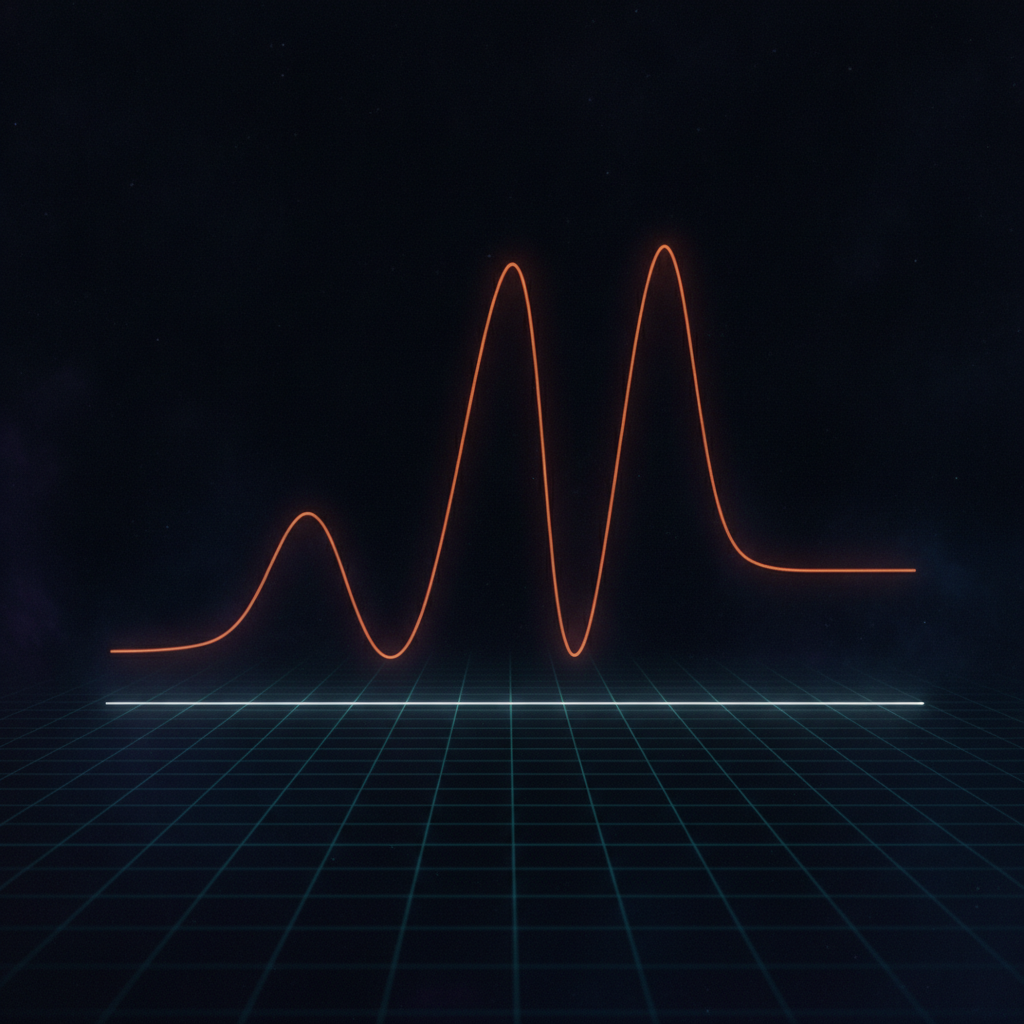
A Surgeon Dataset's GR00T Fine-Tune Lost to 'Predict No Motion' in All 11 Held-Out Arms
HumynexSurg-1 is a commercial liposuction dataset from Humynex Robotics: 14 narrated episodes with hand force, suction pressure and RGB-D, pitched as a product for robot foundation models. Its proof of concept fine-tunes NVIDIA GR00T N1.7. The paper's own appendix shows every fine-tune scoring worse than a baseline that predicts the hand does not move. That is the most useful thing in the release, and a test any buyer of expert data should run first.
On the held-out session of HumynexSurg-1, NVIDIA's GR00T N1.7 fine-tuned on the dataset predicts the surgeon's tool-hand motion 0.8 seconds ahead with a mean error of 11.20 pixels. Predicting that the hand does not move at all scores 7.70 pixels on the same frames, and a ridge regression scores 7.55. None of the 11 GR00T arms and probes in Appendix A of arXiv:2609.23885, posted 20 September 2026 by Humynex Robotics of Beverly Hills, gets below the zero-motion baseline.
The authors published those baselines, which is more than most dataset releases do. The abstract and Section 6 describe the fine-tune as having learned the recorded sessions. Against the zero-motion baseline, it did not do that either: in-sample it scores 8.14 pixels against 7.50.
What Humynex released, and what it sells
HumynexSurg-1 version 0 is one surgeon, David L. Matlock, the company's CEO and co-founder, who reports more than 10,000 liposuction procedures since 1987, working on porcine abdominal wall in three sessions of 22, 10 and 6 minutes. Suction pressure segments them into 14 episodes and 35.6 minutes of in-episode data at 20 Hz, 42,738 frames. Channels are six-axis hand force/torque at 467 Hz, suction pressure at 100 Hz, a RealSense D455 top-down RGB-D camera, a side camera and a lavalier microphone. The narration yields 356 utterances, 95% of which compile into a nine-field label schema, lipo_v0. Access is under licence; nothing is public.
The paper is explicit that the dataset, schema, QA reports and evaluation protocol are the product. It is also unusually open about cost: fine-tuning takes 36 minutes on one H100 for under $5 of compute, and the next capture's sensor tiers are priced at $2k to $4k (tier A: 6-DoF handle pose, re-validated force, hardware-triggered cameras), $8k to $15k (tier B: ultrasound of the fat layer, tactile sensing on the palpating hand, contact and suction-line sensing) and $15k to $40k (tier C: ground-truth tracking).
Two things in version 0 are estimated rather than measured. The action a robot would reproduce, the cannula's motion, is a 2-D pixel track of the surgeon's tool hand in the side video, directly observed in 90%, 78% and 82% of frames by session and interpolated otherwise. The force channel is provided as state, not as a target, and the next capture is what re-mounts and validates it before every session. Tissue state is not captured at all.
Every held-out GR00T number sits above the zero-motion line
| Arm or baseline | Held-out MAE | In-sample MAE | Source |
|---|---|---|---|
| Hold: predict no motion | 7.70 px | 7.50 px | arXiv:2609.23885 Table 10 |
| Linear AR probe (ridge, fit on training episodes) | 7.55 px | 7.02 px | arXiv:2609.23885 Table 10 |
| GR00T N1.7, side RGB, 3 seeds | 11.20 +/- 0.07 px | 8.14 px | arXiv:2609.23885 Table 10 |
| GR00T N1.7, no narration | 11.18 px | 8.87 px | arXiv:2609.23885 Table 10 |
| GR00T N1.7, side + top colour + depth | 10.67 px | 7.80 px | arXiv:2609.23885 Table 10 |
| GR00T N1.7, 20,000 steps | 10.73 px | not reported | arXiv:2609.23885 Table 8 |
| Both hands as target: GR00T vs hold | 11.40 vs 7.68 px | 7.96 vs 6.97 px | arXiv:2609.23885 Table 10 |
| Wrench as target: GR00T vs hold | 0.327 vs 0.285 | 0.206 vs 0.186 | arXiv:2609.23885 Table 10 |
| Moving frames only (74%): GR00T vs hold | 11.97 vs 10.10 px | not reported | arXiv:2609.23885 Table 11 |
| Open-H surgical corpus size | 750 h, 120,000 trajectories (NVIDIA card); 780 h, 119 datasets (Humynex) | not applicable | Hugging Face card; arXiv:2609.23885 Sec. 1 |
Narration is neutral: 11.18 without it against 11.20 with it, on a kinematic target. Extra camera views help by 5% and a longer schedule by 4%, both statements the paper makes, and both improvements land in the region between constant velocity and hold.
'Every new session helps' is true, and still above the floor
Section 6.3 draws the release's business conclusion from three probes. Trained on session 1 alone, the policy scores 13.56 pixels on session 3; on sessions 1 and 2, 11.15, an 18% drop. Adding one 2.6-minute episode of session 3 lowers the error on its other episode from 10.02 to 9.27. Varying training episodes from 2 to 12 within the same two sessions leaves the error in a band from 11.15 to 13.64. The authors read this as session diversity being the lever, and they size the next capture at ten or more sessions and about 100 episodes.
Table 13 prints the hold baseline beside each probe. Every arm is above it, including the adaptation arm that has seen the target session (9.27 against 7.30) and the within-session test (8.82 against 6.71). The best saved checkpoint of each arm, reported as a diagnostic, is also above it. The trend is real. It is a trend toward a floor that a predictor with no parameters already sits under.
Why hold is so hard to beat here
This is our reading, not the paper's. The target is a pixel position 16 steps, 0.8 seconds, ahead. The paper measures the aspiration stroke at 1 to 1.7 Hz over a few centimetres. Over 0.8 seconds an oscillating hand travels out and most of the way back, so the start position is a strong guess for every step of the chunk, and a model that predicts motion pays for every phase error. Table 11 supports this: on still frames hold scores 0.96 pixels and GR00T 8.97, and even on the 74% of frames where the hand moves more than 5 pixels, hold still wins, 10.10 to 11.97.
So the result does not say the surgeon's data carries no learnable structure. It says this action definition, at this horizon, with 35.6 minutes of it, does not let a 3B foundation model beat a constant. A measured 6-DoF handle pose, the tier A upgrade, would change the target itself, and that is the change we would expect to matter more than more sessions of the same pixel track.
What it means if you sell or buy expert data
For a seller, the lesson is the table the authors had and did not lead with. A proof of concept is only evidence of value when it beats the trivial predictors on the same frames, in the main text. Hold, constant velocity, training mean and a linear probe cost nothing to run. Humynex ran them, which is to its credit, and a buyer's first diligence question will be why they sit in an appendix.
For a buyer, three questions come before price. Which channels are sensors and which are models: here the action is a model's output. Is force validated per session: here not until the next capture. And does the licensed evaluation protocol beat hold: here not yet. The disclosed tier costs of $2k to $40k make the upgrade path cheap relative to the expert's time, which is the real scarce input in a one-surgeon corpus.
For anyone building a similar corpus, and BLO LAB is one, the paper is a free design review. It shows that narration can be captured and compiled into labels at 95% coverage, that force at 467 Hz is easy to record, and that neither helps if the action target is defined where a constant is hard to beat.
Check it yourself
Pull the appendix tables from the HTML render and compare the GR00T rows to the hold row:
curl -s https://arxiv.org/html/2609.23885v1 | sed 's/<[^>]*>/ /g' | tr '\n' ' ' | tr -s ' ' | grep -o 'Hold (zero motion).\{0,300\}' | head -3
The protocol, predicting 16 steps from true observations at every 16th frame and scoring MAE in side-camera pixels, is in Section 6.1 and the caption of Table 10. The session split, session 3 held out, is in Section 4.1. For the Open-H comparison, read NVIDIA's own card at huggingface.co/datasets/nvidia/PhysicalAI-Robotics-Open-H-Embodiment, which states 750 hours and 120,000 trajectories under CC BY 4.0, against the 780 hours and 119 datasets in Humynex's introduction.
You cannot reproduce the fine-tune: the dataset is available only to licensees. What you can reproduce is the reasoning. For any 1 to 1.7 Hz periodic signal sampled at 20 Hz, compute the error of predicting the current value for the next 16 samples; it is small relative to the stroke amplitude.
What would prove this wrong
Our reading is that the action target, not the data volume, is why GR00T loses to hold, so more sessions of the same 2-D pixel track will not close the gap.
With a date: by 30 June 2027, if a Humynex release with at least ten sessions reports a GR00T-class held-out error below its hold baseline on this same protocol while still using the 2-D tool-hand track as the action, then volume was the constraint and our reading was wrong. If the first release to beat hold is the one that adds the measured 6-DoF handle pose, the target was the constraint.
We would also count it against us if Humynex publishes a closed-loop or longer-horizon evaluation, say 2 seconds or more, where GR00T beats hold by a clear margin. That would mean the 0.8-second open-loop test was the wrong instrument, not the wrong model.
Sources
- Huang, Matlock, Reich, HumynexSurg-1: A Curated Expert Liposuction Dataset, arXiv:2609.23885, 20 September 2026
- arXiv HTML render: Sections 2 to 7, Appendix A Tables 10 to 13
- Open-H-Embodiment: A Large-Scale Dataset for Enabling Foundation Models in Medical Robotics, arXiv:2604.21017
- NVIDIA, PhysicalAI-Robotics-Open-H-Embodiment dataset card, CC BY 4.0, retrieved 23 September 2026
- NVIDIA, GR00T-H-N1.7 model card
- BLO LAB, dataset provenance and audit
Building or training robots?
We license manipulation datasets and run custom capture programs. Get in touch to see what fits.

A Closed-Form Weight Edit Took pi0.5 From 27 to 106 of 128 on a Misread Instruction, but Only When Written Into the VLM

V-JEPA 2's Predictor Adds 0.04 Top-1 Over Copying the Present on 27,000 Egocentric Trials. By Horizon, It Runs From Minus 0.05 at 1 s to Plus 0.16 at 3.5 s.
