
SoTa's Human Tactile Demos Doubled Success to 45.9%. Against the Matched Robot-Only Recipe They Added 16.9 Points, and With Touch Removed From the Auxiliary Loss the Same Demos Scored 8.1%.
SoTa (arXiv:2610.02338, 1 October 2026) is a sub-$10 capacitive skin with the same 202-taxel layout on a human glove and a robot hand. Its headline, 22.8% to 45.9% when 150 human demos per task are added, compares against a robot-only policy trained with a simpler recipe. The matched robot-only two-stage control scored 29.1%, so the human demos account for 16.9 points. Dropping touch from the auxiliary objective cut the same setup to 8.1%. One seed, 40 trials per condition, code and data not yet released.
Adding 150 human tactile demonstrations per task to a robot policy raised mean success from 22.8% to 45.9% across eight test conditions in SoTa, arXiv:2610.02338, posted 1 October 2026. That comparison changes two things at once. Against the paper's own matched control, the same two-stage recipe trained on robot data only, mean success went from 29.1% to 45.9%: the human demonstrations account for 16.9 points, not 23.1.
The sharper number is the other ablation. With touch removed from the auxiliary objective, the same 150 human demonstrations per task produced 8.1%, below the 22.8% robot-only reference in six of eight conditions. In this setup the human data paid off only through the tactile channel.
What the SoTa paper released on 1 October
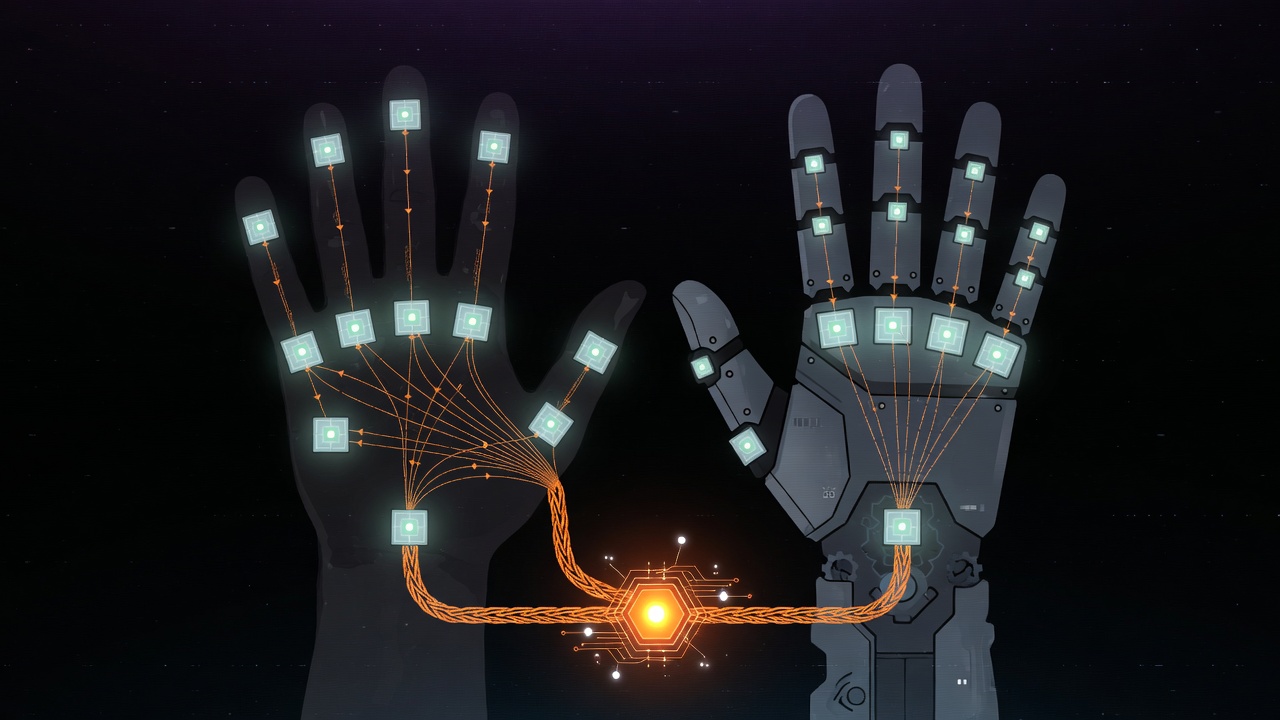
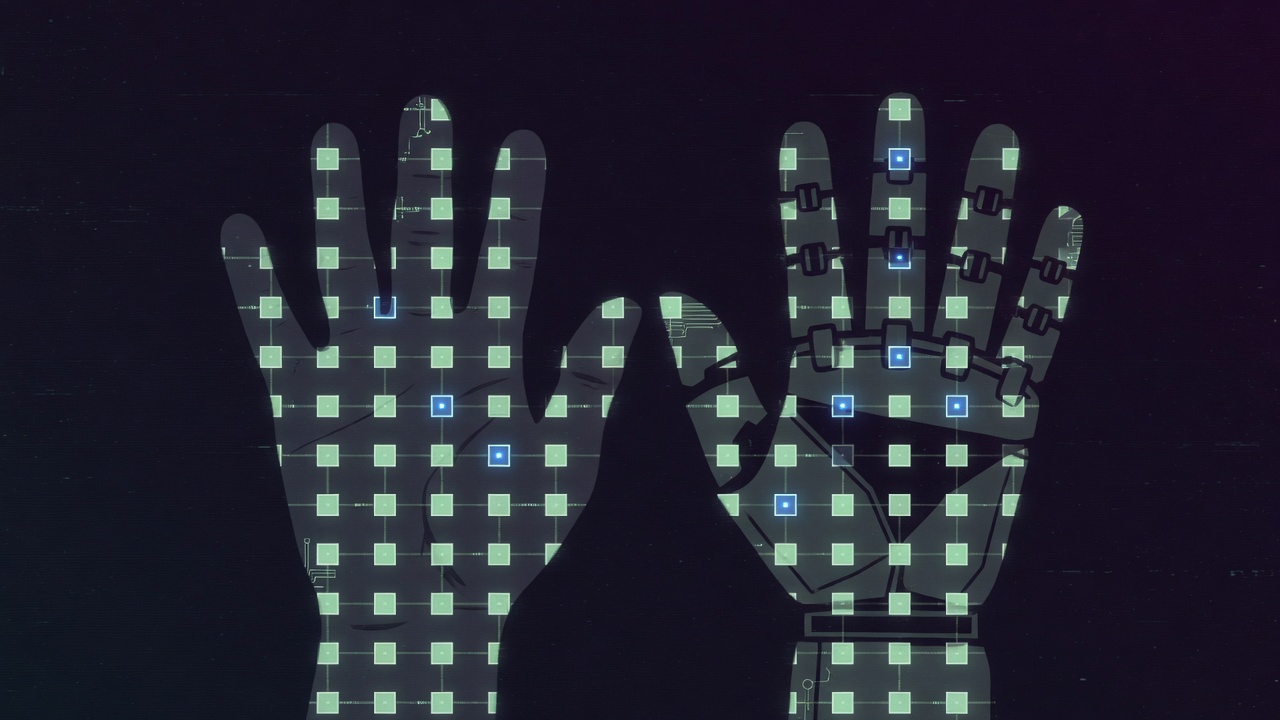
SoTa is a capacitive tactile skin from Jingyun Yang and co-authors, with fabric electrodes and 202 taxels arranged in the same layout on a human glove and on a robot hand, so taxel k means the same finger or palm region on both. The paper puts materials at under $10 per skin and about $30 for the readout board at an order of 100 units. The skin responds to 20 mN to 10 N, keeps over 97% of its response span after 10,000 load cycles and keeps trace continuity through 1,280 tight-fist folds.
The policy is built on FTP-1, a generalist tactile policy pretrained on about 3,000 hours from 21 tactile sensors. New tactile encoders for the SoTa skins are trained from scratch and shared by human and robot data. Human demonstrations carry no action labels. They enter only through an auxiliary loss that predicts the current task phase ('approach the box', 'reorient the box', 'release') from vision and touch. Section III-C states that human demonstrations never contribute to the action loss.
The test set is three tasks: box reorientation, cup picking (one thin cup out of a stack) and plug insertion. The robot set has 75, 50 and 75 teleoperated demonstrations, each with one object. The human set has 150 per task across three objects, one of which is the robot's object. Each condition is 40 trials, fully successful only, one training seed per method. The project page, sota-skin.github.io, linked only the paper on 5 October 2026. The paper says the authors are committed to open-sourcing the sensing stack; no code, CAD or data link exists yet.
Four recipes, eight conditions, every value from Figure 7
Figure 7 prints a value on every bar. The table copies them. Each value times 40 is the success count, which is how we get the trial totals in the last row.
| Condition | Robot-only reference | Robot-only two-stage + phase labels | +150 human V+T demos/task | Human demos, no touch in aux loss | Source |
|---|---|---|---|---|---|
| box ID | 67.5 | 100 | 97.5 | 10 | arXiv:2610.02338 Fig. 7 |
| box OOD-1 | 32.5 | 52.5 | 70 | 0 | arXiv:2610.02338 Fig. 7 |
| cup ID | 45 | 22.5 | 47.5 | 12.5 | arXiv:2610.02338 Fig. 7 |
| cup OOD-1 | 17.5 | 15 | 30 | 10 | arXiv:2610.02338 Fig. 7 |
| cup OOD-2 | 2.5 | 7.5 | 20 | 0 | arXiv:2610.02338 Fig. 7 |
| plug ID | 17.5 | 32.5 | 55 | 15 | arXiv:2610.02338 Fig. 7 |
| plug OOD-1 | 0 | 2.5 | 32.5 | 15 | arXiv:2610.02338 Fig. 7 |
| plug OOD-2 | 0 | 0 | 15 | 2.5 | arXiv:2610.02338 Fig. 7 |
| Mean of 8 conditions | 22.8 | 29.1 | 45.9 | 8.1 | Fig. 7; means 22.8 and 45.9 also in Sec. IV-C text |
| Successes out of 320 | 73 | 93 | 147 | 26 | Our count, value x 40 per bar |
Which comparison isolates the human demonstrations
The paper's headline, 22.8% to 45.9%, compares the full method with a policy that skips representation pretraining and the phase-label loss. The full method has both, plus the human data. Table II lists a control that differs only by the human data: robot-only two-stage training with visuo-tactile phase labels. It scored 29.1% (93 of 320 trials). The full method scored 45.9% (147 of 320). Recipe alone: plus 6.3 points. Human data on top: plus 16.9.
The 16.9 points hold up condition by condition. The full method is higher in 7 of 8 conditions and one trial lower on box ID (39 vs 40 of 40). The biggest gaps are out of distribution: plug OOD-1 (a plug 109 g heavier) went from 1 to 13 of 40, Fisher p = 0.001 by our count, and plug OOD-2 (25% shorter) from 0 to 6, p = 0.026. Cup ID went from 9 to 19 (p = 0.034). The other five conditions are not separable at 40 trials and one seed.
The robot-only two-stage control also hurt where the full method did not. Cup ID dropped from 18 of 40 for the reference to 9 of 40 with phase-label training. The authors note this in Section IV-C.
Touch in the auxiliary loss mattered more than the human data
The vision-only ablation keeps all 150 human demonstrations per task and removes tactile input from the phase-label objective, for human and robot data alike. During representation pretraining the from-scratch tactile encoder stays frozen and learns only from robot actions later. That policy scored 26 of 320 trials, 8.1%. Box ID fell from 27 of 40 for the reference to 4 of 40, and box OOD-1 from 13 to 0.
Line up the two ablations and the order of importance is clear. Robot data with touch in the auxiliary loss: 93 of 320. Robot plus human data without it: 26 of 320. Removing touch from the auxiliary objective cost more than adding human demonstrations gained. The authors say so in their own limits: the ablation 'does not isolate the contribution of human touch, which would require an asymmetric modality configuration' (Section IV-C). Human touch with robot vision-only auxiliary training, or the reverse, was not run.
A second confound is object variety. The human set spans three objects per task and the robot set one. Section IV-C attributes the OOD gains to that broader coverage. The 150 human demos are also two to three times the robot count (150 vs 50 or 75), and no arm adds the same number of robot demonstrations, so the paper does not give a human-to-robot exchange rate.
Tactile input alone, before any human data
Figure 6 compares vision-only and vision-plus-touch policies trained on robot data. Touch helped every in-distribution condition: box 50 to 67.5%, cup 32.5 to 45%, plug 0 to 17.5%, and box OOD-1 0 to 32.5%. It hurt cup OOD-1 (27.5 to 17.5%) and cup OOD-2 (10 to 2.5%) and plug OOD-1 (2.5 to 0%); plug OOD-2 stayed at 0%. The paper's reading is that with one robot training object per task, the policy learns contact features tied to that object's geometry.
What this means for anyone collecting human tactile data
The useful property of SoTa is the shared layout, not the price. Because taxel k is the same hand region on both embodiments, human tactile frames flow into the robot's encoder without a learned mapping, and that is the configuration that produced the 54 extra successes. A glove with a different taxel layout would need the alignment stage this paper skips.
The data deliverable that mattered was narrow: synchronized wrist-camera video, the 202-taxel stream at 30 Hz, and per-frame phase labels assigned by hand in a web tool. No hand pose was used. The paper recorded Rokoko glove joint angles for a hand-pose loss and reports that it did not help. Judgement: a buyer specifying human tactile data for this kind of co-training should pay for phase annotation and layout match before paying for hand kinematics.
The value of the human set is also bounded by what it replaces. Every policy here still needs 50 to 75 teleoperated robot demonstrations per task for the action loss. Human demonstrations changed generalization to new objects; they did not remove the robot set, and the paper does not test how small it can get.
BLO LAB has covered other tactile-glove results where the channel's value depended on how it entered training: the DTWM world model kept 41% of its gain with touch switched off, and UVTA needed about 500 human tactile demos to cross a robot-data baseline.
Check it yourself
Open https://arxiv.org/html/2610.02338v1/auxiliary_supervision_cotraining.png. Every bar carries its value. Multiply by 40 for counts, then sum per recipe: 73, 93, 147 and 26 of 320.
Means: python3 -c "R=[67.5,32.5,45,17.5,2.5,17.5,0,0];L=[100,52.5,22.5,15,7.5,32.5,2.5,0];F=[97.5,70,47.5,30,20,55,32.5,15];V=[10,0,12.5,10,0,15,15,2.5];print([sum(x)/8 for x in (R,L,F,V)])" prints 22.8125, 29.0625, 45.9375 and 8.125.
The p-values: python3 -c 'from scipy.stats import fisher_exact as f; print(f([[13,27],[1,39]])[1], f([[6,34],[0,40]])[1], f([[19,21],[9,31]])[1])' prints about 0.001, 0.026 and 0.034 (plug OOD-1, plug OOD-2 and cup ID, full method vs robot-only two-stage).
The data sizes (75, 50, 75 robot and 150 human per task, three human objects) are under 'Data Collection' in Section IV-A of https://arxiv.org/html/2610.02338v1. The recipe definitions are Table II. The sentence about not isolating human touch is the last paragraph before 'Analysis' in Section IV-C. Figure 6 is https://arxiv.org/html/2610.02338v1/effect_of_tactile_feedback.png.
What would prove this wrong
Our claim: in SoTa's setup, the human demonstrations are worth about 17 points of mean success over a matched robot-only recipe, and the tactile auxiliary signal is a larger lever than the human data.
It is wrong if, by 30 June 2027, the authors or another group run the missing arms on these three tasks with at least two seeds, and either the full method beats the robot-only two-stage control by 23 points or more, or a configuration with human tactile data but no robot tactile auxiliary loss scores above the robot-only two-stage control's 29.1%. We will update this article if a released version reports either.
Sources
- Yang et al., SoTa: Soft Tactile Skins for Dexterous Manipulation, arXiv:2610.02338, 1 October 2026
- arXiv HTML render: Sections III-C, IV-A, IV-C, Table II
- Figure 7 image with printed values
- Figure 6 image, tactile vs vision-only
- SoTa project page (checked 5 October 2026: paper link only)
- BLO LAB, DTWM tactile glove world model kept 41% of its gain with touch off
- BLO LAB, UVTA human tactile crossover near 500 demos
Building or training robots?
We license manipulation datasets and run custom capture programs. Get in touch to see what fits.

A Closed-Form Weight Edit Took pi0.5 From 27 to 106 of 128 on a Misread Instruction, but Only When Written Into the VLM

V-JEPA 2's Predictor Adds 0.04 Top-1 Over Copying the Present on 27,000 Egocentric Trials. By Horizon, It Runs From Minus 0.05 at 1 s to Plus 0.16 at 3.5 s.
