
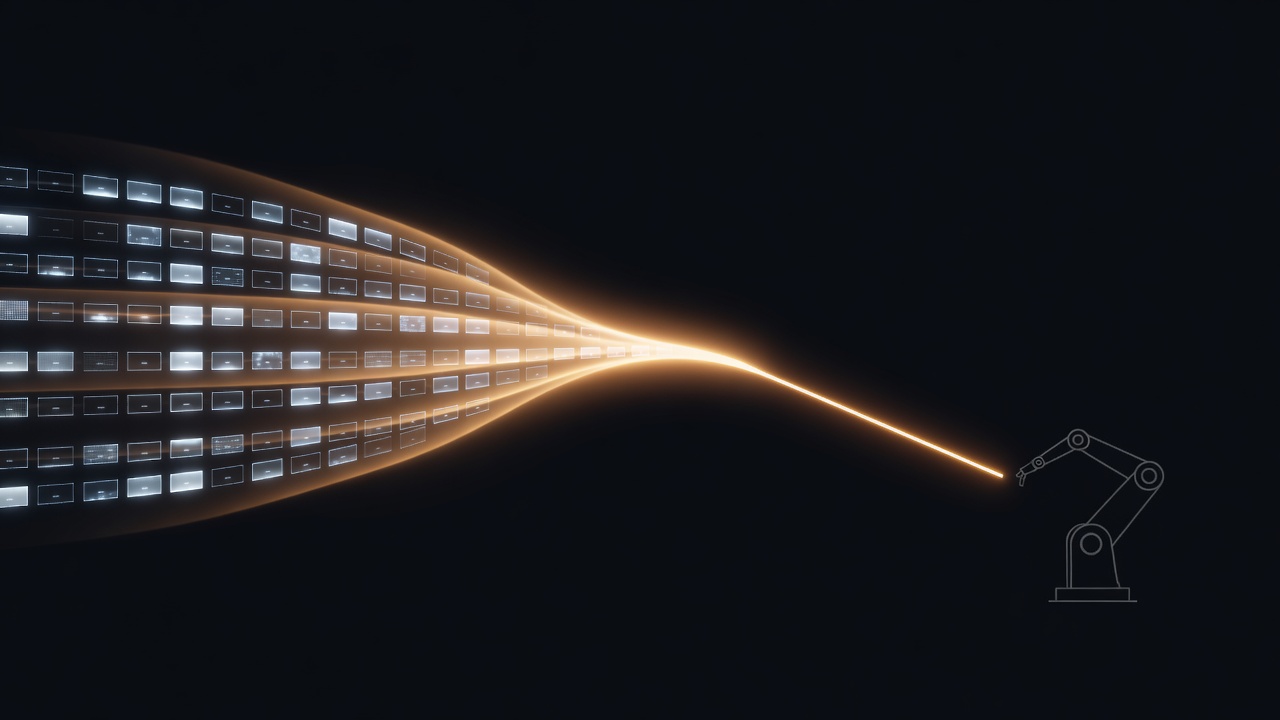
LAPT-Scale Pretrained on 5,000 Hours of Egocentric Video and Hit 85% Real-Robot Success. Its Hand-Pose Baseline Collapsed Back to 55% at the Same Scale.
LAPT-Scale (arXiv:2610.13732, accepted CoRL 2026, 9 October 2026) pretrains a VLA policy's latent-action model on human video before any robot data. Scaling that pretraining to 5,000 hours lifted real-robot success from 55.0% to 85.0%. A baseline that reads supervision straight off tracked hand poses rose to 75.0% at 3,000 hours, then fell back to 55.0%, the zero-hour score, at 5,000.
LAPT-Scale pretrains the latent-action model behind a vision-language-action policy on human video, then aligns it to a target robot before any task-specific robot data is collected (arXiv:2610.13732, accepted at CoRL 2026, submitted 9 October 2026). Scaling the annotated human-video pretraining set from 0 to 5,000 hours raised real-robot success from 55.0% to 85.0%, averaged over three manipulation tasks at 20 trials each (60 trials per data point).
The baseline that isolates what LAPT-Scale's learned latent actions are doing differently did not scale the same way. A method the paper calls Hand motion, which treats the tracked human hand as a pseudo end-effector and uses hand-pose trajectories directly as pretraining targets, improved from 55.0% to 58.3% to 75.0% as data grew from 0 to 1,000 to 3,000 hours, then dropped back to 55.0% at 5,000 hours: the same score as using no human video at all.
What changed: a continuous latent replaces the hand pose
The authors are Zhiyuan Xiang, Peidong Liu, Mingyang Li, Jiawei Li, Wenhow Li, Wenbo Ding and Xiang Deng. LAPT-Scale has two parts. LAPT-Scale-LAM learns a continuous latent action by explaining frame-to-frame visual transitions in human video, using perceptual, semantic (DINO) and optical-flow alignment signals on top of pixel reconstruction, rather than the vector-quantized codes most prior latent action models use. LAPT-Scale-Policy then runs the resulting latents through three training stages: pretraining on human video, embodiment alignment on 250 hours of target-robot data, and task-specific post-training.
The real-robot evaluation ran on an AgiBot G1 across seven tasks: the three original tasks in the scaling table (Mouse Pad, Headphones, Cup) plus four harder ones added later (paper-ball disposal, pen grasping, small-eraser grasping under self-occlusion, multi-stage book stowing). Against other published policies on the same 250-hour robot corpus, LAPT-Scale reached 85.0% average success versus 80.0% for JoyAI-RA, 56.7% for pi0.5 and 45.0% for Diffusion Policy (paper's Table 3).
The 23,300 hours of raw human video that feed LAM pretraining come from six sources: Egocentric-10K (10.0K raw hours, 0 cleaned, excluded from Stage 1), EgoDex (0.7K raw, 0.5K cleaned), Ego4D filtered by EgoVid (1.8K raw, 0.8K cleaned), Xperience (1.1K raw, 0.4K cleaned), EgoVerse (1.2K raw, 0.5K cleaned, arXiv:2604.07607, an academic egocentric corpus unrelated to any commercial product of the same name), and self-collected video (8.5K raw, 2.9K cleaned). Cleaning for Stage 1 kept roughly a fifth of the raw hours (5.1K of 23.3K).
The scaling table: label quality decides whether more hours help
Table 14 of the paper reports average success (%) over the three original tasks at four pretraining-data sizes. The 0-hour column is a shared robot-only control, so every method starts at the same point.
| Stage-1 supervision | 0 h | 1,000 h | 3,000 h | 5,000 h |
|---|---|---|---|---|
| Hand motion (tracked pseudo-actions) | 55.0% | 58.3% | 75.0% | 55.0% |
| DreamDojo LAM (reconstruction-only latent) | 55.0% | 61.7% | 75.0% | 76.7% |
| LAPT-Scale-LAM (continuous, multi-signal) | 55.0% | 63.3% | 80.0% | 85.0% |
Plotted, the three curves separate cleanly once data passes 1,000 hours. Hand motion is the only one that bends downward.
Why the hand-pose baseline breaks: noise that compounds with scale
The paper's own explanation is offered as a hypothesis, not a tested result: "Explicit hand-motion pipelines can accumulate source-dependent hand-estimation noise" under camera motion, occlusion and viewpoint shifts, and "a hand tracker can produce plausible but wrong pseudo-actions in these cases." More hours from more sources means more exposure to exactly the footage where hand tracking fails quietly, so the pseudo-action labels get noisier, not just more numerous. The paper does not run an experiment isolating which source or failure mode drove the 5,000-hour drop; it names the mechanism and shows the number.
The diagnostic for why LAPT-Scale-LAM avoids this comes from a separate LAM-quality comparison (Table 7): LAPT-Scale-LAM reaches PSNR 34.42, SSIM 0.933, LPIPS 0.055 and LARY accuracy 0.713, against a vector-quantized LAM at PSNR 18.34, SSIM 0.674, LPIPS 0.344 and LARY 0.232. The continuous latent is reconstructing the scene transition itself, not a tracked keypoint, so a bad hand-tracking frame degrades the training signal gradually instead of inserting a wrong label outright.
An alignment-signal ablation (Table 5) shows each supervision channel earning its place. Removing any one drops downstream manipulation success on RoboTwin Hard.
What this means for anyone pretraining on human video
The headline number to take from this paper is not 85.0%, it is that a simpler, intuitively reasonable baseline (track the hand, use its pose as the action) loses ground as you add more data, while a method built to tolerate label noise keeps gaining. If a team's human-video pipeline bottoms out at hand-pose extraction, scaling the corpus without fixing extraction is a plausible way to make a policy worse, not better, exactly when that would be hardest to notice without an ablation like this one.
The 23,300-hour source mix is also a practical answer to "how much diverse human video is enough": six sources, none dominant after cleaning, with self-collected video supplying the largest single cleaned share (2.9K of roughly 5.1K total cleaned hours). No single public corpus here was sufficient alone.
Check it yourself
Tables 3, 4, 5, 7, 8, 14 and 16 are in the HTML build at https://arxiv.org/html/2610.13732v1. The 5,000-hour Hand motion average: python3 -c "print(sum([75.0,50.0,40.0])/3)" prints 55.0, matching the paper's Appendix E per-task breakdown (Mouse Pad 75.0, Headphones 50.0, Cup 40.0). Converting cell percentages to trial counts: python3 -c "print(round(35/60*100,1), round(45/60*100,1))" prints 58.3 and 75.0, the 1,000-hour and 3,000-hour Hand motion entries.
The PDF is at https://arxiv.org/pdf/2610.13732. The paper states it is accepted at CoRL 2026; as of 13 October 2026 we found no project page or code release linked from the abstract page.
What would prove this wrong
Our claim: on this benchmark, continuous multi-signal latent actions scale with human-video volume where hand-pose pseudo-actions do not, and the gap (30 points at 5,000 hours in Table 14) is a property of the supervision signal, not a one-off result of this robot or these three tasks.
It is wrong if, by 31 December 2027, an independent re-run on a different robot embodiment or task set shows the Hand motion baseline continuing to improve past 3,000 hours rather than degrading, or shows LAPT-Scale-LAM losing its margin over Hand motion at any data scale tested. It is also wrong in part if the authors' own code release (once published) reveals a data-cleaning step for Hand motion that was omitted from the paper's description, since that would move the explanation from signal quality to a pipeline bug.
Sources
- Xiang, Liu, Li, Li, Li, Ding, Deng, LAPT-Scale: Scaling Embodied Policies with Latent Action Pre-Training on Human Videos, arXiv:2610.13732, 9 October 2026 (accepted CoRL 2026)
- arXiv HTML: Tables 3, 4, 5, 7, 8, 14, 16; Section 4.3; Appendices C, D.3, E
- Punamiya, Kareer, Liu, Citron et al., EgoVerse: An egocentric human dataset for robot learning from around the world, arXiv:2604.07607
- BLO LAB, End-to-End Robot Training: the data wall and the shift to human video
- BLO LAB, VioLA: 93.2% human frames, won locomotion, lost manipulation
Building or training robots?
We license manipulation datasets and run custom capture programs. Get in touch to see what fits.

A Closed-Form Weight Edit Took pi0.5 From 27 to 106 of 128 on a Misread Instruction, but Only When Written Into the VLM

V-JEPA 2's Predictor Adds 0.04 Top-1 Over Copying the Present on 27,000 Egocentric Trials. By Horizon, It Runs From Minus 0.05 at 1 s to Plus 0.16 at 3.5 s.
