
Ten Hours of Human Touch Data Moved a Robot Hand's Contact Prediction by 0.003 F1. The Next 90 Hours Moved It by 0.152.
DexTouch-WM (arXiv:2609.20649, 17 September 2026, HKUST Guangzhou, Xspark AI, Tsinghua and others) held robot data at 5 hours and added 0, 10, 50 and 100 hours of human interaction recorded with the same 320-taxel glove layout the robot hand wears. Contact-F1 on held-out robot episodes went 0.551, 0.554, 0.659, 0.706: flat for the first 10 hours, then rising, and still rising at 100 hours after visual metrics had stopped. Used to generate half of a training set, it lowered the real-robot score in five of six policy and generator combinations.
Adding 10 hours of human glove data to a robot hand's visuo-tactile world model moved its contact-prediction F1 on held-out robot episodes from 0.551 to 0.554. Adding 100 hours moved it to 0.706. Robot data was fixed at 5 hours throughout, and the human and robot task sets were disjoint, so the gain is transfer, not task overlap. The paper is DexTouch-WM, arXiv:2609.20649, posted 17 September 2026 by Yan Qin, Yue Chen and colleagues at HKUST (Guangzhou), Xspark AI, Tsinghua, Peking University and HKU, with Renjing Xu as corresponding author.
Two results sit beside the headline and matter as much to anyone buying or collecting this data. Contact prediction was still improving at 100 hours after the visual metrics had levelled off. And when the finished model generated half of a policy's training set, five of six policy and generator combinations scored below all-real training; the sixth beat it by 0.006.
The transfer rests on one glove layout, worn by both the human and the robot hand
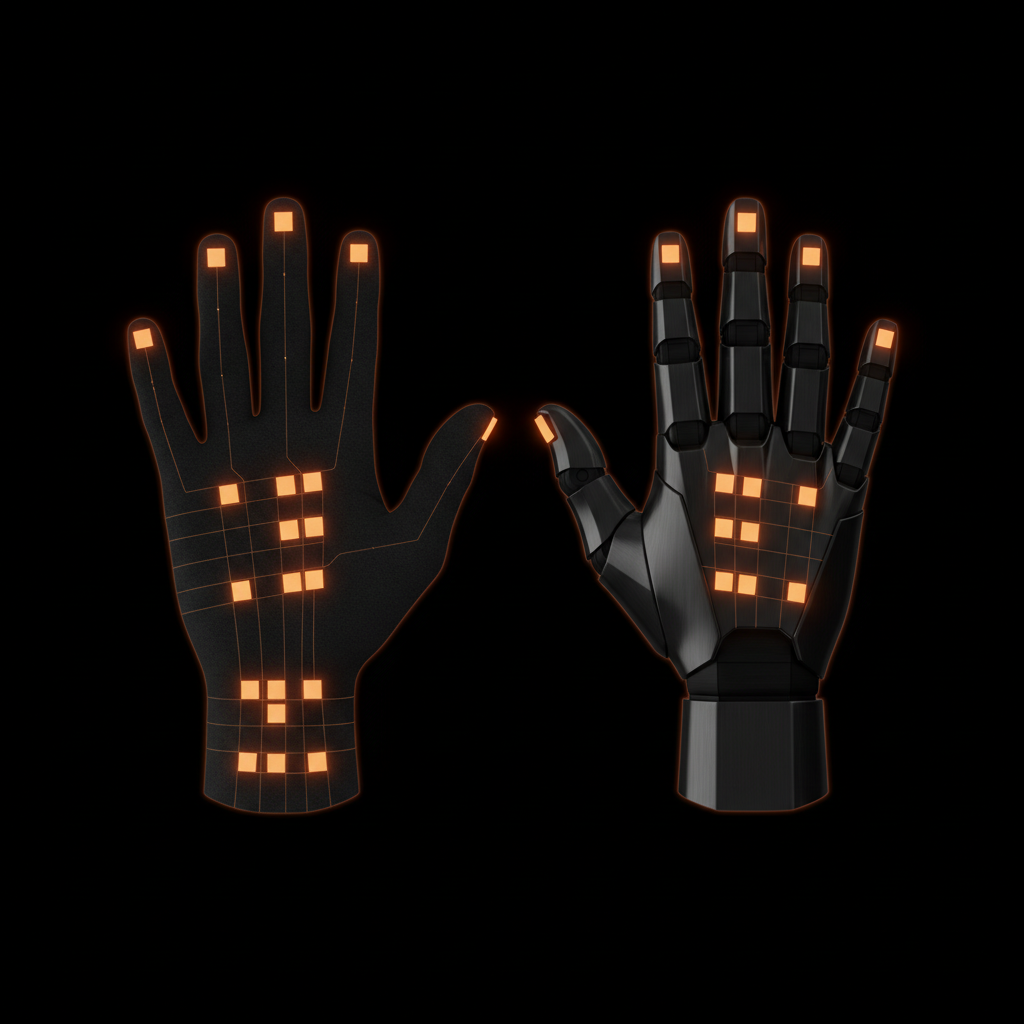
Human collectors wore Moxian piezoresistive tactile gloves beneath Manus MetaGloves, with HTC Vive trackers for 6-DoF wrist pose, two wrist cameras and a head camera. The gloves record 360 taxels per hand at 60 Hz; training keeps 320 of them, five 4x4 fingertip pads and one 15x16 palm pad. That corpus, HumanTouch, is about 100 hours across 50 everyday bimanual tasks: transport, grasping and regrasping, impact, insertion, articulated and deformable objects.
The robot is a Tianji arm with a 20-DoF Wuji hand, and the same glove layout is mounted on the robot hand. That is the design choice everything rests on: human and robot share one tactile observation space, and human hand motion is retargeted into the same 67-dimensional pose vector (two wrists, two 20-DoF hand configurations, head camera) the robot uses. There is no learned mapping between sensors. Robot data is 5 hours over 6 tasks for pretraining, plus 4 disjoint tasks held back for adaptation and evaluation.
The model pairs a video expert initialised from Wan2.2-TI2V-5B with a lightweight tactile expert, exchanging information by joint attention, and conditions both on pose through AdaLN. On the 5-hour robot set alone, AdaLN beat cross-attention on every tactile contact metric (Contact-IoU 0.39 to 0.42, Contact-F1 0.52 to 0.55), which is why the scaling runs use it.
The scaling table: flat first, then contact keeps climbing
Every column below uses the same 5 hours of robot data and is evaluated on the same held-out robot episodes from six manipulation tasks. At +10 hours the tactile metrics are almost unchanged and tactile MSE is slightly worse (0.093 to 0.108). The gains arrive between 10 and 50 hours. Between 50 and 100 hours, visual PSNR adds 0.222 dB and trajectory accuracy adds nothing, while Contact-F1 adds 0.047 and Contact-IoU 0.054.
| Metric (held-out robot episodes) | Robot-only, 0 h human | +10 h | +50 h | +100 h | Source |
|---|---|---|---|---|---|
| Visual PSNR (higher better) | 23.473 | 24.032 | 26.874 | 27.096 | Table I |
| Trajectory Accuracy (higher better) | 0.891 | 0.900 | 0.962 | 0.962 | Table I |
| Geometry Error (lower better) | 0.131 | 0.112 | 0.102 | 0.100 | Table I |
| Tactile PSNR per taxel (higher better) | 24.813 | 24.349 | 28.401 | 29.179 | Table I |
| Tactile MSE (lower better) | 0.093 | 0.108 | 0.038 | 0.029 | Table I |
| Contact-IoU (higher better) | 0.415 | 0.417 | 0.534 | 0.588 | Table I |
| Contact-F1 (higher better) | 0.551 | 0.554 | 0.659 | 0.706 | Table I |
As an evaluator it ranks policies well and scores them too high
The authors roll the same three policies (FTP-1, pi0.5 and X-VLA) out in the real world and inside two adapted world models on four tasks: WM-Robot, adapted on 200 robot trajectories, and WM-Mix, adapted on 100 robot plus 100 task-specific human demonstrations. Mean Pearson correlation with real scores was 0.646 for WM-Robot and 0.844 for WM-Mix, and mean rank violation fell from 0.025 to 0.017. Replacing half the robot adaptation data with human demonstrations made the evaluator more faithful, not less.
The absolute numbers are another matter. pi0.5 scored 0.450 on Place Shoes in the real world and 0.950 and 0.900 in the two imagined environments. X-VLA scored 0.600 on Stand Bottle in reality and 0.150 in WM-Robot. Stand Bottle's ranking of pi0.5 and X-VLA was reversed by both models. Use these models to order policies, not to predict a success rate.
As a data generator it did not replace real demonstrations
Each policy was trained on 200 real trajectories, or on 100 real plus 100 generated by a world model from the recorded actions of held-out episodes. All scores below were measured on the robot.
| Policy | 200 real, four-task mean | 100 real + 100 from WM-Robot | 100 real + 100 from WM-Mix | Largest single-task change | Source |
|---|---|---|---|---|---|
| FTP-1 | 0.731 | 0.688 | 0.694 | Stack Bowls 0.500 to 0.350 (WM-Robot) | Table IV |
| pi0.5 | 0.625 | 0.563 | 0.494 | Place Phone 0.700 to 0.350 (WM-Mix) | Table IV |
| X-VLA | 0.500 | 0.506 | 0.400 | Stand Bottle 0.600 to 0.000 (WM-Mix) | Table IV |
What this means if you are collecting or buying human tactile data
A pilot that stops at 10 hours would have measured nothing on contact prediction here and could reasonably have cancelled the programme. In this curve the return appears between 10 and 50 hours and has not flattened by 100. Budget a human-touch pilot past the first 10 hours before judging it, and treat that number as one paper's single run, not a law.
Visual and trajectory metrics saturate first; contact does not. Our reading: once a world model has enough human video to predict motion, extra human hours keep paying mainly through the tactile channel. Hours of glove data without a tactile stream would have stopped earning at around 50 in this setup.
The transfer was only shown with identical sensing on both sides: the same 320-taxel glove layout on the human hand and the robot hand. A buyer whose robot carries different tactile hardware is outside what this paper tested, and should ask for a mapping result before paying for the tactile channel. The cost per hour of human versus robot collection is not reported.
Generated demonstrations are not yet a substitute. Even from a model that orders policies correctly, half-imagined training sets lowered the four-task mean for five of six policy and generator pairs.
Check it yourself
Tables I, II, III and IV render as HTML at https://arxiv.org/html/2609.20649v1; every number in this article is in one of them or in Sections III-C, IV-A and IV-E.
Download once: `curl -sL https://arxiv.org/html/2609.20649v1 -o dtwm.html` then `grep -o 'Contact-F1[^<]*' dtwm.html | head` to find the table row and the Section IV-C prose that says +10h Human is almost flat on tactile metrics.
Recompute the headline deltas: `python3 -c 'f=[0.551,0.554,0.659,0.706]; print(round(f[1]-f[0],3), round(f[3]-f[1],3), round(f[3]-f[2],3))'` prints 0.003, 0.152 and 0.047.
Recompute a Table IV mean: `python3 -c 'print(round(sum([0.375,0.350,0.850,0.400])/4,3))'` prints 0.494, pi0.5 trained with WM-Mix data.
Version 1 of the paper links no code, model weights or HumanTouch download, so as of 19 September 2026 the scaling runs cannot be re-run independently.
What would prove this wrong
If HumanTouch is released and a re-run with at least three seeds per column puts the +10 hour Contact-F1 more than 0.03 above robot-only, the flat start in this article is noise from a single run and the pilot advice above is wrong.
Prediction, dated: if the authors or anyone else extend this setup to 200 human hours by 31 March 2027, Contact-F1 on held-out robot episodes will exceed 0.706 while visual PSNR stays within 0.5 dB of 27.096. A contact score that stalls at or below 0.706 would mean the tactile channel saturates about where vision did, and the case for paying for long tactile collection weakens accordingly.
Sources
- Qin, Chen et al., DexTouch-WM: Learning Action-Conditioned Tactile World Models from Human Touch for Dexterous Robot Manipulation, arXiv:2609.20649, 17 September 2026
- arXiv HTML render, Tables I to IV and Sections III-C to IV-E
- Wan2.2, the video model the visual expert is initialised from
- Black et al., pi0.5, one of the three evaluated policies, arXiv:2504.16054
- WUJI, Wuji Hand 2 debut at ICRA 2026, 5 June 2026
- BLO LAB, force-instrumented gloves over vision-tactile fingertips
Building or training robots?
We license manipulation datasets and run custom capture programs. Get in touch to see what fits.

A Closed-Form Weight Edit Took pi0.5 From 27 to 106 of 128 on a Misread Instruction, but Only When Written Into the VLM

V-JEPA 2's Predictor Adds 0.04 Top-1 Over Copying the Present on 27,000 Egocentric Trials. By Horizon, It Runs From Minus 0.05 at 1 s to Plus 0.16 at 3.5 s.
