
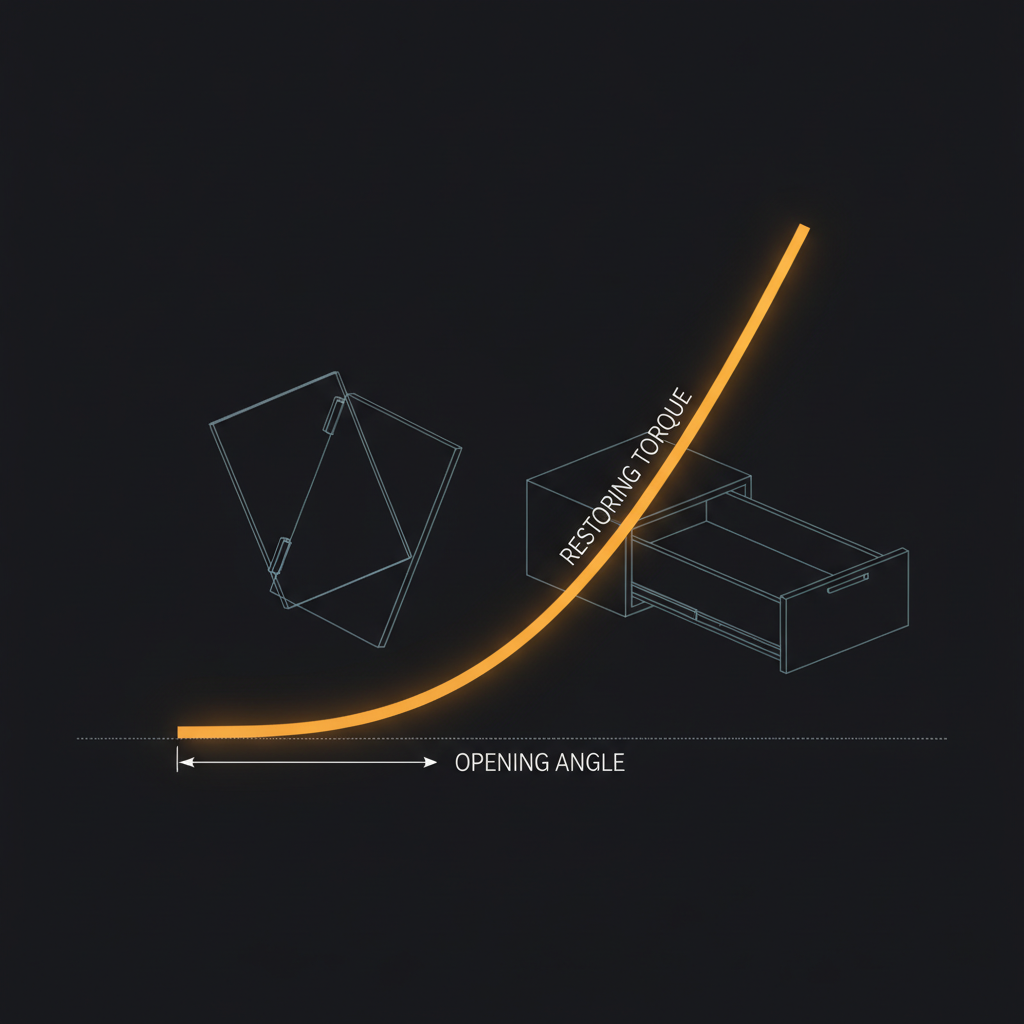
A Human Probe With a Force Sensor Beat a Language Model's Physics Guess by 27.6 Points, All of It on Three Objects
ForceTwin identifies an articulated object's inertia, friction and closing mechanism from one person probing it with a force-sensing handheld gripper. Mean goal completion across nine object-robot pairs is 87.3% against 59.7% for a vision-language prior. On the drawer and the sliding door the prior completes more often. The entire margin sits on the oven and the metal door, where both baselines stall below 5%. That is a purchasing rule for physical-interaction data, and it is narrower than the headline.
Across nine object-robot pairs, a digital twin whose dynamics were identified from one person probing the object with a force-sensing handheld gripper completed 87.3% of opening goals, against 59.7% for a twin whose physical parameters came from a vision-language model prior and 56.9% for a kinematics-only twin with no dynamics compensation. The paper is ForceTwin, arXiv:2609.21751, posted 18 September 2026 by Tim Engelbracht, Rene Zurbrugg, Mayank Mittal, Marco Hutter, Marc Pollefeys, Hermann Blum and Zuria Bauer at ETH Zurich, NVIDIA, Microsoft and the University of Bonn.
Read the per-object rows and the 27.6-point headline splits in two. On the drawer and the sliding door, all three methods complete the goal and the language prior completes it more often than the measurement does: 95.2% against 88.0% on the Spot drawer, 93.1% against 85.6% on the Franka drawer. The entire margin comes from three pairs where a built-in mechanism is pushing back, the oven on both robots and the metal door on the Franka. There both baselines stall below 5% completion while the identified twin reaches 67.6% to 100%.
Anyone paying humans to capture physical-interaction data should read that split as a purchasing rule. The measurement is not worth its collection cost on objects that offer no resistance. It is the difference between a robot that stalls and a robot that works on the ones that do.
What the capture rig actually records, and what the protocol demands
The capture device is the Hoi! handheld gripper (Engelbracht et al., CVPR 2026), which supplies posed RGB-D observations, the tool trajectory from Project Aria machine perception services, and the contact wrench from a wrist-mounted force-torque sensor. A person grasps the handle and opens and closes the part across a range of speeds and accelerations chosen to excite each term of the regressor separately: slow low-acceleration motion for Coulomb friction, a wide speed spectrum for viscous damping, high accelerations for inertia, and passive following for the mechanism.
That protocol sentence is the commercially load-bearing one in the paper, and it appears in the limitations rather than the abstract. In the authors' words, identification 'needs physical interaction: each part is probed individually, and the probing has to excite the individual regressor axes, so passive demonstration recordings do not suffice.' A video of somebody opening a door is not this dataset. Neither is a teleoperation log of a robot opening it normally. What has value here is a deliberate, instrumented excitation sweep of one specific hinge.
Identification is also one instance at a time and one shot. A loaded drawer or a readjusted door closer is a different object, and refining a twin online from the robot's own interaction forces is listed as open. Priors scale across a scene where probing does not, which the authors state plainly and which is the honest reason both approaches survive.
Where the 27.6 points actually live
The controller is fixed across conditions. ForceTwin's identified inertia, Coulomb and viscous terms plus the mechanism residual enter a Cartesian impedance controller only through the feedforward force, so robot, controller, task and 6-second goal time are held constant and only the source of the twin varies. Each trial starts with the handle already grasped.
ForceTwin has the lowest tracking error on every one of the nine pairs, by factors of 1.3 to 4 on the easy ones. Completion is the metric that splits. On the metal door with Spot the comparison does not exist at all: the object's forces exceed Spot's actuation limits, and the row reads N/A rather than zero.
| Object / robot | Mechanism | ForceTwin compl. | VLM prior compl. | Kinematics compl. | ForceTwin track | VLM track | Kin. track |
|---|---|---|---|---|---|---|---|
| Sliding door / Spot | none | 100.0 | 100.0 | 100.0 | 10.5 | 15.4 | 18.5 |
| Sliding door / Franka | none | 93.7 | 98.7 | 99.3 | 10.5 | 17.2 | 26.9 |
| Drawer / Spot | weak | 88.0 | 95.2 | 90.6 | 9.2 | 34.1 | 38.0 |
| Drawer / Franka | weak | 85.6 | 93.1 | 85.1 | 17.6 | 37.0 | 22.4 |
| Wood door / Spot | medium | 100.0 | 91.2 | 88.3 | 14.0 | 24.3 | 27.3 |
| Wood door / Franka | medium | 69.8 | 51.7 | 44.0 | 30.3 | 47.7 | 56.0 |
| Oven / Spot | strong | 100.0 | 4.0 | 2.2 | 33.3 | 91.1 | 91.9 |
| Oven / Franka | strong | 67.6 | 1.8 | 0.9 | 49.7 | 90.8 | 91.6 |
| Metal door / Franka | strong | 81.2 | 1.6 | 1.5 | 24.4 | 91.0 | 91.0 |
| Metal door / Spot | strong | not run | not run | not run | not run | not run | not run |
| Overall mean | 87.3 | 59.7 | 56.9 | 22.2 | 49.8 | 51.5 |
Bolded baseline cells above are the ones where a guess beat a measurement. There are three of them, all on completion, all on objects with no mechanism or a weak one. The metal door on Spot was not run because the object's forces exceed Spot's actuation limits, so the overall mean is taken over nine pairs, not ten.
The prior underestimates everything, the measurement overestimates everything
Only inertial parameters admit independent ground truth here: mass on a scale for prismatic joints, and one-third m L squared for revolute panels under constant density. On the four objects where that reference exists, the interaction-based estimate posts a macro mean absolute relative error of 29.5% against 53.0% for the prior, and wins on three of four.
The direction of each error is more useful than its size. The language prior underestimates the inertial parameter on all four objects despite being given scale information and prompted to reason about material. Its worst case, 83.5%, is the heavy drawer, whose effective mass is dominated by its contents. ForceTwin overestimates on all four, consistently enough that the authors attribute it to residual unmodelled effort being absorbed into the inertial term during the parametric fit rather than to an optimiser that stopped early.
Its accuracy also scales with the size of the thing being measured: 10.4% and 13.7% on the two heaviest parts, 63.8% and 30.2% on the two lightest, because a light part excites forces that sit inside the sensor's noise band. The single case where the prior wins is the smallest object in the set. If you are specifying a capture programme, that is a sensor-selection constraint, not a modelling one.
Two more results worth separating from the headline
Free-swing fidelity is the cleanest system-level check in the paper. Release the metal door and the wood door from 45 and 90 degrees and compare measured closing time against each simulated twin. The identified twin's macro mean absolute relative error is 16.3% against 57.7% for the prior, and it wins all four conditions. The prior closes every door in roughly 2 seconds regardless of door or release angle, against real times of 3.7 to 8.4 seconds. The authors note the measure is not injective: a large mismatch proves the dynamics are wrong, but compensating errors could produce a matching closing time.
The model-class ablation prices the two pieces of complexity separately. Adding viscous damping to a Coulomb-plus-inertia model cuts in-sample effort RMSE by up to 12%. Adding the structured mechanism residual cuts it by a further 67% to 73% on mechanism-dominated parts, and by 12% on the sliding door, which has no mechanism. The same split appears again: the expensive machinery earns its keep only where a mechanism exists.
The policy-learning result is the weakest claim here and the paper says so. Identified wood-door and metal-door dynamics were registered onto the door asset in Isaac Lab, replacing that pipeline's domain randomisation, and whole-body traversal policies were deployed on an ANYmal with an arm. The wood-door policy succeeded on the wood door in all five trials; the metal-door policy also succeeded there but moved stop-and-go with higher jerk. Whether identified dynamics beat domain randomisation in a controlled comparison is explicitly left to future work, so nobody should quote this section as evidence that it does.
| Measurement | ForceTwin | Best baseline | Baseline name | Note |
|---|---|---|---|---|
| Revolute axis angle error | 1.5 deg | 1.7 deg | MoMa-SG | both interaction-based |
| Revolute axis position error | 23 mm | 46 mm | MoMa-SG | halved |
| Revolute type accuracy | 100% | 54.1% | OPDMulti (vision only) | no interaction at all |
| Inertial parameter, macro ARE | 29.5% | 53.0% | VLM prior | 4 objects with ground truth |
| Free swing, macro ARE | 16.3% | 57.7% | VLM prior | 4 release conditions |
| Metal door 45 deg, closing time | 5.9 s | 2.1 s | VLM prior | real 5.6 s |
| Metal door 90 deg, closing time | 8.8 s | 2.5 s | VLM prior | real 8.4 s |
| Wood door 45 deg, closing time | 5.0 s | 2.0 s | VLM prior | real 3.7 s |
| Wood door 90 deg, closing time | 6.0 s | 2.4 s | VLM prior | real 5.0 s |
What a data buyer should take from this
Price physical-interaction capture by mechanism class, not by hour. The data in this paper is worth roughly nothing on a sliding door and worth the whole task on an oven with a strong closer. If a capture programme is quoted as a flat per-object rate, the buyer is subsidising the easy half.
Specify excitation, not activity. The paper's own limitation section rules out passive demonstration recordings for this purpose. A contract that asks for 'human demonstrations of opening doors' will produce footage that cannot identify a single friction coefficient. A contract that asks for a speed sweep, an acceleration sweep and a passive release per hinge will.
Budget for instrument noise at the low end. Light parts excite small forces, and the estimate degrades to 63.8% error there while a language prior does better. Either use a lower-range force-torque sensor for small parts or accept that this method has a floor.
Treat the twin as perishable inventory. Identification is one-shot and per instance. Loading the drawer or readjusting the closer invalidates it. Anybody selling identified-physics assets is selling something with a shelf life set by whether the object was touched since.
Check it yourself
Read the per-object rows rather than the abstract. `https://arxiv.org/html/2609.21751v1` renders Table II in full; the three bolded baseline wins above are in the Spot drawer, Franka sliding door and Franka drawer rows. The protocol constraint is in Section V, the paragraph beginning 'Our decomposition of the effort model is not unique'.
Check the capture device before assuming a dataset qualifies. Hoi! (Engelbracht et al., CVPR 2026) is a multimodal dataset for force-grounded cross-view articulated manipulation, and it is the same first author. A capture rig without a wrist force-torque sensor produces trajectories, not wrenches, and cannot feed this pipeline no matter how many hours it holds.
Reproduce the classification, not the numbers: code and video are both listed as 'soon' on the project page as of 22 September 2026. What you can reproduce today is the sort. Take any articulated-object dataset, label each part weak, medium or strong by whether a spring or closer contributes to the articulation force, and check what fraction of it falls in the class where this measurement pays.
What would prove this wrong
The claim in this article is narrower than the paper's: instrumented human probing changes manipulation outcomes only on parts whose built-in mechanism contributes materially to the articulation force, and on the rest it buys tracking quality that does not convert into completion.
It is wrong if, by 31 March 2027, a controlled comparison holding robot, controller and task fixed shows identified dynamics beating a domain-randomisation baseline by more than 5 points of completion on an object rated 'none' or 'weak' for mechanism. The authors left exactly that comparison to future work, so the experiment is already specified.
It is also wrong if a follow-up shows the prior's failure on the oven and metal door is a prompting artefact rather than a perception limit. The paper's own evidence cuts against that (the prior underestimates every object, with the worst case on hidden drawer contents) but one prompt-engineering ablation would settle it, and none exists yet.
Sources
- ForceTwin: Physics-informed Digital Twins for Robotic Manipulation from Instrumented Human Interaction, arXiv:2609.21751 (18 Sep 2026)
- Full HTML with Tables I, II and III
- Project page, ETH Zurich / NVIDIA / Microsoft / University of Bonn
- Project Aria: A New Tool for Egocentric Multi-Modal AI Research, arXiv:2308.13561
- Robotic Systems Lab, Learning to Open and Traverse Doors with a Legged Manipulator (10 Sep 2024)
Building or training robots?
We license manipulation datasets and run custom capture programs. Get in touch to see what fits.

A Closed-Form Weight Edit Took pi0.5 From 27 to 106 of 128 on a Misread Instruction, but Only When Written Into the VLM

V-JEPA 2's Predictor Adds 0.04 Top-1 Over Copying the Present on 27,000 Egocentric Trials. By Horizon, It Runs From Minus 0.05 at 1 s to Plus 0.16 at 3.5 s.
