
FOMI Transmits Real Object Force to a Robot-Free Data Collector's Hand With No Force Sensor Anywhere in the Device. Collection Efficiency Rose 29%, Completion Rose From 64.6% to 86.6%, and the Force Is Never Recorded.
FOMI (arXiv:2610.19839, HKUST, HKU, Robbyant and SUSTech, 14 October 2026) is a scissor-shaped handheld interface whose parallelogram linkage carries the gripper's own contact force straight to the operator's hand, with no force sensor and no logged force value. Across four contact-rich tasks it collects 17.8 successful demonstrations per 10 minutes against 13.8 for the best existing robot-free interface, and its own force-ratio validation measured only two points, one of which falls outside its own claimed range.
FOMI is a scissor-shaped handheld interface that transmits the force a gripper feels during object contact straight to an operator's hand through its own actuation links, with no force sensor anywhere in the device (arXiv:2610.19839, Hong Kong University of Science and Technology, University of Hong Kong, Robbyant and Southern University of Science and Technology, submitted 14 October 2026). Across four contact-rich tasks and three operators, it collects 17.8 successful demonstrations per 10 minutes against 13.8 for the best existing robot-free interface tested (UMI) and 11.6 for a finger-driven alternative (Ring), and its task completion rate reaches 86.6% against UMI's 64.6%.
The force the operator feels is never recorded as a number. The paper states plainly that interaction forces are not logged for policy learning: the mechanism is feedback for the human, not a training signal.
What changed: force feedback from geometry, not from a sensor
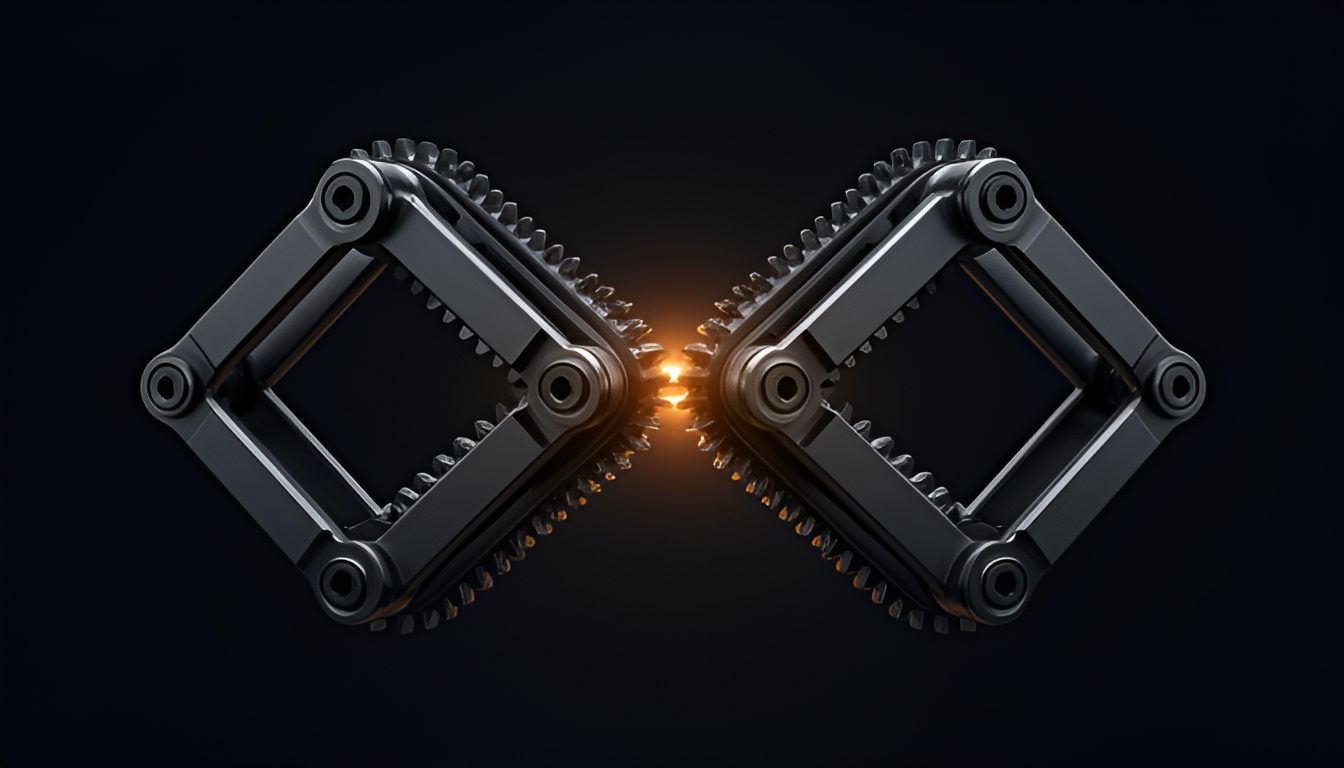
Handheld, robot-free interfaces like UMI let an operator collect demonstrations by moving a camera-equipped gripper rig through the world by hand, without a robot or teleoperation rig present, which scales data collection but gives the operator no sense of how hard the gripper is actually pressing on an object. FOMI's two mirrored branches, each combining a handle, a sector gear and an actuation link, mesh at a 1:1 gear ratio so they open and close symmetrically like a pair of scissors. Each actuation link forms a parallelogram with a guide link, the gripper carrier and the base, which keeps the gripper's contact surfaces parallel through the full range of motion. There are no return springs, so whatever force reaches the operator's hand comes from the object the gripper is touching, not from spring preload fighting the hand.
The device records only what it needs to replay the collected trajectory: a fisheye camera image, the 6-DoF pose from a tracker, and the gripper opening width from two 14-bit magnetic rotary encoders read by an Arduino Nano. The same mechanism, remapped, drives teleoperation: FOMI's handle pose and opening map onto a robot end effector's pose and gripper command, compared here against GELLO (joint-space leader-follower) and a PICO-controller VR setup.
Downstream policies are fine-tuned from the pi0.5 vision-language-action model, 10,000 training steps, batch size 64, predicting 50-step bimanual action chunks with real-time chunking at deployment, the same base model ForceBench benchmarks force-integration designs on in a separate paper from the same week.
Collection efficiency across four contact-rich tasks, mean and sample standard deviation across three operators, three sessions each:
| Task | Robot-free UMI | Robot-free Ring | Robot-free FOMI | Teleop GELLO | Teleop VR | Teleop FOMI |
|---|---|---|---|---|---|---|
| Pick Chip | 16.6 ± 1.8 | 10.7 ± 3.5 | 22.0 ± 1.5 | 6.4 ± 0.8 | 0.2 ± 0.4 | 7.2 ± 1.2 |
| Insert Tube | 13.8 ± 1.0 | 9.9 ± 3.0 | 17.7 ± 1.5 | 4.9 ± 0.5 | 1.6 ± 0.7 | 7.4 ± 1.3 |
| Wash Dish | 11.0 ± 1.8 | 10.9 ± 1.9 | 13.3 ± 2.4 | 8.8 ± 0.4 | 7.2 ± 0.4 | 9.3 ± 0.7 |
| Open Pouch | 13.7 ± 3.4 | 15.0 ± 3.0 | 18.2 ± 2.4 | 8.1 ± 0.4 | 4.6 ± 1.3 | 9.7 ± 1.7 |
| Mean | 13.8 | 11.6 | 17.8 | 7.1 | 3.4 | 8.4 |
Task completion rate, the share of attempts that finished rather than were abandoned mid-collection, tells a sharper version of the same story. Robot-free: UMI 64.6%, Ring 64.5%, FOMI 86.6%. Teleoperation: GELLO 54.0%, the PICO-controller VR setup 34.1%, FOMI 75.6%.
The mechanism, and where its own numbers do not quite close
FOMI's authors derive, from a virtual-work balance on the parallelogram linkage, that the force reaching the handle stays between 0.49 and 0.65 of the actual gripper contact force across the full opening range, a ratio they call approximately proportional. That derivation assumes rigid links and ignores friction, gravity and tangential loads. Validation against a real sensor was limited to two positions with a tension gauge: 0.667 near full closure and 0.511 near full opening. The paper attributes the higher measured value to joint friction the model leaves out, but 0.667 sits above the paper's own stated 0.65 upper bound, a small inconsistency the paper does not resolve.
That gap matters less for FOMI's actual use than it might: the force is feedback for the human operator's hand, not a value the system logs. Robot-free demonstrations store only images, the calibrated end-effector pose and the calibrated gripper command; teleoperated demonstrations add the measured robot end-effector pose. No tactile or force channel enters the recorded data or the downstream pi0.5 policy at all.
What it means for teams building collection hardware
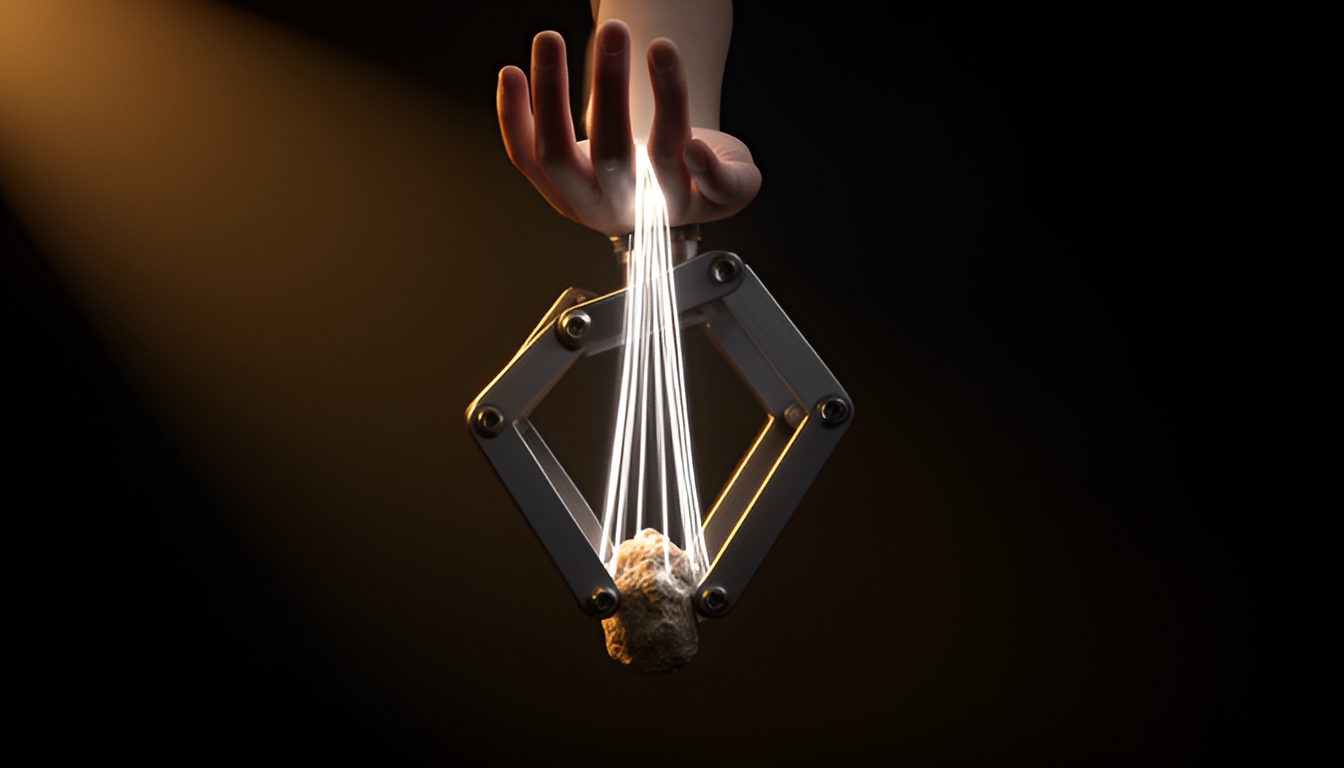
Force feedback for a human operator does not require a force sensor. A parallelogram linkage with no return springs can carry real contact force to the hand well enough to raise completion rate from 64.6% to 86.6% in robot-free collection, which is a mechanical design result, not a sensing or machine-learning one, and it is likely cheaper and more durable than a sensorized handle.
That same design choice is a limit for anyone hoping to mine FOMI's logs for a force-labeled training signal: there is not one. A team that wants force or contact labels alongside demonstrations collected this way would need to add a sensor on top of FOMI's existing mechanism, and could not retrofit the claimed 0.49 to 0.65 force ratio as a substitute measurement, since the paper's own two-point check already falls outside that range at one end.
The gains hold in both collection modes FOMI supports, robot-free and teleoperated, against every baseline tested in each mode. That is the more durable claim here: a single mechanical interface that improves both ways of collecting demonstrations is a stronger result than improving either one alone.
Check it yourself
Table 2 (collection efficiency) and Figure 5a (completion rate) are in the HTML build at https://arxiv.org/html/2610.19839v1. The robot-free FOMI mean checks out: python3 -c "print(round((22.0+17.7+13.3+18.2)/4,1))" prints 17.8, matching the paper's reported mean.
The force-ratio validation is in Appendix A: a tension gauge at two positions, 0.667 near closure and 0.511 near full opening, against a claimed analytical range of 0.49 to 0.65. As of 15 October 2026 we found no project page, code repository or video linked from the abstract.
What would prove this wrong
Our claim: FOMI's completion-rate and collection-efficiency gains come from its mechanical force path rather than from some other difference between it and the baselines (operator training, camera placement, or the specific tasks chosen), and its own force-ratio model is not fully validated, since the one measured point near closure already falls outside the claimed range.
It is wrong if, by 1 July 2027, an independent build of FOMI's linkage, tested across a different task set and operator pool, fails to reproduce a completion-rate advantage over UMI of at least half the 22-point gap reported here. It is also wrong, in the narrower sense, if a fuller force-sensor validation across the whole opening range finds the 0.49 to 0.65 ratio holds throughout, which would mean the two-point discrepancy here was measurement error rather than a gap in the model.
Sources
- Shen, Luo, Wang, Yang, Yang, Xu, Shen, Zhang, Zhou, Xu, FOMI: A Force-Feedback Manipulation Interface for Teaching Contact-Rich Manipulation, arXiv:2610.19839, 14 October 2026
- arXiv HTML build: Table 2 (collection efficiency), Figures 5, 7, 8, Appendix A (force-ratio validation)
- BLO LAB, ForceBench: six ways to feed wrist force into one VLA backbone
Building or training robots?
We license manipulation datasets and run custom capture programs. Get in touch to see what fits.

A Closed-Form Weight Edit Took pi0.5 From 27 to 106 of 128 on a Misread Instruction, but Only When Written Into the VLM

V-JEPA 2's Predictor Adds 0.04 Top-1 Over Copying the Present on 27,000 Egocentric Trials. By Horizon, It Runs From Minus 0.05 at 1 s to Plus 0.16 at 3.5 s.
