
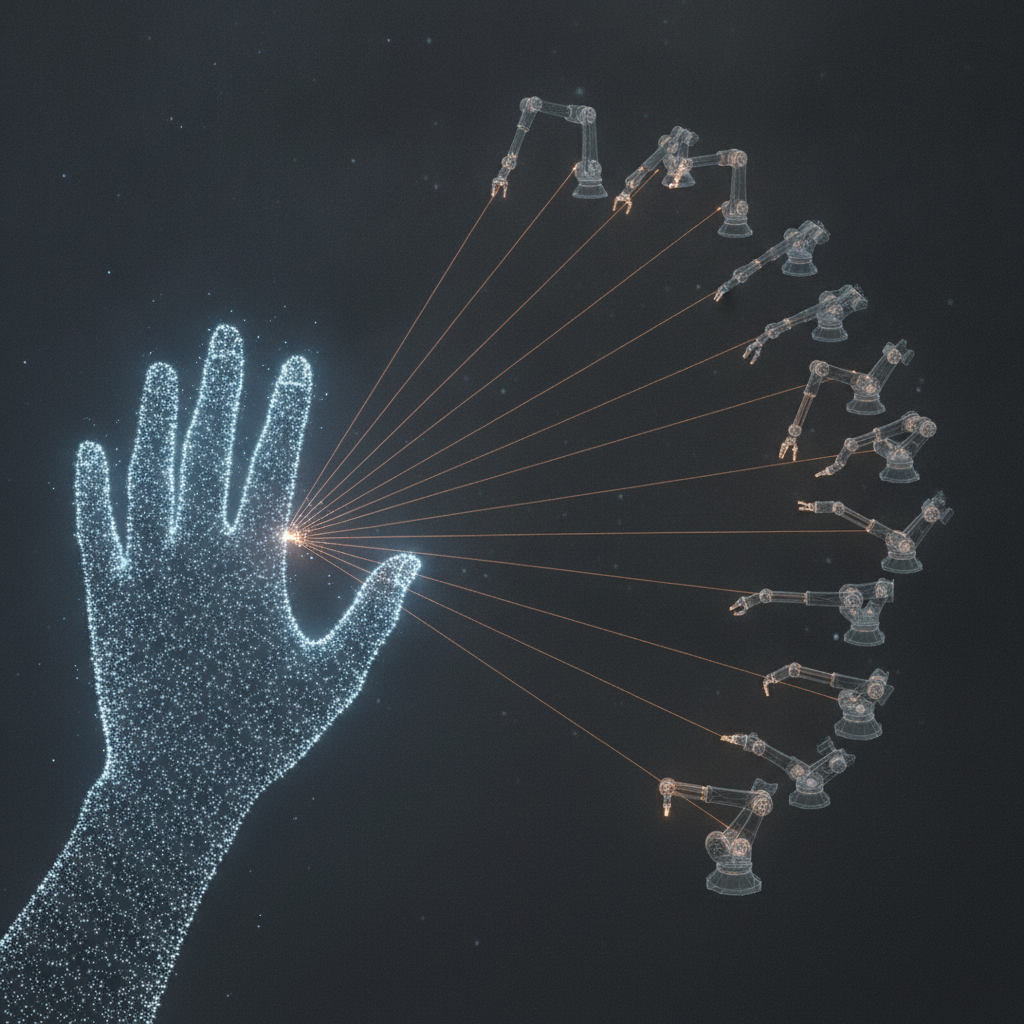
Ego2Robot Rendered 1,940 Hours of Human Video Onto 15 Robot Arms. Going From 1 Arm to 15 Added 1.8 Points.
arXiv:2608.02580 (Qwen Team at Alibaba with Renmin University, ShanghaiTech and BIGAI, 3 August 2026) turns 1,940 hours of egocentric video into 18,561 hours of synthetic robot data across 15 arm morphologies. In its own ablation, rendering onto 15 arms instead of 1 lifts RoboTwin Randomized success from 31.7% to 33.5%, and adding the unrendered human video back lifts it to 37.3%. Franka success under the embodiment perturbation fell under all three data mixes.
Ego2Robot's headline is 18,561 hours of robot training data. Its own ablation says most of the value is not in the multiplication. With ego-only pretraining scored on RoboTwin 2.0 Randomized, human video rendered onto one robot arm reaches 31.7%, rendered onto 15 arms 33.5%, and 15 arms plus the raw, unrendered human video 37.3%. Fourteen extra arms bought 1.8 points. The original footage bought 3.8.
The paper, arXiv:2608.02580, was posted on 3 August 2026 by the Qwen Team at Alibaba with Renmin University's AIM3 Lab, ShanghaiTech University and BIGAI. On 15 September 2026 the project page's Code link pointed to `#`, and none of the authors' data was on the Hugging Face Hub.
What goes in, and what the 18,561 hours count
Four egocentric sources feed the pipeline: ANT, the authors' in-house pick-and-place set (7 h), EgoDex (732 h), ViTRA (249 h) and EgoVerse (954 h), 1,940 hours in all. Each clip goes through action retargeting, robot-arm visual synthesis by inpainting and depth-aware compositing, and three levels of quality curation, run independently for each of 15 morphologies: Panda, UR5e, ARX-L5, xArm7, Sawyer, Kinova Gen3, IIWA, Jaco, FR3, UR10e, ViperX, WidowX, Piper, YAM and Aloha-Agilex.
18,561 divided by 1,940 is 9.57. The synthetic corpus is the same 1,940 hours of human behaviour, rendered roughly ten times over. If the hours were spread evenly across the 15 arms, which the paper does not report, each arm would keep about 1,237 hours, or 64% of the source. Base placement is grid-searched per arm within that arm's kinematic reach; our reading is that clips an arm cannot reach are the likeliest losses, but the paper gives no per-arm or per-stage drop rates.
The robot-only comparison corpus is DROID, AgiBot World and InternData: 6,565 hours.
How a human hand becomes a parallel gripper
Retargeting is where the modality budget gets spent. From 21 hand keypoints the pipeline builds a virtual fingertip as 0.7 times the index fingertip plus 0.3 times the middle fingertip. The tool centre point is the midpoint of the thumb tip and that virtual fingertip, and the gripper opening is the distance between them. Grasp orientation comes from the jaw line, the wrist-to-fingertip direction and the approach axis. When the opening drops below 0.01 m, orientation freezes at its last valid value.
Everything else about the hand is dropped. The authors list it as their first limitation: retargeting to parallel-jaw grippers discards fine-grained finger articulation. The paper describes no force or contact signal anywhere in the sources, the retargeting, or the output.
Which mix helps, and where
Pretraining mixes Ego2Robot data with the 6,565 robot hours at 1:3, 3:1 and 1:1. The 1:1 mix leads on five of seven columns. The 3:1 mix has the best embodiment and EBench scores. The 1:3 mix is worse than robot-only on four of seven.
| Pretraining | Clean | Randomized | Embodiment | Task | EBench | Source |
|---|---|---|---|---|---|---|
| Robot-only (6,565 h) | 62.2 | 50.9 | 23.8 | 46.2 | 39.6 | arXiv:2608.02580, Table 1 |
| Ego2R + Robot 1:3 | 61.4 (-0.8) | 51.0 (+0.1) | 21.9 (-1.9) | 49.5 (+3.3) | 47.4 (+7.8) | arXiv:2608.02580, Table 1 |
| Ego2R + Robot 3:1 | 64.1 (+1.9) | 49.2 (-1.7) | 28.2 (+4.4) | 51.6 (+5.4) | 51.7 (+12.1) | arXiv:2608.02580, Table 1 |
| Ego2R + Robot 1:1 | 68.1 (+5.9) | 53.5 (+2.6) | 27.2 (+3.4) | 54.1 (+7.9) | 49.8 (+10.2) | arXiv:2608.02580, Table 1 |
Fifteen arms in pretraining, and Franka got worse
Table 2 of the paper splits the embodiment column into three test arms. Under the 1:1 mix, ARX rises from 44.1 to 51.2 and UR5 from 20.2 to 25.0 (31.4 under 3:1). Franka falls from 7.0 to 5.3, and it falls under every mix: 4.5 at 1:3, 5.6 at 3:1, 5.3 at 1:1. Panda and FR3, both Franka arms, are among the 15 rendered morphologies.
Two readings fit. Franka starts near the floor at 7.0%, where a 1.7-point move may be a handful of episodes, so the drop could be noise. Or rendering Franka-shaped arms over human hands does not teach what RoboTwin's Franka setting actually tests. The paper reports no seeds or confidence intervals, so the two cannot be separated from the published numbers.
The largest per-factor gains at 1:1 are not about arms: object +10.3 (29.3 to 39.6), lighting +7.6, robot colour +6.4, language +5.4. That matches the authors' own attribution of the background and lighting gains to scene diversity in egocentric video.
The ablation, step by step
Figure 3 isolates the pipeline with ego-only pretraining, no robot data, scored on RoboTwin Randomized. Raw ego video co-training: 28.1%. Rendered onto one morphology: 31.7%, a 3.6-point gain. Onto 15 morphologies: 33.5%, a further 1.8. Fifteen morphologies plus raw ego video (20,501 h): 37.3%, a further 3.8. The figure also plots 5 and 10 morphologies; those values are not stated in the text, so they are left out here.
The authors read the last step as raw ego video acting as a 16th morphology. A simpler reading, marked as ours: unrendered video keeps the scene and the hand exactly as captured, and a step that inpaints an arm over the hand removes some of that. At the observed rate the marginal arm is worth about 0.13 points (1.8 across 14 arms), and the raw footage is worth about 29 arms.
What seven minutes of play video did on a real robot
The real-robot test uses an ARX ACone dual-arm platform, five long-horizon tasks, 20 teleoperated demonstrations per task, and a 100-point sub-step score over 20 trials. The authors also filmed about 7 minutes of egocentric hand play per scene and ran it through the pipeline. Fine-tuning on the teleop demonstrations mixed 1:1 with that converted play beat robot-only on all five tasks, by 14 points on Put Blocks (open drawer, place 2 blocks, close drawer) and 13 on Insert Screw (bimanual handover and insertion of 2 screws). Per-task absolute scores appear only as a bar chart.
What this means if you are building an ego-to-robot pipeline
Spend on source diversity before rendering breadth. In this paper, 14 more rendering passes returned 1.8 points; keeping the raw video in the mix returned 3.8 with no rendering at all.
Do not count synthetic hours as data hours. 18,561 hours is 1,940 hours of human behaviour. When a paper or a vendor quotes rendered hours, divide by the morphology count before comparing it with a teleoperation corpus.
Treat the mixing ratio as a first-order setting. At 1:3 the embodiment column fell 1.9 points and Franka fell 2.5; the same data at 1:1 lifted embodiment by 3.4.
The cheap result is the play video. About seven minutes of a person handling objects in the target scene, converted, moved two real-robot tasks by 13 to 14 points. That is the most portable finding in the paper.
A judgement, marked as one: a pipeline that reduces a hand to a width and a pose, with no force, transfers what a parallel gripper can do by looking. Insert Screw gaining 13 points shows geometry carries further than that sounds. It does not show the policy learned how hard to push.
Check it yourself
Table 1 as flat text from the paper's HTML:
``` curl -sL https://arxiv.org/html/2608.02580 | sed -e 's/<[^>]*>/ /g' | tr -s '[:space:]' ' ' | grep -oE 'Table 1: Main results.{0,900}' ```
Change the anchor to `Table 2: Per-perturbation` for the ARX, UR5 and Franka columns, and to `Raw ego co-training` for the ablation sentence with 28.1, 31.7, 33.5 and 37.3. The retargeting weights sit in the LaTeX alt text:
``` curl -sL https://arxiv.org/html/2608.02580 | grep -oE 'alttext="[^"]*(0.7|0.01)[^"]*"' | head -4 ```
Release state: the Code button on https://www-ye.github.io/ego2robot_blog/ linked to `#` on 15 September 2026. The Hub search `curl -sL 'https://huggingface.co/api/datasets?search=ego2robot'` returned three repositories, none linked from the paper or its project page; the largest is a 50-episode factory set created in November 2025, before the paper.
What would prove this wrong
A dated prediction: if Ego2Robot's data or code is released and the 1-versus-15 morphology ablation is re-run with at least three seeds by 30 June 2027, the 15-arm gain on RoboTwin Randomized will be under 2.5 points, smaller than the raw-ego step, and Franka's embodiment score under a 1:1 mix will not beat robot-only by more than 2 points. A 15-arm gain above 3.6 points, the size of the single-arm pipeline gain, would mean arm breadth is the lever and this note has the priority backwards.
If a revised version reports per-morphology hours showing most of the 18,561 hours landed on a few arms, the 1-to-15 comparison is closer to a data-volume test than an arm-diversity test, and the 1.8-point reading changes with it.
Sources
All retrieved 15 September 2026. Primary sources first.
- Ego2Robot: Scalable Robot Data Synthesis from Egocentric Human Data, Wang et al., arXiv:2608.02580, submitted 3 August 2026
- arXiv:2608.02580 HTML: Table 1, Table 2, Figure 3 ablation, retargeting equations, Table 4 real-robot scoring
- Ego2Robot project page (Code link '#' on 15 September 2026)
- EgoDex: Learning Dexterous Manipulation from Large-Scale Egocentric Video, arXiv:2505.11709
- EgoVerse: An Egocentric Human Dataset for Robot Learning from Around the World, arXiv:2604.07607
- RoboTwin 2.0 benchmark, arXiv:2506.18088
Building or training robots?
We license manipulation datasets and run custom capture programs. Get in touch to see what fits.

A Closed-Form Weight Edit Took pi0.5 From 27 to 106 of 128 on a Misread Instruction, but Only When Written Into the VLM

V-JEPA 2's Predictor Adds 0.04 Top-1 Over Copying the Present on 27,000 Egocentric Trials. By Horizon, It Runs From Minus 0.05 at 1 s to Plus 0.16 at 3.5 s.
