
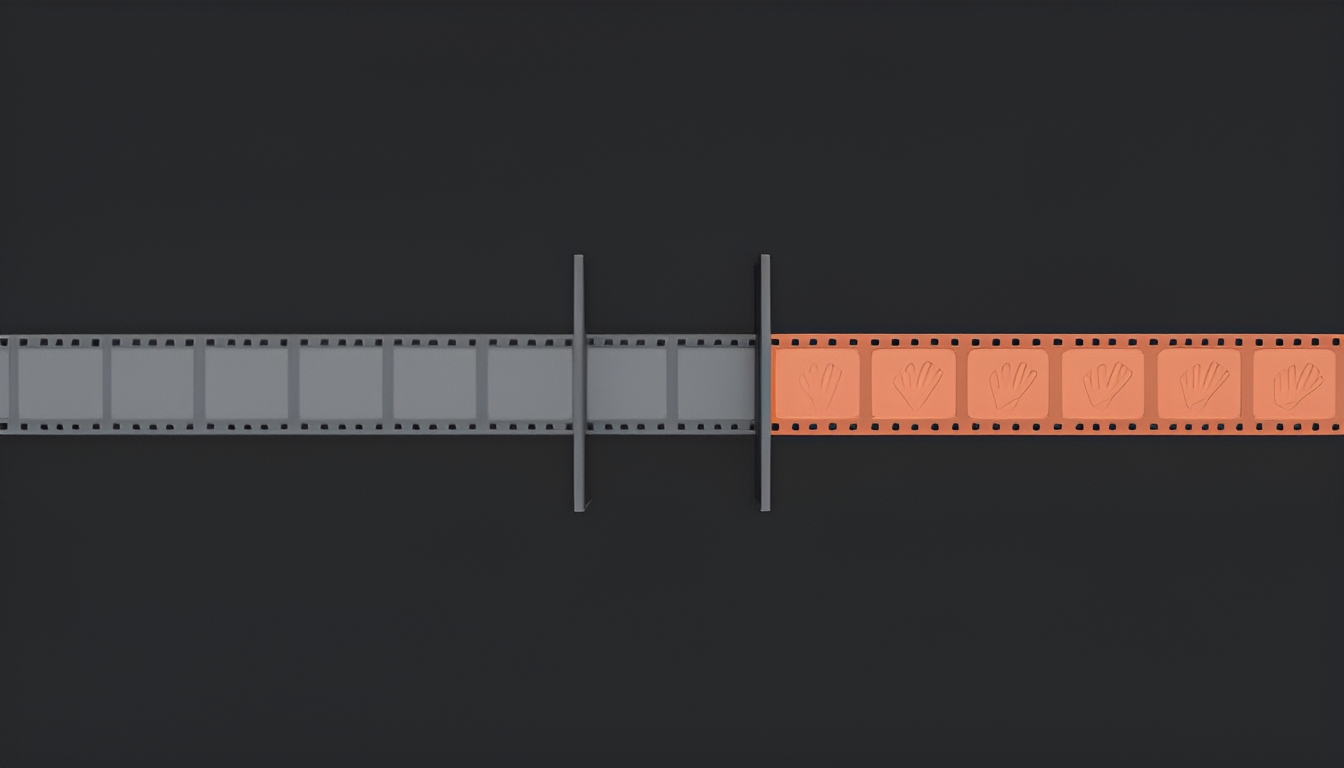
Raw Ego4D Scored Below Robot-Only Training. The 975 of 3,976 Hours With Visible Hands Beat It, and the Real Robot Tied pi0.5 at 20 vs 22 of 50.
Ego Guidance (arXiv:2611.13685, Zhejiang University, Peking University and Ant Group, 10 November 2026) co-trains a VLA on human egocentric video with no action labels. Unfiltered Ego4D underperformed the robot-only baseline; two filters that discard 75% of the hours reversed that. On a real bimanual robot the model scored 20 of 50 against 22 of 50 for pi0.5, and under visual perturbations 26 of 60 against 28 of 60, winning on one task and losing on the other.
Co-training a vision-language-action model on raw Ego4D video made it worse than training on robot data alone. Keeping only the 975 of 3,976 hours that pass a camera-motion filter and a visible-hand filter made it better. That is the curation result in Ego Guidance (arXiv:2611.13685, 10 November 2026), which uses human video with no action labels at all.
On a real bimanual robot the resulting model completed 20 of 50 trials against 22 of 50 for pi0.5. Under visual perturbations it completed 26 of 60 against 28 of 60, ahead on one task and behind on the other. The perturbation totals are our sums of the paper's Table 2.
Who built it and what the method changes
The authors are Lin Long, Tianren Ma, Zhong Chu and Di Wu (equal contribution), Maosong Cao, Qixiang Ye, Junbo Zhao and Shanghang Zhang, from Zhejiang University, University of Chinese Academy of Sciences, Nanyang Technological University, Peking University and Ant Group. The paper is CC BY 4.0.
Their architecture, SPAR (Shared Prediction on Action and Representation), puts two separately parameterised transformer stacks on a Qwen3.5-2B backbone. The action expert predicts 8-step action chunks by flow matching. The generation expert predicts the visual features of one future frame, about 0.53 seconds ahead during pretraining. Robot data trains both. Human video trains only the generation expert. At inference the generation expert is deleted, so the deployed policy costs the same as a plain VLA.
Robot pretraining data for the simulation studies is a filtered DROID subset: about 38,000 episodes, 230 hours, 66% retention. Human video is Ego4D (3,976 raw hours) and Open-AoE (arXiv:2607.14183, about 1M captioned clips, 2,000 hours). Pretraining and fine-tuning each run 20,000 steps, and results are averaged over three seeds.
What the paper gives as numbers, and what it leaves in figures
Several of the headline comparisons exist only as plotted points in v1. The table separates the two.
| Measurement | Value | Stated as | Source |
|---|---|---|---|
| Ego4D raw duration | 3,976 h | number | arXiv:2611.13685 v1, Section 3.1 |
| After Gate 1 (camera motion, optical flow) | 1,893 h (48%) | number | Section 4 |
| After Gates 1 and 2 (visible hand) | 975 h (about 25%) | number | Section 4 |
| Raw Ego4D co-training vs robot-only, LIBERO-Plus | below robot-only | figure only, value not reported | Section 4, Figure 3 |
| Both-gate clips vs robot-only, LIBERO-Plus | above at 16k and 20k steps | figure only, value not reported | Section 4, Figure 3 |
| Open-AoE scaling 0, 150, 450, 1,500 h: in-domain LIBERO | changes little | figure only, value not reported | Section 4, Figure 4a |
| Open-AoE scaling 0, 150, 450, 1,500 h: LIBERO-Plus | rises steadily | figure only, value not reported | Section 4, Figure 4a |
| Diversity at a fixed 200K clips (scene, object, interaction) | no consistent gain | figure only, value not reported | Section 4, Figure 4b |
| Prediction target SigLIP2 / Qwen-ViT / DINOv2 / Wan-VAE, LIBERO-Plus average | 76.2% / 75.6% / 74.9% / 60.0% | number | Section 3.3 |
| SigLIP2, one vs four future frames | 74.32% vs 74.62% | number | Section 3.3 |
| Real robot, five tasks, pi0.5 vs SPAR | 22/50 vs 20/50 | number | Table 1 |
| Real robot, six perturbed cells, pi0.5 vs SPAR | 28/60 vs 26/60 (derived) | our sum | Table 2 |
Three quarters of Ego4D was a net negative
The pipeline cuts Ego4D into uniform 5-second clips and applies two gates adapted from EgoSmith. Gate 1 keeps clips whose optical-flow check passes on at least 85% of sampled points with no failed run longer than 2. Gate 2 runs a YOLO hand detector and keeps clips where a valid hand box (confidence at least 0.30, 2% to 50% of the image area) shows up in at least 10% of sampled frames with no gap longer than 5 frames. One hand is enough.
Gate 1 passes 1,893 hours. Gate 2 passes 975 of those, 51.5% of the Gate 1 survivors. In total 3,001 hours are discarded. Per the paper, raw clips underperform the robot-only baseline, Gate 1 alone gives at most a small improvement, and only the clips with visible hands surpass robot-only training. Finer EgoSmith quality filters were tried and added nothing.
A locally run Qwen3.6-35B-A3B then writes one imperative sentence per clip from 15 frames, and that caption is the instruction for future-frame prediction. The human video therefore arrives with machine-written language and no human-written labels.
How unlabeled video reaches the policy
There is no hand-pose estimation, no retargeting and no pseudo-action anywhere in the method. The generation loss back-propagates through cross-attention into the language model, and the action expert is updated by robot batches only. Any benefit has to pass through the shared representation.
On the real robot it tied pi0.5, and the perturbation result split by task
Hardware is an AgileX Cobot Magic V2.0 with two 6-DoF arms and three RealSense cameras. For this evaluation the robot corpus was extended to about 8,000 hours of public datasets plus teleoperated demonstrations: 220 for Cucumber Transfer, 160 for Flower Handover, 150 for Toaster Loading, 139 for Cup Hanging and 57 for Bottle Uncapping. Each method was fine-tuned per task for 20k steps and run for 10 trials.
Per task, pi0.5 against SPAR: Cucumber 9 and 9, Flower 9 and 8, Toaster 2 and 2, Cup 1 and 0, Bottle 1 and 1. Both models mostly fail the three precise or long tasks. The authors read 40% against 44% as comparable given a smaller robot corpus and an action expert trained from scratch. With 10 trials per cell we agree it is a tie and no more than that.
The perturbation table is where a generalisation benefit should show. On Cucumber Transfer SPAR is ahead in all three perturbed settings, 22 of 30 against 18 of 30. On Flower Handover it is behind, 4 of 30 against 10 of 30, including 0 of 10 with distractor flowers. Summed, pi0.5 leads 28 to 26. The paper's text cites the Cucumber result as consistent with LIBERO-Plus and attributes the Flower result to pi0.5's bimanual action priors.
What a data buyer or builder should take from it
Hand visibility is a purchasing criterion. A dataset's headline hours overstated its usable hours here by a factor of about four (3,976 against 975), and the unusable part was harmful when included. Anyone pricing egocentric video by the hour should ask for the fraction of clips with a hand in frame and stable camera motion, measured with stated thresholds, before comparing offers. First-person capture designed around manual work clears this gate by construction; general lifelogging video does not.
More hours helped out of distribution and did nothing in distribution, across 0 to 1,500 hours of Open-AoE. Rebalancing a fixed 200K-clip budget toward more scenes, objects or interaction types did not help consistently. Our reading: at this scale, volume of hand-visible video beat curation for diversity. The values behind both claims are plotted, not tabulated, so the size of the effect cannot be checked from the text.
One number in the paper sets a noise floor that its encoder ranking does not clear. SigLIP2 with a diffusion objective and one future frame is reported at 76.2% in the target comparison and 74.32% in the separate frame-count experiment, a 1.88-point gap for nominally the same configuration. The spread between the top three targets (76.2%, 75.6%, 74.9%) is 1.3 points. We would treat SigLIP2, Qwen-ViT and DINOv2 as tied and only the Wan-VAE result (60.0%) as a finding.
What the method cannot do is in its own design: human video never supervises an action. That fits visual generalisation and does not address contact, force or grasp precision, which is where both models failed on Cup Hanging, Bottle Uncapping and Toaster Loading (4 of 30 for pi0.5, 3 of 30 for SPAR). The authors say most of their failures occur during grasping.
Check it yourself
Open https://arxiv.org/html/2611.13685v1. Section 4 has the three hour counts; Appendix B has the gate thresholds (Equations 5 and 6). Tables 1 and 2 have the real-robot counts.
Reproduce the derived figures: python3 -c "print(round(100*1893/3976), round(100*975/3976,1), round(100*975/1893,1), 3976-975, 9+8+5, 7+7+4, 2+2+0, 5+2+3, round(76.2-74.32,2), 1+1+2, 0+1+2)" prints 48 24.5 51.5 3001 22 18 4 10 1.88 4 3.
To apply the same gates to your own egocentric footage, the fields to compute per 5-second clip are flow_pass_ratio (at least 0.85), flow_max_invalid_run (at most 2), hand1_pass_ratio (at least 0.10) and hand1_max_invalid_run (at most 5), all named in Appendix B. The project page is https://llong-cs.github.io/EgoGuidance; we did not find released weights or filtered clip lists linked from v1.
What would prove this wrong
If a later version of the paper, or an independent replication by 30 June 2027, tabulates the Figure 3 values and raw Ego4D co-training is within 1 point of the visible-hand subset on LIBERO-Plus, then the filtering result is inside the 1.88-point run-to-run gap the paper itself shows and the 75% discard is not justified by the evidence.
The generalisation claim fails on real hardware if a rerun with at least 30 trials per perturbed cell shows SPAR at or below pi0.5 on Cucumber Transfer as well as Flower Handover.
Sources
- Long, Ma, Chu, Wu, Cao, Ye, Zhao and Zhang, Ego Guidance: Enhancing Robot Policy Learning with Action-Free Human Egocentric Videos, arXiv:2611.13685 (10 Nov 2026)
- arXiv:2611.13685 v1, HTML full text with Appendix B gate criteria
- Ego Guidance project page
- Li et al., Open-AoE: An Open Egocentric Manipulation Dataset and Toolchain for Embodied Learning, arXiv:2607.14183
- Fei et al., LIBERO-plus, arXiv:2510.13626
- BLO LAB, Unselected human data scored below no human data
- BLO LAB, IronMind: egocentric scaling flat to 5,000 hours, step at 10,000
- BLO LAB, LIBERO, LIBERO-Plus, SimplerEnv and RoboArena do four different jobs
Building or training robots?
We license manipulation datasets and run custom capture programs. Get in touch to see what fits.

A Closed-Form Weight Edit Took pi0.5 From 27 to 106 of 128 on a Misread Instruction, but Only When Written Into the VLM

V-JEPA 2's Predictor Adds 0.04 Top-1 Over Copying the Present on 27,000 Egocentric Trials. By Horizon, It Runs From Minus 0.05 at 1 s to Plus 0.16 at 3.5 s.
