
Ego-Exo4D-HM Fits 104.59 Hours of SMPL-H Motion to Ego-Exo4D. Three Days After the Paper, the Files Were Not Public, and the Parent Licence Names No Robot Use.
UT Austin's Ego-Exo4D-HM (arXiv:2609.30187, 24 September 2026) reconstructs full-body and hand motion for 2,649 of Ego-Exo4D's 5,035 takes, at 56.21 mm body error. On 27 September the linked code repository returned 404 and the Hugging Face dataset 401. Once it appears, what a robotics team may do with it is set by Ego-Exo4D's licence, which permits commercial use for activity understanding, 3D reconstruction and VR or AR, and does not mention robot control.
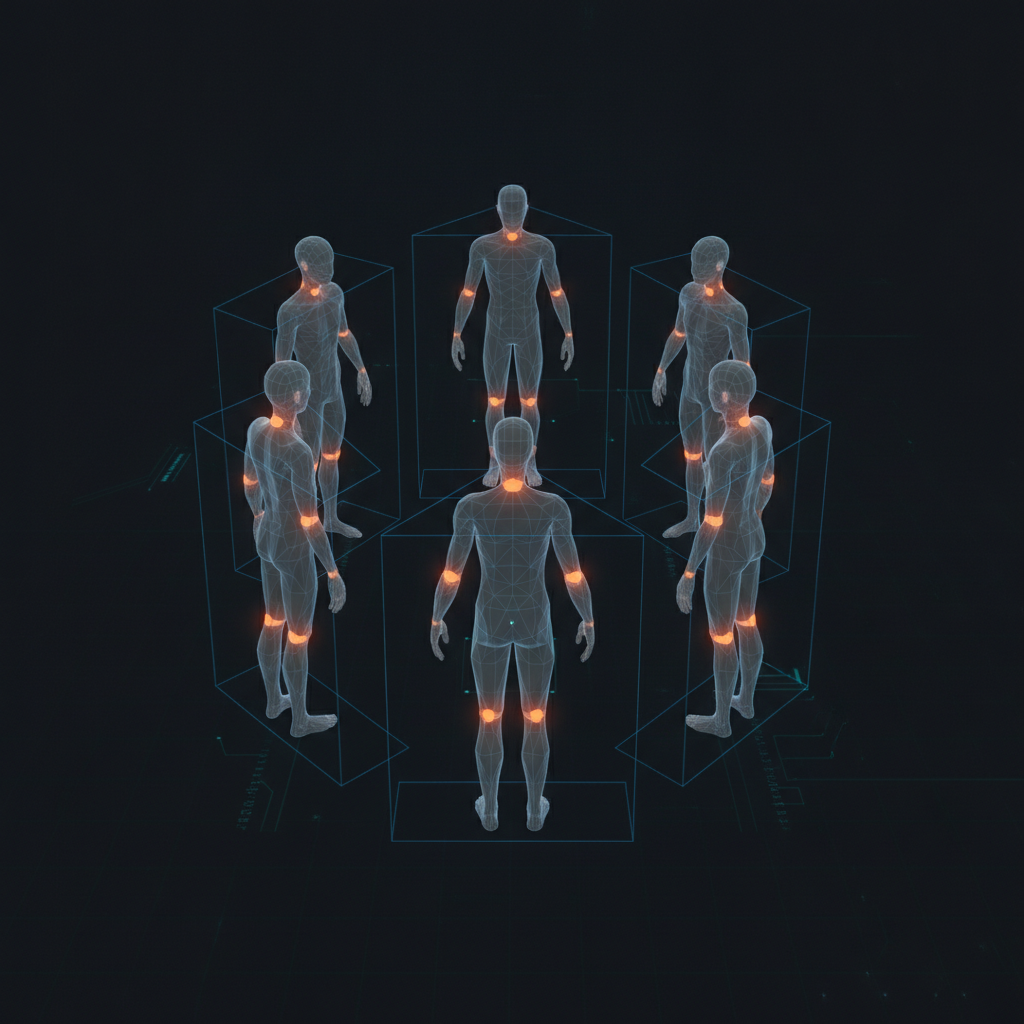
Ego-Exo4D-HM turns 2,649 takes of Meta's Ego-Exo4D into 104.59 hours of SMPL-H body and hand motion, fitted from four exocentric cameras and the wearer's Aria glasses, with a global joint error of 56.21 mm on the body and 51.59 mm on the hands. The paper is arXiv:2609.30187, posted 24 September 2026 by Abhiram Maddukuri and Georgios Pavlakos of the University of Texas at Austin. It cites humanoid whole-body controllers trained on motion capture as a motivating use.
On 27 September 2026 we could not download it. The GitHub repository the project page links returns HTTP 404, and the Hugging Face dataset it names returns 401, which Hugging Face serves for private or missing repositories. The Ego-Exo4D-HM organisation exists on Hugging Face with no public datasets. And when the files do appear, their use is governed by Ego-Exo4D's licence, whose list of permitted commercial purposes does not include training a robot.
What the release contains, according to the paper and project page
Ego-Exo4D, released by a Meta-led consortium with Carnegie Mellon University as licensor, holds 5,035 takes and 1,286.3 hours of synchronised video from 740 camera wearers in eight scenarios, in its V2 release. It ships sparse 3D body and hand keypoint annotations, not dense motion. Ego-Exo4D-HM fills that gap. For each exocentric view a Mask R-CNN detector picks out the camera wearer by projecting the head position from the Aria SLAM trajectory, ViTPose and HaMeR give 67 body and hand keypoints, each keypoint is triangulated from at least two calibrated views, and SLAHMR fits an SMPL-H body with cameras held fixed.
The authors ran the pipeline on about 3,200 takes and discarded 551 (17.1%) that failed a reprojection or triangulation-coverage check, leaving 2,649. Each take is one npz file of SMPL-H parameters, per-frame camera intrinsics and extrinsics, 3D joints and their 2D reprojections, about 48 GB in total. The project page says the pre-computed results cover 'the full Ego-Exo4D take set'; the paper's own numbers put it at 52.6% of takes. Rendering a mesh video needs the raw Ego-Exo4D download regardless, since frames are re-extracted from it.
The numbers, and the condition each holds under
| Measurement | Value | Condition | Source |
|---|---|---|---|
| Takes released | 2,649 | of about 3,200 processed; 551 filtered (17.1%) | arXiv:2609.30187 Sec. 4.1 |
| Motion hours | 104.59 h | 522.96 h of video across 4 exo views + 1 ego view | Sec. 4.1 |
| Share of Ego-Exo4D V2 | 52.6% of takes, 47.3% of ego hours, 40.7% of video hours | V2: 5,035 takes, 221.26 ego h, 1,286.3 h | BLO LAB from docs.ego-exo4d-data.org |
| Body accuracy | 56.21 mm global MPJPE | 845 takes with ground-truth body keypoints, no alignment | Sec. 4.2 |
| Hand accuracy | 51.59 mm global MPJPE | 190 takes with ground-truth hand keypoints | Sec. 4.2 |
| Keypoints per frame | 67 body and hand | ViTPose + HaMeR | Sec. 3.1 |
| Release size | about 48 GB, one npz per take | as stated | project download page |
| Code repository | HTTP 404 | github.com/Abhiram824/egoexo4d_human_meshes, 27 Sep 2026 | BLO LAB check |
| Hugging Face dataset | HTTP 401 (private or missing) | Ego-Exo4D-HM/npz-datasets, 27 Sep 2026 | BLO LAB check |
| Licence of the release | not stated | paper and project page | paper, project page |
| Parent licence, commercial use | allowed for activity understanding, 3D reconstruction, VR or AR | Ego-Exo4D licence clause on Purpose | Ego-Exo4D licence PDF |
| Per-scenario coverage of the release | not reported | paper |
About half the takes, and the hours skew away from the long cooking sessions
Take counts and hours tell different stories in Ego-Exo4D. Rock Climbing contributes 1,401 takes but 93.90 hours; Cooking contributes 678 takes and 564.13 hours, 43.9% of the video. Ego-Exo4D-HM covers 52.6% of takes but only 40.7% of video hours and 47.3% of egocentric hours, so the processed takes are shorter than average or were trimmed. Which scenarios survived is not reported, and neither is whether the 17.1% filter fell harder on some of them. For a buyer who wants hand-object manipulation (cooking, bike repair) rather than whole-body sport (basketball, climbing, soccer, dance), that split is the number that matters, and it is missing.
The accuracy figures come with their own denominator. Body error is measured on 845 takes and hand error on 190, the takes where Ego-Exo4D provides ground-truth keypoints. Those ground-truth labels are themselves annotations over the same camera views, so 56.21 mm is agreement with the parent dataset's annotation, not with a marker-based motion-capture system.
The parent licence decides what a robotics team can do with it
Access to Ego-Exo4D goes through a signed licence with Carnegie Mellon University as licensor; the project FAQ says approval takes about two days. The PDF linked from the licence page (headed 'DRAFT FOR REVIEW') defines the permitted Purpose in three parts: showing images or video in research publications; using the database to research, develop, train, evaluate or improve software 'designed to (a) detect, classify, recognize, retrieve, or understand at least one object, event, place, or activity; (b) model or reconstruct at least one three-dimensional object or environment; and (c) improve any virtual reality application or augmented reality application', each explicitly including commercial product development; and 'creating and distributing annotations'.
Two further clauses pull in different directions. The intellectual property clause lets the licensee keep models and annotations derived from the database and use them 'for academic, commercial, or noncommercial purposes'. The uses-not-permitted clause says data contained in the database 'may not appear in or be visible in any program, dataset, or product'. SMPL-H fits are plainly derived annotations. The per-frame camera intrinsics and extrinsics in each npz are the calibrated values from Ego-Exo4D, held fixed during fitting, which reads closer to database data appearing in a dataset. That is our reading, not legal advice.
Training a humanoid or a robot hand to reproduce a motion is not one of the named purposes. A policy that tracks human motion is designed to act, not to detect or understand. The IP clause could be read to permit it, since the derived annotation belongs to whoever made it. The purpose clause could be read to forbid it, since the use of the database has to fit one of the listed designs. Our judgement: a company planning to train a commercial controller on Ego-Exo4D-HM should get the licensor's answer in writing first.
What it means for anyone sourcing human motion for robots
Motion derived from a licensed dataset inherits the licence. Ego-Exo4D-HM adds no rights of its own; every user needs an Ego-Exo4D agreement to render anything, and the release states no licence of its own. A data buyer should treat 'released on Hugging Face' as a pointer to the parent terms, not as a licence grant.
Check the distribution before planning on it. Three days after posting, neither link worked from outside. That may be a gated release in preparation, which would be the careful choice given the licence. Until it is public, 104.59 hours is a number in a paper.
Ask for the scenario split. For manipulation, what matters is how many of the 2,649 takes are cooking and bike repair with hands visible to two or more cameras. The paper reports hand accuracy on 190 takes. That is the figure a manipulation team should weigh, not the 2,649.
Check it yourself
Availability, from any machine without credentials:
curl -s -o /dev/null -w '%{http_code}\n' https://github.com/Abhiram824/egoexo4d_human_meshes ; curl -s -o /dev/null -w '%{http_code}\n' https://huggingface.co/api/datasets/Ego-Exo4D-HM/npz-datasets ; curl -s 'https://huggingface.co/api/datasets?author=Ego-Exo4D-HM'
On 27 September 2026 those printed 404, 401 and an empty list []. The counts are in Section 4.1 of the paper: curl -s https://arxiv.org/html/2609.30187v1 | sed 's/<[^>]*>/ /g' | tr '\n' ' ' | tr -s ' ' | grep -o 'removing 551 takes.\{0,200\}' returns the 17.1% filter, 2,649 takes, 104.59 hours and 522.96 hours.
Ego-Exo4D V2 totals (5,035 takes, 1,286.30 video hours, 221.26 ego hours) are on the first page of docs.ego-exo4d-data.org; the scenario table is on ego-exo4d-data.org. The licence text: download http://ego4d.github.io/pdfs/Ego-Exo4D-Model-License.pdf (linked from ego4ddataset.com/egoexo-license) and search for 'Purpose' and 'USES NOT PERMITTED'. Coverage shares: python3 -c "print(2649/5035, 104.59/221.26, 522.96/1286.3)".
What would prove this wrong
Two claims can fail. First, that the release was not publicly reachable on 27 September 2026; a public commit or dataset creation date before that day on either host would disprove it.
Second, a prediction: when Ego-Exo4D-HM becomes downloadable, it will be gated behind proof of an Ego-Exo4D licence rather than published under an open licence such as CC BY. If by 31 December 2026 the dataset is downloadable without an Ego-Exo4D agreement, or its card grants commercial robot-training rights on its own terms, we were wrong about how the parent licence constrains it.
Sources
- Maddukuri, Pavlakos (UT Austin), Ego-Exo4D Human Meshes Dataset: 4D Human Motion Reconstruction for Ego-Exo Captures, arXiv:2609.30187, 24 September 2026
- Ego-Exo4D-HM project page and download instructions
- Grauman et al., Ego-Exo4D: Understanding Skilled Human Activity from First- and Third-Person Perspectives
- Ego-Exo4D site: scenario table, 5,035 takes, 1,286.3 hours, licence FAQ
- Ego-Exo4D documentation, V2 release totals
- Ego-Exo4D licence agreement PDF (Carnegie Mellon University, licensor)
- Ego4D (@ego4d954), Ego-Exo4D Dataset and Benchmark Suite, 30 November 2023
Building or training robots?
We license manipulation datasets and run custom capture programs. Get in touch to see what fits.

A Closed-Form Weight Edit Took pi0.5 From 27 to 106 of 128 on a Misread Instruction, but Only When Written Into the VLM

V-JEPA 2's Predictor Adds 0.04 Top-1 Over Copying the Present on 27,000 Egocentric Trials. By Horizon, It Runs From Minus 0.05 at 1 s to Plus 0.16 at 3.5 s.
