
DexRoam's Headset Demos Took GR00T From 29% to 56% on a Mobile Two-Handed Robot. Mis-Timed, the Same Human Data Scored 20% Where Robot-Only Scored 50%.
HKUST, BAAI and Peking University (arXiv:2609.35761, 28 September 2026) captured whole-body human demonstrations with a Meta Quest 3 and a ZED Mini, no trackers, and co-trained VLAs on an Astribot with XHands. The gain depends on alignment: absolute poses scored 0%, skipping temporal resampling cost 24 points, zero robot demos scored 0%. The public release is 50 robot episodes of one task and no human data.
Whole-body human demonstrations recorded with a consumer VR headset and a clip-on stereo camera raised GR00T N1.7's average success on five mobile two-handed tasks from 29% to 56%, and pi0.5's from 32% to 57%. That is DexRoam, arXiv:2609.35761, posted 28 September 2026 by HKUST, the Beijing Academy of Artificial Intelligence and Peking University. Each task is 20 real trials on an Astribot mobile base with two XHand hands.
The same paper shows what the human data is worth without its processing. With actions kept as absolute poses, every ablated cell scored 0%. Without task-progress resampling, the best strategy scored 20% on Pick Chips Can, below the 50% a robot-only policy reached on that task. With no robot demonstrations at all, success was 0% on every task.
What the DexRoam team released on 28 September
Rui Zhou, Yibo Yuan and Junkai Zhao (equal contribution), with Fangyuan Zhao, Xiaoguang Zhao, Shanghang Zhang and Sirui Han, describe two capture rigs. Robot demonstrations come from single-operator whole-body teleoperation: a Meta Quest 3S for the upper body, VR controllers for wrist poses and MANUS Pro gloves for the fingers. Human demonstrations use only a Meta Quest 3, read through WebXR for head pose, 33 body joints and 25 joints per hand, plus a head-mounted ZED Mini recording stereo RGB at about 30 Hz. The ZED stream is shown inside the headset, so the demonstrator sees what the policy will see.
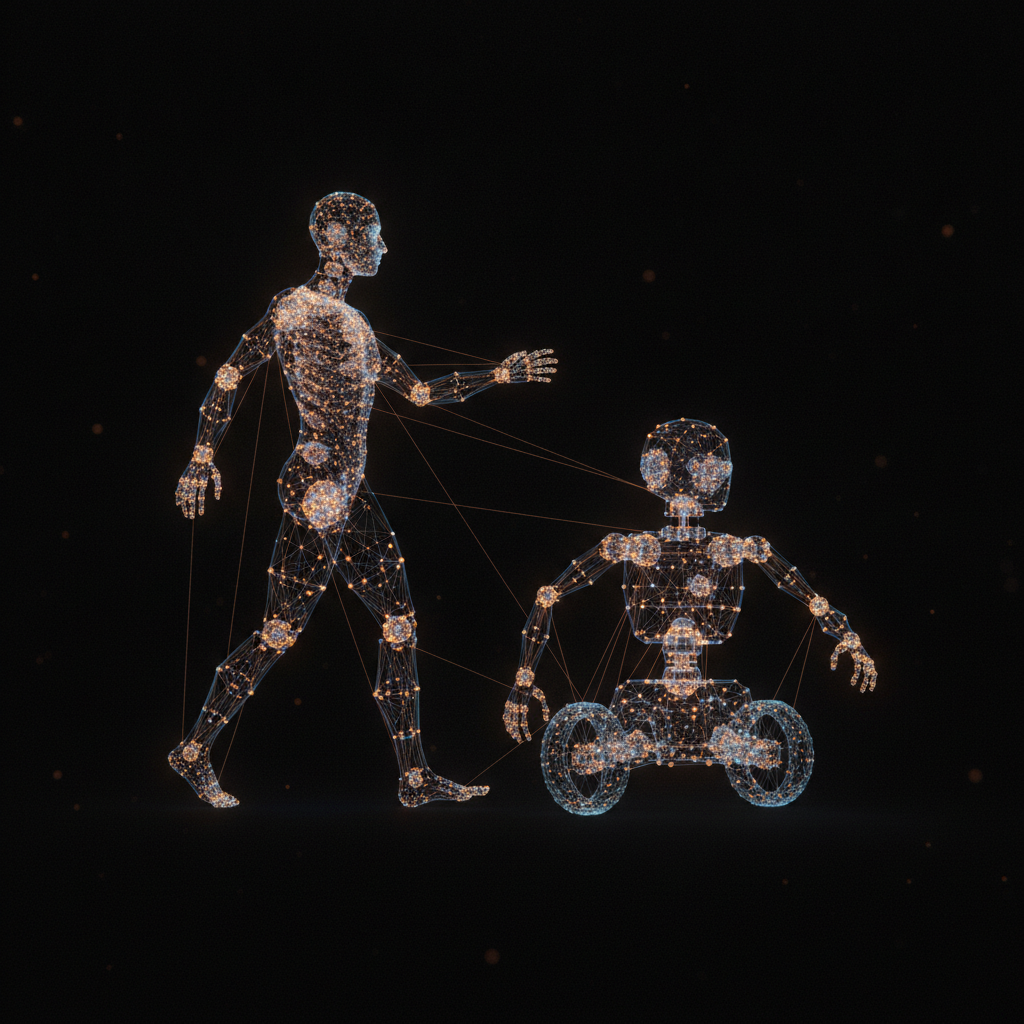
Three alignment stages map that motion onto the robot: root-centric retargeting for the body, robot-centric relative actions for the control interface, and resampling on task progress because humans finish the same task in fewer steps. The capture and alignment code (github.com/zhourui9813/DexRoam) and the policy training code went public on 29 September under MIT. The Hugging Face dataset, created 20 September, holds one task.
The numbers, and what is and is not public
The headset-only rig held up against a tracked one. On the same 15 trajectories, dropping the five PICO Motion Trackers changed torso error from 13.16 to 12.54 mm and right-arm error from 5.63 to 6.30 mm. For a collection budget, that removes the body-worn trackers from the bill of materials at a cost of well under a millimetre on the arms.
| Measurement | Value | Source |
|---|---|---|
| Average success, GR00T N1.7: robot-only vs best human strategy | 29% vs 56% | arXiv:2609.35761 abstract, Sec. IV-C |
| Average success, pi0.5: robot-only vs best human strategy | 32% vs 57% | Sec. IV-C |
| Trials per task and setting | 20 | Sec. IV-A2 |
| Robot demos needed to match 50-demo robot-only, GR00T, with 50 human demos | 25 (3 tasks) | Sec. IV-D1, Fig. 8 |
| Success with 50 human demos and 0 robot demos | 0% on every task | Sec. IV-D2 |
| Absolute actions instead of relative (6 cells) | 0% in all 6 | Table III |
| No temporal resampling, 6-cell mean | 44.2% vs 68.3% | Table III |
| Replay of 15 transferred human trajectories | 15/15, no IK failures | Table I |
| Torso / right-arm replay error, headset only | 12.54 mm / 6.30 mm | Table II |
| Same, PICO headset + five Motion Trackers | 13.16 mm / 5.63 mm | Table II |
| Human demo duration or collection time | not reported | paper |
| Hugging Face release | 50 robot episodes, Push Chair & Close Laptop only, 37,422 frames, about 20.7 min, about 227.3 GiB | dataset README, checked 30 Sep 2026 |
| Human demonstrations released | none | dataset file list, checked 30 Sep 2026 |
| Dataset licence | not stated (code is MIT) | dataset card, GitHub LICENSE |
How the human motion becomes a robot action
Mis-timed human data scored below no human data
Table III is the part of the paper a buyer of human demonstrations should read first. It holds the human data fixed and removes one processing stage at a time, on Pick Chips Can and Throw Trash, for three training strategies.
Absolute poses fail completely, 0 of 20 in all six cells. The authors' explanation is compounding error: the first action chunk looks plausible, but its bias toward the demonstrator's own configuration pushes the next observation off the robot distribution. Removing only the temporal stage is subtler. The mean falls 24.1 points, and on Pick Chips Can the strategy that works best with alignment, Human Pretrain + Cotrain FT, drops from 90% to 20%.
That 20% is 4 of 20, against 10 of 20 for robot-only training on the same task. By our Fisher exact test the difference is p = 0.10, so this is one cell and not a proven harm. The direction matches what earlier BLO LAB notes found in other papers: a human-data gain belongs to the pipeline that uses the data, not to the data itself.
Which way of adding the human data mattered
All three strategies beat robot-only on both backbones. Pretraining on human data and then fine-tuning on robot data alone was the weakest on GR00T (+13 points) and, in the data-efficiency sweep, the least stable as robot demos were added. Keeping human data in the fine-tuning mix was best or tied-best on every task and backbone. The distribution-shift test on Pick Chips Can points the same way: a new background took robot-only from 50% to 20% and the best human strategy from 90% to 55%.
The side-grasp is the one qualitative example the paper gives of human data adding a behaviour. Robot-only policies approached the chips can from the front and knocked it over when it was rotated; with human data the policy sometimes took a side approach that appears in the human recordings and not in the robot ones.
What this means for anyone collecting whole-body human data
The capture side is cheap: a Quest 3, a ZED Mini, a 3D-printed mount whose files are in the repository, and a laptop. The expensive part is the alignment code and the robot data it needs. Zero robot demos gave zero success, and 25 robot demos were still needed to match 50 on GR00T. On this evidence a human demo substitutes for about half a robot demo per task at these budgets, not for the robot demos themselves.
Delivery specification matters as much as capture. A dataset delivered as absolute human poses would have scored 0% in this pipeline. A buyer should ask for the timing needed to resample on task progress (per-frame timestamps and task-phase or completion markers) and the root-frame convention, not only the joint streams.
The release does not yet let anyone check the headline. The public data is 50 robot episodes of the one task not used in the ablation, the README calls it an integration example, and the card carries no licence. Judgement: until the human demonstrations are released, the 29% to 56% result is reproducible only by recollecting the human data with the published rig.
Teaching dexterous mobile robots from human demonstrations
The first author's video shows the tracker-free capture rig in use and the five real-robot tasks, including the side-approach grasp on the chips can. It is the paper's own footage, uploaded the day the paper was posted.
Check it yourself
What the dataset actually contains:
curl -s https://huggingface.co/api/datasets/zhourui9813/DexRoam_Realworld_Data | python3 -c 'import json,sys; d=json.load(sys.stdin); print(d["createdAt"], d.get("cardData")); print(sorted({s["rfilename"].split("/")[1] for s in d["siblings"] if "/" in s["rfilename"]}))'
That prints a creation date of 2026-09-20, a card with tags and no license key, and a single folder, robot_push_chair_and_close_laptop. The README at https://huggingface.co/datasets/zhourui9813/DexRoam_Realworld_Data lists 50 episodes, 37,422 frames and about 20.7 minutes.
The p-values: python3 -c 'from scipy.stats import fisher_exact as f; print(f([[4,16],[10,10]])[1], f([[0,20],[10,10]])[1])' prints about 0.096 and 0.0004. Counts are Table III and Sec. IV-F percentages times 20 trials.
Tables I to III, Sec. IV-D and IV-F, and the capture timing in Appendix A are in https://arxiv.org/html/2609.35761v1. The capture code is https://github.com/zhourui9813/DexRoam (MIT, created 29 September 2026).
What would prove this wrong
Our claim: DexRoam's gain is conditional on its alignment stages and on robot data, and the public release cannot yet reproduce it.
It is wrong if, by 31 March 2027, the authors or another group release DexRoam human demonstrations for at least three of the five tasks and a retraining shows the full method within 10 points of the reported 56% GR00T average, and a rerun without temporal resampling shows no task below robot-only. We expect the release to reproduce the headline within 10 points, and the no-resampling arm to fall below robot-only on at least one task again.
Sources
- Zhou, Yuan, Zhao, Zhao, Zhao, Zhang, Han (HKUST, BAAI, Peking University, Beihang, CASIA), DexRoam: Learning Mobile Bimanual Dexterous Manipulation from Egocentric Whole-Body Human Demonstrations, arXiv:2609.35761, 28 September 2026
- arXiv HTML render: Tables I to III, Sec. IV, Appendices A and D
- DexRoam project page
- DexRoam capture and alignment code, MIT
- DexRoam policy training code, MIT
- DexRoam Real-World Data on Hugging Face, 50 robot episodes (checked 30 September 2026)
- Rui Zhou, Teaching Dexterous Mobile Robots from Human Demonstrations, YouTube, 28 September 2026
- BLO LAB, touchless human demos carried the Lego result in VisTacAlign
Building or training robots?
We license manipulation datasets and run custom capture programs. Get in touch to see what fits.

A Closed-Form Weight Edit Took pi0.5 From 27 to 106 of 128 on a Misread Instruction, but Only When Written Into the VLM

V-JEPA 2's Predictor Adds 0.04 Top-1 Over Copying the Present on 27,000 Egocentric Trials. By Horizon, It Runs From Minus 0.05 at 1 s to Plus 0.16 at 3.5 s.
