
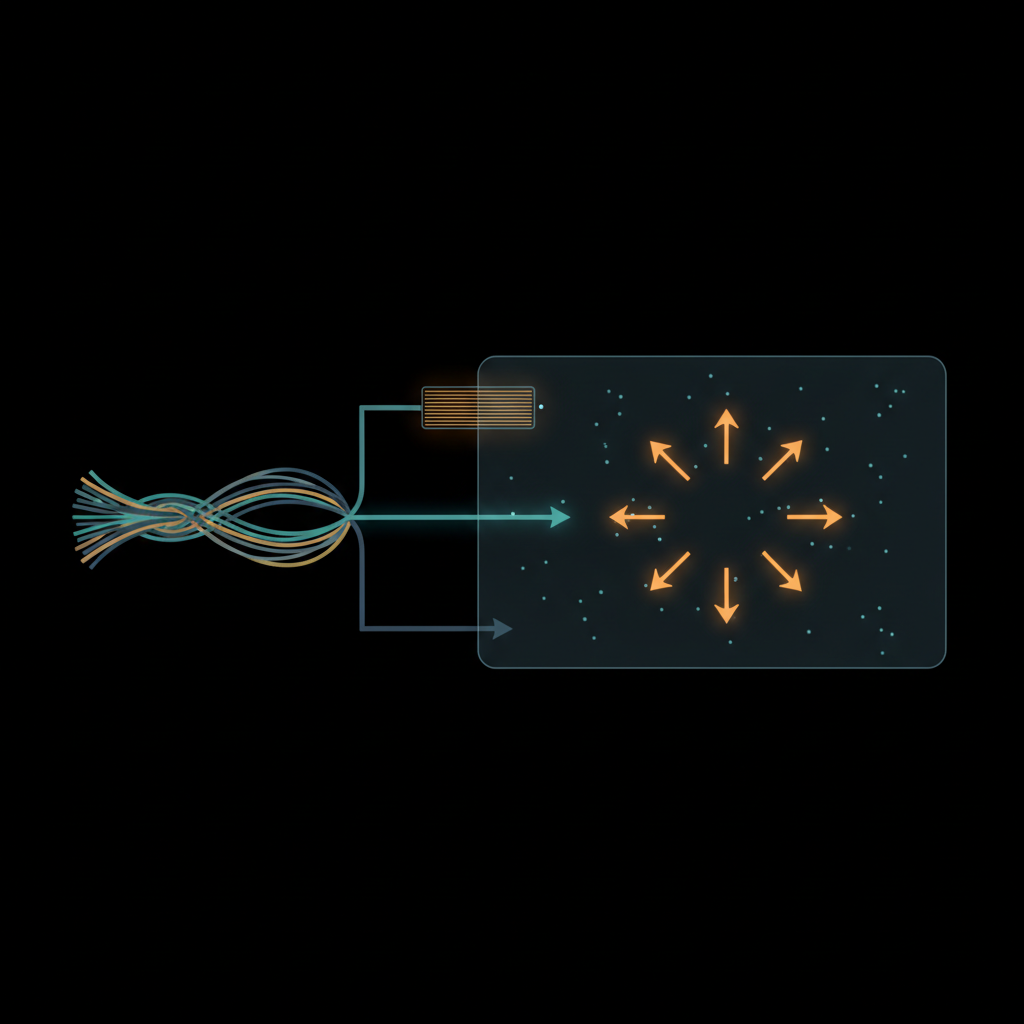
The Same Contact Data Was Worth -5.7 Points in the State Vector and +15.7 in the Image
Visible Touch renders contact as an overlay on the RGB frames a policy already reads. On LIBERO, the same contact signal concatenated to the proprioception state instead scored 5.7 points below having no contact signal at all, on every suite. In the real-world evaluation, a condition that renders geometric markers with the contact information stripped out recovers 16 of the 19 trials the full overlay gains on one pick stage. Delivery, not content, is doing most of the work.
A BC-Transformer given a 12-dimensional contact wrench concatenated to its proprioception state scored below the plain RGB baseline on every LIBERO suite, 5.7 percentage points worse on average. The identical contact measurements, rendered as arrows composited onto the same RGB frames, scored 15.7 points above that baseline in the 2-view setting and 33.7 points above it on LIBERO_LONG. The paper is Visible Touch, arXiv:2609.14156, posted 12 September 2026 by Metin Alp Dogan, Edward Sun, Feng Xu and colleagues at UCLA, released under CC BY 4.0.
That is a 21.4 point spread between two ways of handing a policy the same numbers. It is the single most useful result of the month for anyone assembling contact data, because it says the format contract matters more than the sensor spec, and most tactile datasets ship the format that lost.
Where the contact signal lands, and what each landing site is worth
The overlay is geometric, not symbolic. Each sensing element has a known pose on the finger, so its contact vector is projected through the kinematic chain into the camera frame and drawn at the image location where the contact physically is. Three variants span a granularity spectrum: Multi-arrows draws one arrow per taxel, Avg. Arrow aggregates per finger and draws one arrow at the projected finger centre, and Binbars collapses each finger to a magnitude bar at a fixed image position. Left finger renders cyan and blue, right finger magenta and red, so finger identity survives from colour alone. No architectural change is required, which is the point: any image-conditioned policy consumes it.
The comparison conditions are what make the paper worth reading rather than the method. Proprio concatenates an aggregated 12-D contact wrench to the state. Tac-View renders the same per-taxel arrows into a spare camera slot as a separate image, which is how vision-based tactile sensors are normally integrated. Position-Only renders the projected markers with the contact information removed entirely. Binary Contact (1x) and (9x) keep occurrence and throw away direction and magnitude.
The LIBERO numbers, suite by suite
The gain is not uniform and the paper says where it concentrates. Per-task improvement across the 40 LIBERO tasks correlates with task headroom at r = 0.924, p < 0.001, so overlays help most where vision-only performance is lowest. After controlling for headroom, two properties keep independent predictive power: contact-event count at r = -0.571, p < 0.001, and trajectory length at r = -0.368, p = 0.019. Bucketed by gripper-close events, multi-grasp tasks (n = 7) gain 43.3 points while tasks with no grasps gain nothing. The same structure replicates on miniVLA across 90 tasks: 1-grasp tasks (n = 78) gain 17 points, 2-or-more-grasp tasks (n = 4) gain 23.8.
| Condition | What the policy receives | LIBERO result | Change vs plain | Source |
|---|---|---|---|---|
| Plain, 2-view | RGB agentview + wrist, 8-D proprioception | baseline | 0 | arXiv:2609.14156 Fig. 3 |
| Proprio, 2-view | Plain plus a 12-D contact wrench in the state vector | below plain on every suite | -5.7 pp avg | arXiv:2609.14156 Sec. 4.1 |
| Wrist camera added to plain, no overlay | a second RGB view, no contact | helps on average, hurts on OBJECT | +4.1 pp avg, -7.9 pp OBJECT | arXiv:2609.14156 Sec. 4.1 |
| Visible Touch, 1-view | Plain plus the overlay, no wrist camera | above plain on every suite | +12.5 pp avg | arXiv:2609.14156 Sec. 4.1 |
| Visible Touch, 2-view | Plain plus the overlay | above plain on every suite | +15.7 pp avg, +33.7 pp LONG | arXiv:2609.14156 Sec. 4.1 |
| miniVLA pretrained on LIBERO_90 with overlays | Qwen2.5 0.5B, DINOv2 + SigLIP, 224 px | 63.2% vs 48.3% released checkpoint | +14.9 pp, 90 tasks x 20 trials | arXiv:2609.14156 Table 1 |
| miniVLA fine-tuned with overlays | per-suite fine-tuning, 5 seeds | 76.2% vs 50.9% baseline average | +25.3 pp avg, +34.1 pp LONG | arXiv:2609.14156 Table 1 |
| pi-0.5 (pi05_droid, 2.3B) LoRA, real robot | two camera views, overlays applied post-hoc | macro-averaged across four tasks | +30.3 pp | arXiv:2609.14156 Sec. 4.2 |
The row that should worry anyone selling tactile data
Position-Only draws the projected markers and deletes the contact reading. It is the condition that tells you how much of the benefit is touch and how much is geometric registration, and on the hardest real-world stages the answer is uncomfortable. On Transfer Tube Pick, the baseline scores 5 of 30 and the full Multi-arrows overlay scores 24 of 30. Position-Only, carrying no contact information at all, scores 21. Sixteen of the nineteen trials gained are available from drawing a dot where the finger is.
On Transfer Tube Insert the picture reverses and touch earns its keep: baseline 0 of 30, Position-Only 7, Multi-arrows 16. Tac-View, which carries the full per-taxel contact vectors but in a separate image, scores 0. The information was present and the policy could not use it.
So the honest decomposition of the headline +30.3 points is three effects stacked: end-effector localisation, which needs no sensor; contact occurrence, which needs a cheap binary sensor; and contact direction and magnitude, which need the real thing. The paper separates all three and finds each contributes, with direction and magnitude mattering most on the spatially complex stages. Nobody selling a tactile corpus is separating them.
Optimal granularity reverses between simulation and hardware
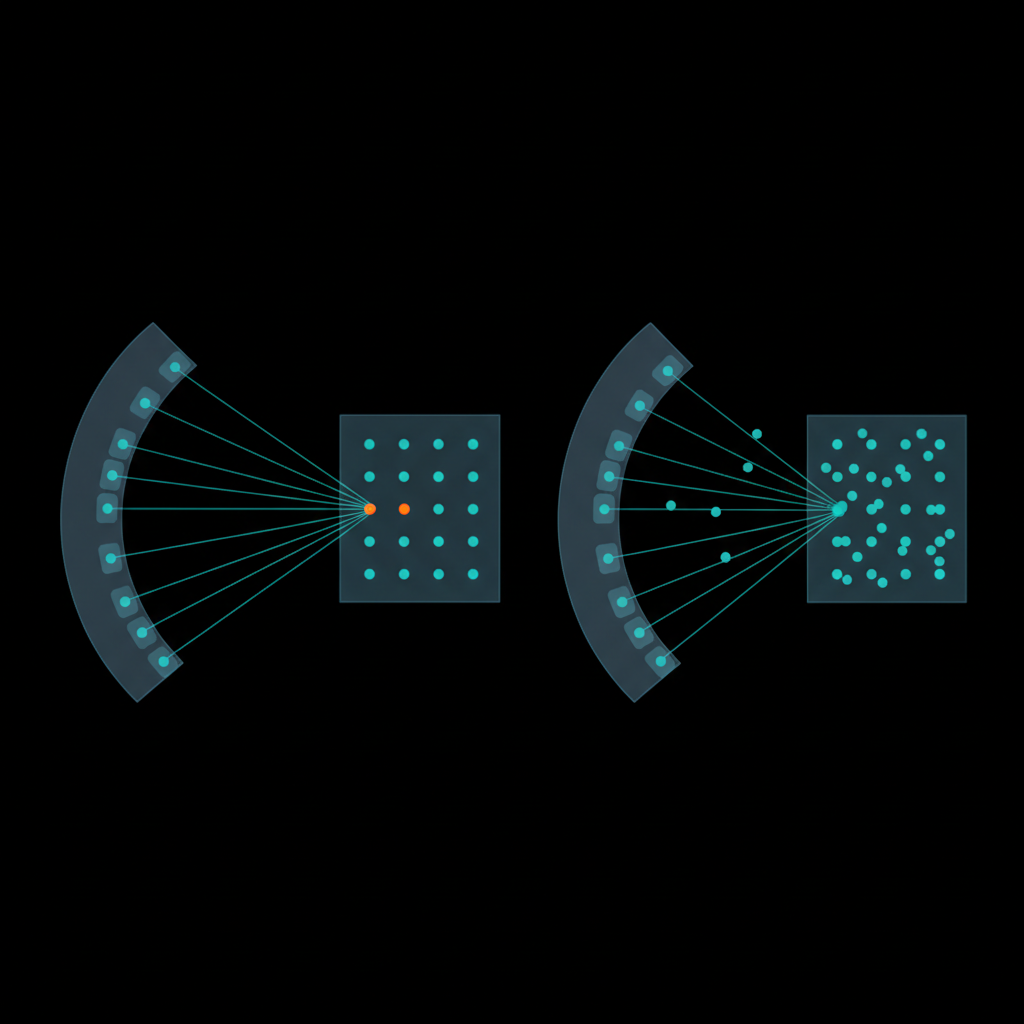
In simulation, the per-finger average beats the per-taxel rendering: Avg. Arrow averages 92.5% across suites against 88.1% for Multi-arrows, with the largest deficit on LIBERO_LONG at 10.3 points. On the real robot, Multi-arrows is strongest in every column. The authors attribute the reversal to spatial stability rather than to resolution. MuJoCo contacts arise anywhere on the finger collision mesh, so per-contact arrows land at inconsistent image positions across timesteps; on hardware the signals arrive at fixed taxel positions on the gripper's inner surface, so the same rendering carries stable structure that the per-finger average throws away.
For a data specification that inverts the usual shopping list. Taxel count is not the variable; the stability of the mapping from taxel index to a fixed physical position is. A sensor with nine taxels at known, repeatable locations is worth more to this pipeline than a denser array whose readings cannot be tied to a consistent point on the finger. The same logic says a simulator-derived tactile corpus and a hardware-derived one are not interchangeable even when both are dense, because the spatial consistency of the signal differs in kind.
Reproducibility is unusually good here. The sensor is a 3x3 magnetic array, bill of materials under $50, split into a $3.62 consumable silicone pad and about $41 of reusable electronics: an Allegro A31031 magnetometer PCB, an ESP32-based microcontroller and a flat flex cable. Fabrication takes about 48 hours of elapsed time, dominated by elastomer curing. Four units built independently from the same parametric molds show trial-to-trial standard deviation of 10 to 30 microtesla and monotonic response across the full 0 to 1.6 mm indentation range, characterised in 0.1 mm steps with 20 repeats against a BOTA six-axis force-torque reference.
What this changes for a contact dataset
Ship the geometry with the signal, or the signal is unusable. Every result above depends on knowing where each sensing element sits on the finger and where the finger is in the camera frame at every timestep. A tactile stream without the sensor-to-link transform, the link-to-camera extrinsics and the per-timestep kinematics cannot be rendered into image space at all, which means it can only be delivered through the channel that lost by 21.4 points.
Log raw and render late. The real-world evaluation collected 100 teleoperated demonstrations per task and applied every overlay variant post-hoc, so all eight conditions train on the same underlying data. That is the only reason the comparison is clean, and it is a data-collection decision, not a modelling one. A corpus that bakes a visualisation into the frames cannot be re-rendered when the optimal granularity turns out to be different on your hardware, which this paper shows it will be.
Do not calibrate flux to newtons if you do not have to. The pipeline feeds baseline-subtracted magnetic flux straight in, with no per-sensor calibration, and tolerates roughly 20% unit-to-unit variation in absolute response. A dataset that insists on calibrated newtons buys a maintenance obligation, per-unit recalibration on every replacement, that this particular consumer does not need. That cuts against the GIFT pipeline's argument on the same day, where the newton was the whole interface. The difference is that GIFT's two instruments never touch each other, and here one sensor feeds one policy.
Our judgement on the weakest part: the Proprio comparison tests one specific state-vector integration, a raw concatenation with no learned encoder, and the authors say so. A learned tactile encoder might close part of the 21.4 point gap. The direction of the finding has survived two architectures, three vision encoder families and a real robot, so we expect it holds; the size of it is one implementation's number.
Check it yourself
The per-sub-task counts are in the appendix, not the figures, and they are what the argument rests on. Pull Table 15 and read the Position-Only row against the Multi-arrows row:
curl -s https://arxiv.org/html/2609.14156v1 | python3 -c 'import sys,re,html; t=re.sub(r"<[^>]+>"," ",sys.stdin.read()); print(html.unescape(re.sub(r"\s+"," ",t)))' | grep -o 'Table 15.\{0,1600\}'
To reproduce the simulation side you need no tactile hardware at all. LIBERO exposes no native tactile observation, so the paper extracts per-contact force vectors straight from the MuJoCo contact array, filtered to gripper-finger geometries, and renders them. That means the delivery-channel comparison is runnable today against LIBERO with a stock BC-Transformer: train Plain, Proprio and overlay conditions on the same episodes and check whether your Proprio run also lands below Plain.
The real-world side needs the sensor, which is documented to the bill of materials: XP-565 silicone at 10:1 base to activator, nine neodymium magnets at 2 mm diameter by 1 mm, an Allegro A31031 3x3 magnetometer PCB, three PLA molds from a parametric CAD pipeline. Under $50 assembled. The robot is a UFactory xArm7 with a parallel-jaw gripper and two Intel RealSense D435 cameras.
What would prove this wrong
The claim we are making is stronger than the paper's: that delivery format, not sensor quality, is the binding constraint on the value of a contact dataset today. The clean test is the one the authors list as a limitation.
Falsifiable, with a date: by 31 March 2027, if anyone trains a BC-Transformer on LIBERO 2-view with the same 12-D contact wrench fed through a learned tactile encoder rather than raw concatenation, and reaches within 5 points of the Visible Touch overlay average across the four suites, then the gap is an encoder problem and not a delivery problem, and a state-vector contact stream is fine as long as you encode it. If that run still lands below the plain RGB baseline, the format contract is the whole story and every tactile corpus shipped as a side-channel array is underselling itself.
A second date, on the granularity reversal: by 31 December 2027, a replication on a second gripper with a different taxel layout should show Multi-arrows beating Avg. Arrow on hardware again, if the explanation is spatial stability. If the ordering flips with the layout, the reversal is about this specific 3x3 geometry and the specification advice above is premature.
Sources
- Dogan, Sun, Xu, Wu, Peng, Hong, Cui, Visible Touch: Rendering Contact for Visuomotor Policies, arXiv:2609.14156, 12 September 2026, CC BY 4.0
- arXiv HTML render, Tables 1, 2, 3 and 15, Figures 3, 4 and 7, Sections 4.1 to 4.2 and Appendix B
- LIBERO, the benchmark and the MuJoCo contact array the overlays are rendered from
- miniVLA, the pretrained checkpoint the overlay-pretrained model is compared against
- AnySkin: Plug-and-play Skin Sensing for Robotic Touch, the magnetic-skin line this sensor design sits in
- BLO LAB, why a force channel needs its geometry shipped with it
Building or training robots?
We license manipulation datasets and run custom capture programs. Get in touch to see what fits.

A Closed-Form Weight Edit Took pi0.5 From 27 to 106 of 128 on a Misread Instruction, but Only When Written Into the VLM

V-JEPA 2's Predictor Adds 0.04 Top-1 Over Copying the Present on 27,000 Egocentric Trials. By Horizon, It Runs From Minus 0.05 at 1 s to Plus 0.16 at 3.5 s.
