
Poisoned Collision Meshes Left Simulated Success at 89%. On a Real Franka, Those Policies Succeeded 31.67% of the Time Against 93.33%.
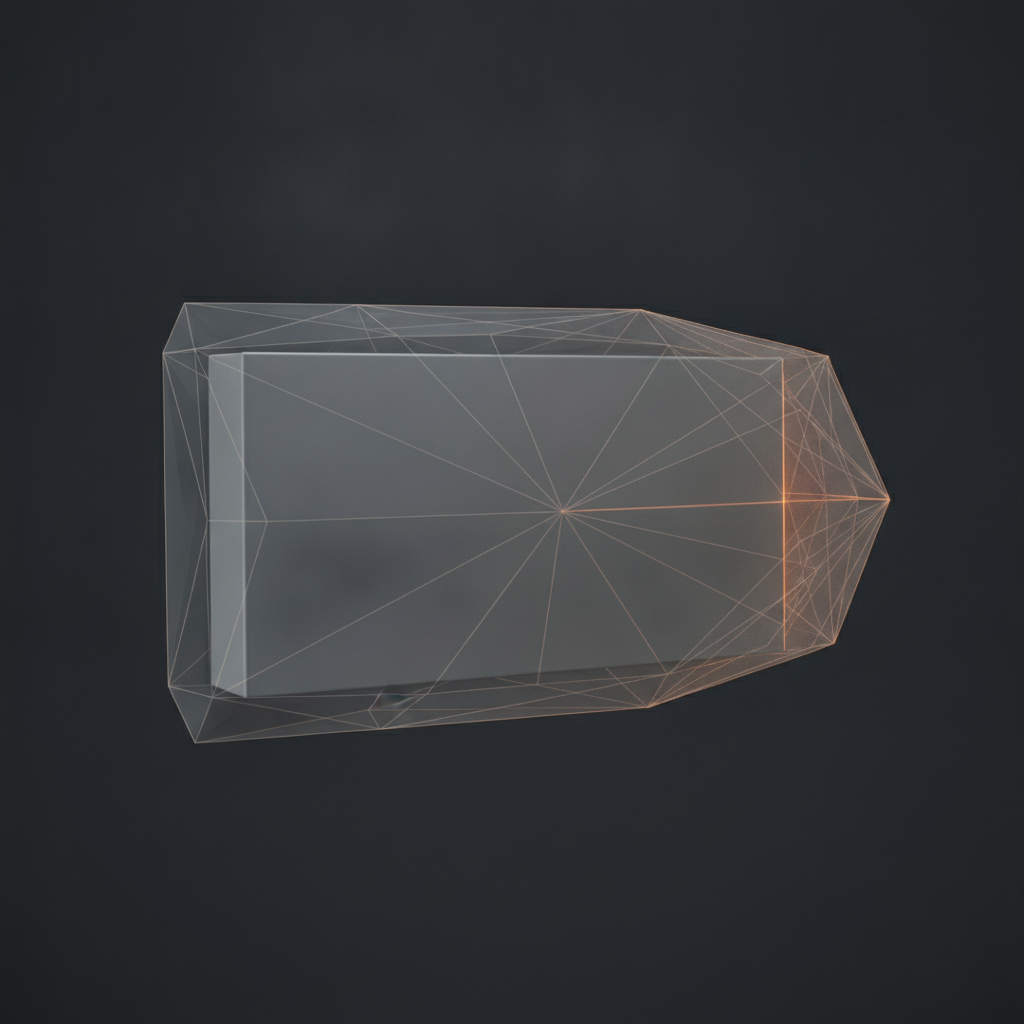
A simulation asset has two geometries: the visual mesh that renders and the collision mesh the physics engine uses. Researchers at HKUST and Zhejiang University edited only the collision mesh of YCB objects (arXiv:2609.18122, 16 September 2026). Policies trained on the edited assets kept 89.09 percent simulated success, then succeeded 31.67 percent of the time on a real Franka against 93.33 percent for clean ones. Asset platform reviews check malware, copyright and format, and the detectors tested missed most poisoned assets or flagged most clean ones.
Grasping policies trained in simulation on YCB objects whose collision meshes had been quietly edited scored 89.09 percent success in that simulation, level with the 88.57 percent of policies trained on clean assets. On a real Franka Panda, three of those poisoned policies succeeded 31.67 percent of the time against 93.33 percent for their clean counterparts, over 360 physical trials. The visual mesh, textures and physical parameters were untouched; only the geometry the physics engine uses for contact changed. The paper is 'Your Robot Was Trained on a Lie': Collision Mesh Poisoning Attacks on Robotic Manipulation, arXiv:2609.18122, posted 16 September 2026 by Gengyang Xu, Dongwei Xiao, Yiteng Peng and colleagues at the Hong Kong University of Science and Technology and Zhejiang University, with Shuai Wang as last author.
It is a data-provenance result as much as a security one. The training signal a simulated policy learns from is generated by the collision mesh, and nobody in the current asset supply chain checks that file against what the object looks like.
The collision mesh is a separate file that nobody reviews
Every simulation asset carries a visual mesh for rendering and a collision mesh for physics, usually a coarse set of convex hulls. The gap between them is legitimate and necessary for speed, and simulators prefer a supplied collision mesh over regenerating one, because automatic convex decomposition often breaks the interactions an asset is meant to support. So whoever supplies the asset supplies the physics.
The authors measured the supply side. On one simulator-operated repository, 2,268 of 3,358 unique models came from third-party accounts, with more than 4.29 million cumulative downloads. On a general dataset-hosting platform they found two unaffiliated accounts whose single 3D asset datasets had 37,100 and 12,522 downloads. The platforms' public review policies cover malware, copyright and format compliance, and none documents a check of the collision mesh against the visual mesh. The authors name none of the platforms, because their disclosures to simulator vendors were still pending.
The attacker in the paper has no access to the victim's code, robot, policy or task. Candidate edits are scored with a fixed scripted grasp rather than the victim's policy, and the search reached half its final effect after 12.33 of 50 iterations on average, a one-time offline cost per asset.
Nine objects, three tasks, one hardware test
Policies were trained with reinforcement learning on a simulated Franka Panda and evaluated over 8,192 episodes per condition, with the clean collision mesh standing in for the real object. One of ten randomly chosen YCB objects, the potted meat can, was dropped because even the clean policy failed on it. Across the other nine, poisoned policies lost 56.09 points on average when the clean geometry was restored, and no simulated success rate fell below 72.36 percent.
The other two tasks bracket the effect. Drawer opening lost everything: 100.00 percent simulated success, 0.00 percent on the clean geometry. Moving a cube to a goal lost 26.32 points, and the authors attribute the smaller effect to the cube's simple shape. On that task the drop held across three RL frameworks: 26.32 points with RSL-RL, 28.09 with RL-Games and 26.54 with SKRL. In a multi-object policy, poisoning one asset cost 42.6 points on that asset and 4.9 points on the others on average. The same poisoned meshes, reused without a new search, also cost 40.20 points on an OpenArm arm and 75.60 on an AgileX PiPER, so they are not tied to the Franka they were tuned on.
| YCB object | Simulated success, poisoned asset | Drop on clean geometry (pts) | Search iterations to 50% effect | Real robot, clean policy | Real robot, poisoned policy | Source |
|---|---|---|---|---|---|---|
| Sugar box | 89.66% | 83.45 | 16 | 100.00% | 10.00% | Tables 1, 5 |
| Mustard bottle | 82.78% | 58.01 | 10 | 85.00% | 15.00% | Tables 1, 5 |
| Mug | 99.04% | 21.72 | 6 | 95.00% | 70.00% | Tables 1, 5 |
| Cracker box | 72.36% | 50.10 | 15 | not tested | not tested | Table 1 |
| Tomato soup can | 80.25% | 58.98 | 14 | not tested | not tested | Table 1 |
| Pudding box | 97.80% | 62.96 | 13 | not tested | not tested | Table 1 |
| Banana | 96.45% | 62.11 | 13 | not tested | not tested | Table 1 |
| Tuna fish can | 87.92% | 66.86 | 12 | not tested | not tested | Table 1 |
| Lego Duplo | 95.52% | 40.62 | 12 | not tested | not tested | Table 1 |
| Average | 89.09% | 56.09 | 12.33 | 93.33% | 31.67% | Tables 1, 5 |
The obvious defences miss most poisoned assets or flag most clean ones
Geometric screening compares the two meshes by volumetric IoU, normalised Chamfer distance, 95th-percentile Hausdorff distance and bounding-box size. Held to 4 false alarms among 78 clean YCB assets (5.13 percent), the best features caught 3 of 9 poisoned assets and the worst caught 1. That was against an attacker who did not try to evade them.
Vision-language models shown the visual and collision renders side by side did worse in the way that matters for a platform: GPT-5 and Qwen3-VL each caught 7 of 9 but flagged 41 and 43 of the 78 clean assets, and GPT-4o caught 4 while flagging 66. Human expert review works per asset but does not scale to benchmarks with more than 5,000 (BEHAVIOR-1K), 2,500 (RoboCasa) and 2,000 (VLABench) assets. Regenerating every collision mesh from the visual mesh throws away the supplier's tuned contact geometry, and ordinary domain randomization perturbs mass and friction, not shape.
| Detector | Poisoned caught (of 9) | Clean flagged (of 78) | Source |
|---|---|---|---|
| Normalised Chamfer distance | 3 | 4 (threshold) | Section 7.1 |
| Bounding-box size difference | 3 | 4 (threshold) | Section 7.1 |
| Volumetric IoU | 1 | 4 (threshold) | Section 7.1 |
| 95th-percentile Hausdorff distance | 1 | 4 (threshold) | Section 7.1 |
| GPT-5 | 7 | 41 | Table 6 |
| Qwen3-VL | 7 | 43 | Table 6 |
| GPT-4o | 4 | 66 | Table 6 |
What changes for teams that train or evaluate in simulation
Treat the collision mesh as training data with its own chain of custody. Record where each asset's collision geometry came from, separately from the visual mesh, and pin it by hash so a silent upstream change is visible. A dataset or benchmark card that lists simulation assets without naming their collision-mesh source is missing the field that determines what the policy learned about contact.
Real-object evaluation is the check that caught it here. In the paper, the attack is invisible in any simulated metric the developer can see and obvious on hardware. The authors also state its boundary: it does not affect policies trained only on real-world data with no poisoned simulation assets, and is not expected to matter for tasks without contact, such as navigation.
Limits worth keeping in view: most harm numbers come from simulation with the clean mesh standing in for the real object; the hardware test used known object poses and hand-eye calibration to isolate the attack from ordinary sim-to-real error, so 61.67 points is the attack's effect under controlled execution, not a field failure rate. The victims were RL policies; the authors argue imitation learning from simulator-generated demonstrations would inherit the problem but did not test it. No attack in the wild has been reported, and the authors withheld hyperparameters and did not release the poisoned assets.
Our judgement: this is the simulation-side version of the provenance problem in human-collected data. A demonstration with no record of who recorded it and under what licence cannot be audited; a simulated demonstration whose contact geometry has no recorded source cannot be audited either.
Check it yourself
Every figure here is in Tables 1, 2, 5 and 6 or Sections 2.2, 5.2, 7 and 8 of https://arxiv.org/html/2609.18122v1. Download it once with `curl -sL https://arxiv.org/html/2609.18122v1 -o cmp.html` and search it with `grep -o 'RW Drop[^<]*' cmp.html` and `grep -o '2,268[^.]*' cmp.html`.
Recompute the headline averages: `python3 -c 'print(round((100+85+95)/3,2), round((10+15+70)/3,2), round((90+70+25)/3,2))'` prints 93.33, 31.67 and 61.67.
Audit your own assets. For a URDF, list every collision geometry file with `grep -A6 '<collision' model.urdf | grep -o 'filename=[^ />]*'`, then fingerprint each with `shasum -a 256 <file>` and commit the hashes next to the asset source URL. A change in that list between two pulls of the same asset is the event this paper says nobody currently notices.
The YCB object scans the authors printed are the public YCB Object and Model Set; the poisoned variants were never released, so the attack itself cannot be re-run from public artifacts.
What would prove this wrong
The defence claim is testable today: if any detector reaches at least 8 of 9 poisoned assets while flagging no more than 4 of the 78 clean YCB assets, on the paper's non-adaptive setup, then 'current defences are insufficient' is wrong.
Prediction, dated: by 30 September 2027, none of Isaac Sim or Isaac Lab, MuJoCo, ManiSkill or Genesis will ship a default check that compares a supplied collision mesh with its visual mesh, or a default warning before externally supplied collision geometry is used for training, which is what the authors recommend. If one of them does, the disclosure changed practice faster than we expect and we will say so here.
Sources
- Xu, Xiao, Peng et al., 'Your Robot Was Trained on a Lie': Collision Mesh Poisoning Attacks on Robotic Manipulation, arXiv:2609.18122, 16 September 2026
- arXiv HTML render, Tables 1, 2, 5 and 6, Sections 2.2 to 8
- Calli et al., The YCB Object and Model Set, the objects used in Task 1 and the hardware test
- Wei et al., CoACD: Approximate Convex Decomposition for 3D Meshes with Collision-Aware Concavity and Tree Search, SIGGRAPH 2022
- BLO LAB, dataset provenance and audit
Building or training robots?
We license manipulation datasets and run custom capture programs. Get in touch to see what fits.

A Closed-Form Weight Edit Took pi0.5 From 27 to 106 of 128 on a Misread Instruction, but Only When Written Into the VLM

V-JEPA 2's Predictor Adds 0.04 Top-1 Over Copying the Present on 27,000 Egocentric Trials. By Horizon, It Runs From Minus 0.05 at 1 s to Plus 0.16 at 3.5 s.
