
Pose-Only Teleoperation Cannot Record Stiffness. A Bilateral Rig Pulled Per-Axis Labels From the Arm's Own Torque Sensors.
A demonstration recorded with a VR controller, a SpaceMouse or a UMI gripper cannot yield the operator's stiffness at any volume, because realized pose and measured force leave intended equilibrium and stiffness confounded. Guda, Colomé and Torras at IRI (CSIC-UPC) used four-channel bilateral teleoperation on a Franka Research 3 to extract per-axis stiffness labels with no force sensor (arXiv:2609.19976, 17 September 2026). Their policy was the only one of five whose contact force followed the word 'firmly': 6.40 N to 9.12 N RMS.
Asked to wipe a whiteboard mark 'firmly' instead of 'normally', a vision-language-action policy trained on stiffness labels raised its RMS contact force from 6.40 N to 9.12 N (Cohen's d 0.89, p 0.023). Four other policies trained on the same demonstrations, including one that reads a force history at every step, showed no significant change (largest effect size 0.24, every p above 0.2). The labels came from nothing but the joint-torque sensors already inside a Franka Research 3, pulled out of four-channel bilateral teleoperation. The paper is Compliance for Free, arXiv:2609.19976, posted 17 September 2026 by Harsha Guda, Adrià Colomé and Carme Torras at the Institut de Robòtica i Informàtica Industrial (CSIC-UPC), Barcelona.
The load-bearing part is not the policy. It is a short identifiability argument about the demonstrations: a pose-only interface cannot record the operator's stiffness, and no amount of data from one fixes that.
No volume of pose-only data recovers stiffness, and the proof is one line
Model contact as a spring: force equals stiffness times the gap between where the arm is trying to be (the equilibrium) and where it is. A pose-only interface records where the arm is and, with a sensor, the force. It never records the equilibrium as a separate number. On one axis, any stiffness scaled by a factor and any deflection divided by the same factor reproduce the measured force exactly, so every positive stiffness is consistent with the recording under some assumed aim point. The paper names VR controllers, SpaceMouse and handheld grippers such as UMI as interfaces that 'cannot supply compliance supervision even in principle'.
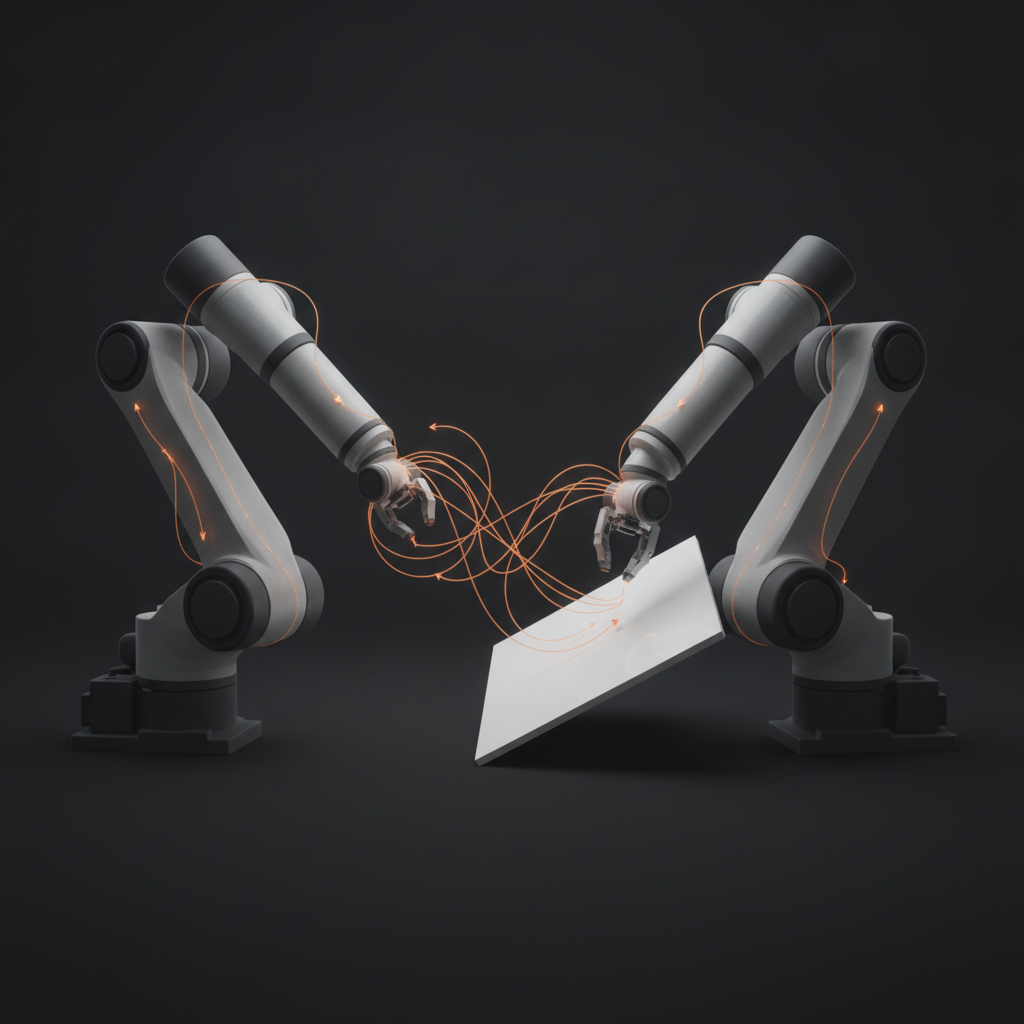
ALOHA-style leader arms do not escape it either. Those arms are unilateral: no contact force is rendered back to the operator, so the leader-follower gap measures the follower servo's tracking error under its own gains, not an operator yielding to felt contact. Bilateral coupling is what makes that gap a measurement. In a four-channel rig the follower tracks the operator's hand and the contact force is rendered back at the leader, so the leader pose is taken as the intended equilibrium and the deflection becomes observed data.
The extraction is sensorless. Payload mass and centre of mass are fitted by least squares over 15 static poses, a per-session bias is subtracted, and a residual error model is learned from free-space sweeps with 512 random Fourier features. Stiffness and damping are then fitted per axis over sliding 300 ms windows at the 1 kHz control rate. A mask keeps a label only where the arm is in contact, deflected, pushing above the measured noise floor and the regression is well conditioned. On the primary operator's demonstrations it retains 84.3 to 96.2 percent of in-contact timesteps on the three translational axes and 71.5 to 82.3 percent on the rotational ones.
Five policies, one set of demonstrations: only compliance output moved the force
All five policies share the demonstrations, the low-level Cartesian impedance controller, three training seeds and the replanning settings; they differ only in inputs and outputs. Each was fine-tuned from SmolVLA (about 450 M parameters, 99.9 M trainable, vision-language backbone frozen) for 2,500 steps to emit 32-step action chunks and rolled out 24 times on a whiteboard tilted about 45 degrees from vertical, over a two-by-two grid of 'wipe the left or right mark, normally or firmly'.
The central claim rests on the force columns, not success. The compliance-output policy's success rate of 50.0 percent against Force-In's 41.7 percent is two rollouts in 24, and the authors say so. What separates it is categorical: it is the only row where the manner word changes the force the arm applies.
| Policy | Force input | Action output | Success | Peak force (N) | RMS force (N) | Protective stops | RMS firmly / normally (N) | Cohen's d (p) | Source |
|---|---|---|---|---|---|---|---|---|---|
| Fixed-K | no | pose; K hand-set at 300 N/m, 20 N·m/rad | 33.3% | 34.9 | 10.9 | 6/24 | 10.69 / 11.20 | -0.22 (0.977) | Tables I, III, IV |
| Fitted-K | no | pose; K = per-axis constants fitted to the labels | 0.0% | 21.4 | 6.5 | 0/24 | 6.78 / 6.23 | 0.24 (0.214) | Tables I, III, IV |
| Force-In | yes, 500 ms history | pose (ForceVLA-style) | 41.7% | 32.3 | 12.9 | 2/24 | 13.23 / 12.58 | 0.10 (0.436) | Tables I, III, IV |
| Hybrid | yes | pose + log K, separate regression head | 20.8% | 19.6 | 7.1 | 0/24 | 7.40 / 6.87 | 0.17 (0.507) | Tables I, III, IV |
| Ours | yes | pose + log K, one shared flow-matching target | 50.0% | 26.3 | 7.8 | 1/24 | 9.12 / 6.40 | 0.89 (0.023) | Tables I, III, IV |
The adverb survives three links, from demonstration to arm
The authors measure the instruction's effect at each stage on the in-plane axis. In the demonstrations, geometric-mean stiffness was 146.2 N/m for 'firmly' against 127.2 N/m for 'normally' (d 0.76, p 0.002, 48 and 39 episodes of the 96 collected). In the policy's own output it was 141.2 against 116.4 N/m (d 0.98, p 0.019). At the arm, RMS force was 9.12 against 6.40 N (d 0.89, p 0.023). On the board normal the label effect is d 0.05, which fits the physics: against a rigid board, pressing harder moves the equilibrium deeper, while wiping firmly shows up as resisting deflection off the stroke.
Hybrid is the instructive failure. It moves its commanded stiffness with the instruction more strongly than the winning policy does (d 2.26 on the y axis), but its stiffness comes from a regression head separate from its pose, the two never co-vary at execution, and its realized force barely moves (d 0.17). Predicting compliance was not enough; decoding pose and stiffness through one target is what made the arm follow. The winning policy also commits to anisotropy: median commanded stiffness of 126.2, 83.0 and 209.1 N/m in the contact frame, an in-plane to normal ratio of 2.50 against roughly 1.2 in the pooled labels, so it is not regressing to the label mean.
Against Fixed-K it removed more ink at 8.6 N lower peak force and 3.1 N lower RMS force, with one protective stop in 24 rollouts against six.
What this changes for anyone recording contact demonstrations
If a dataset was collected with a VR controller, a SpaceMouse, a UMI gripper or unilateral leader arms, the argument says stiffness cannot be recovered from it later. That is a statement about the recording, not the model, so a better network does not help. A team that wants compliance as an action has to choose the interface before collection, and a bilateral rig on an arm with joint-torque sensing is the option this paper shows working with no extra hardware.
The flip side is retroactive value. The authors state the argument applies to any existing bilateral-teleoperation dataset, so labs already holding bilateral recordings on torque-sensed arms may hold stiffness labels they have never extracted. We have not checked which public datasets meet that bar.
Costs the paper reports plainly: the sensorless wrench estimate depends on arm configuration, so the authors pin a fixed nullspace posture and constrain the working volume during calibration and collection. The rotational channels barely get excited by wiping, and all three rotational constants land on the 5 N·m/rad lower bound of the extraction, softer than the controller can command, so read them as 'at least this soft'. The translational constants of 141.1, 149.5 and 158.4 N/m sit well inside the controller's 50 to 1,500 N/m range. One task, one platform, 24 rollouts per policy, and a force-freezing ablation the authors call underpowered by more than an order of magnitude.
Our judgement, for wearable capture such as instrumented gloves: a glove that records fingertip force and hand pose records the realized pose and the force, which is the confounded pair this argument describes. It does not record where the hand was trying to be. Recovering a human operator's stiffness from glove data would need a separate equilibrium signal or deliberate perturbation, and we have not tested either. Force channels still earn their place as observations; they do not become compliance labels on their own.
Check it yourself
The paper, with every number quoted here in Tables II to IV and Sections IV-F and IV-G: https://arxiv.org/html/2609.19976v1. Tables render as HTML, no PDF parsing needed.
Pull the three force rows without a browser: `curl -sL https://arxiv.org/html/2609.19976v1 -o cff.html && grep -o 'firmly[^.]*' cff.html | head` then open Table III in the saved file and confirm 9.12, 6.40, 0.89 and 0.023 for the last row.
Recompute the effect sizes the article leans on: `python3 -c 'print(round(9.12-6.40,2), round(9.12/6.40,3), round(34.9-26.3,1), round(10.9-7.8,1))'` prints 2.72, 1.425, 8.6 and 3.1, the firm-minus-normal gap, its ratio, and the peak and RMS reductions against Fixed-K.
The identifiability claim needs no code: on one axis with force f equal to k times e, check that k times 2 with e divided by 2 gives the same f. The paper's Section III-A generalises that to every positive scale factor.
Project page: icra2027.github.io/free-compliance. On 19 September 2026 its code and data links both read 'coming soon', so the extraction cannot yet be re-run on the authors' demonstrations.
What would prove this wrong
The identifiability argument is mathematics and will not be overturned by an experiment. The empirical claim can be: that labels extracted this way make realized force follow an instruction. Prediction: when the code and data are released, a re-run on a second contact task or a second torque-sensed arm will again show a firm-versus-normal realized force difference with p below 0.05 for the compliance-output policy and not for a force-input position policy. If a replication with at least 24 rollouts per manner finds no significant difference by 30 June 2027, the result was a small-sample artifact of one wiping task.
A second, narrower prediction: by 31 March 2027, no large public dataset collected with pose-only interfaces (DROID, UMI-style handheld grippers, VR teleoperation) will ship per-timestep stiffness labels validated against a force measurement. If one does, it will have added a separate equilibrium or perturbation signal, and we will say so.
Sources
- Guda, Colomé, Torras, Compliance for Free: Learning Identifiable Impedance via Bilateral Teleoperation, arXiv:2609.19976, 17 September 2026
- arXiv HTML render, Tables I to IV, Sections III-A to IV-G
- Project page (anonymised for ICRA 2027 review), code and data marked coming soon on 19 September 2026
- Shukor et al., SmolVLA, the backbone fine-tuned by all five policies, arXiv:2506.01844
- Kobayashi et al., Bi-LAT, bilateral control-based imitation learning with natural language, arXiv:2504.01301
- Zhao, Kumar, Levine, Finn, ACT and ALOHA, the unilateral leader-follower design the paper contrasts, arXiv:2304.13705
- Chi et al., Universal Manipulation Interface, a pose-only handheld interface, arXiv:2402.10329
- BLO LAB, capturing human compliance as a training signal
Building or training robots?
We license manipulation datasets and run custom capture programs. Get in touch to see what fits.

A Closed-Form Weight Edit Took pi0.5 From 27 to 106 of 128 on a Misread Instruction, but Only When Written Into the VLM

V-JEPA 2's Predictor Adds 0.04 Top-1 Over Copying the Present on 27,000 Egocentric Trials. By Horizon, It Runs From Minus 0.05 at 1 s to Plus 0.16 at 3.5 s.
