
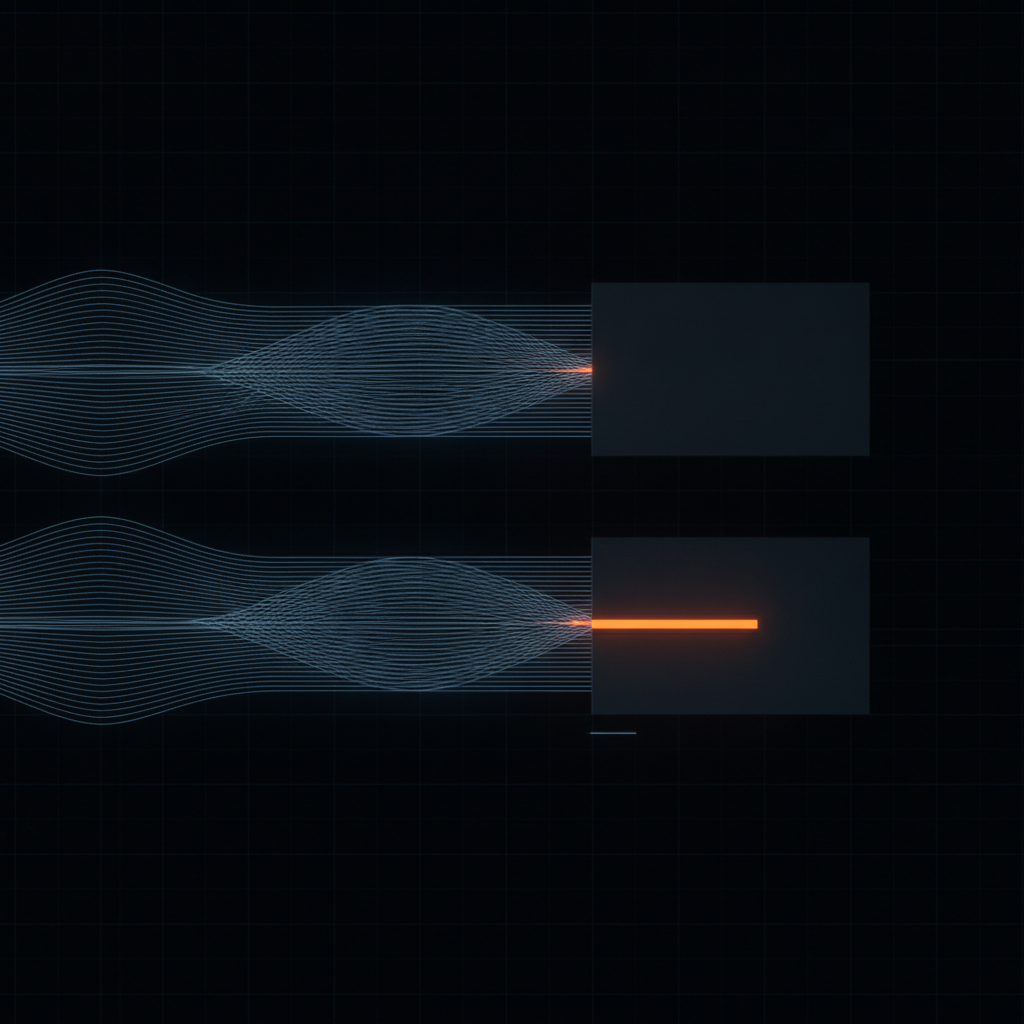
The Ablation That Justified ACT's CVAE Reported 35.3% Down to 2%. An Independent Re-run Got 26.0% Up to 45.2%.
Action Chunking Transformers are the default policy for teleoperated demonstration data, and the encoder at the centre of them is justified by one ablation in the 2023 ALOHA paper: mean success falling from 35.3 percent to 2 percent without it. Bo Kang at Ghent University re-ran that ablation in the original code (arXiv:2609.16745, 15 September 2026). The drop does not reappear in any tested setting. At a 10,000-step budget with the released code's own checkpoint selection and temporal ensembling, removing the encoder raised the two-task mean from 26.0 to 45.2 percent. Probes find no active latent units at any tested positive KL weight.
The ablation that justifies the conditional variational autoencoder inside Action Chunking Transformers reported mean success falling from 35.3 percent to 2 percent when the encoder is removed. An independent re-run in the original code, at a 10,000-step budget with the released code's own validation-loss checkpoint selection and temporal ensembling, got 26.0 percent with the encoder and 45.2 percent without it. Removal helped by 19.1 points. The paper is The Latent That Never Was, arXiv:2609.16745, posted 15 September 2026 by Bo Kang at Ghent University.
That ablation had never been reproduced. The original code ships no removal switch, and the ablation reports neither training length, nor seed count, nor uncertainty. ACT is the workhorse policy for teleoperated demonstration data, so a component at its centre resting on one unreproduced comparison is worth the three weeks of GPU time somebody finally spent on it.
What the re-run actually ran
Three implementations, not one: the original ACT code, LeRobot 0.6.0, and nanoACT, a compact adaptation of LeRobot's ACT written to make controlled changes and latent measurements easy. Both ACT tasks, Transfer Cube and Bimanual Insertion, on both human demonstrations and demonstrations from a programmed controller. Three training seeds per configuration, six for one repeat, and success measured on 512 shared initial poses per policy and seed rather than the released evaluation script's fixed 50.
That last detail matters on its own. The released evaluation script fixes its random seed and reuses the same 50 initial poses, so repeating it adds neither evaluation-sampling precision nor training-run precision. New poses address the first, independently trained policies the second, and this re-run does both.
The published drop does not reappear in any tested setting
At matched 100,000-step budgets the two policies are statistically indistinguishable. On Transfer Cube with human demonstrations, the original code gives 78.8 percent with the encoder against 74.5 without, a 4.4-point edge whose approximate 95 percent interval across three training seeds is plus or minus 21 points. In nanoACT the same comparison is 74.4 against 74.2. In LeRobot 0.6.0 it is 78.6 against 78.8. On Bimanual Insertion it is 17.1 against 16.9.
Switch the demonstrations to a scripted controller and there is still no consistent direction. Original-code Transfer Cube moves 1.8 points in favour of removal with the same sign in every seed pair; Bimanual Insertion moves 1.6 points the other way with the sign changing between seeds.
| Setting | Code | Checkpoint rule | With encoder | Without encoder | With minus without | Source |
|---|---|---|---|---|---|---|
| Transfer Cube, human, 100k steps | original | final | 78.8 (8.0) | 74.5 (2.2) | +4.4 (8.3) | Table II a |
| Transfer Cube, human, 100k steps | original | validation | 70.4 (1.5) | 74.5 (10.0) | -4.1 | Table II a |
| Transfer Cube, human, 100k steps | nanoACT | final | 74.4 (2.8) | 74.2 (1.4) | +0.2 (3.7) | Table II a |
| Transfer Cube, human, 100k steps | LeRobot 0.6.0 | final | 78.6 (2.5) | 78.8 (5.9) | -0.3 (6.8) | Table II a |
| Bimanual Insertion, human, 100k steps | original | final | 17.1 (0.8) | 16.9 (1.1) | +0.3 (1.9) | Table II b |
| Transfer Cube, human, 10k steps | original | validation + ensembling | 35.9 (1.4) | 72.4 (5.1) | -36.5 | Table II e |
| Both tasks, human, 10k steps | original | validation + ensembling | 26.0 (3.3) | 45.2 (6.2) | -19.1 | Table II g |
| Both tasks, human, 100k steps | original | validation + ensembling | 44.4 | 47.2 | -2.7 | Table II g |
| Both tasks, human, published | original (2023) | not reported | 35.3 | 2.0 | +33.3 | ACT, RSS 2023 |
A check with the original ACT images rather than LeRobot's converted ones removes the reversal but does not restore the published drop either. Across 10 seed pairs at 10,000 updates, mean success is 3.3 points higher with the encoder, 95 percent interval [-7.0, +13.6]. A separate three-seed cohort at 100,000 updates gives +3.9 points, interval [-3.7, +11.5]. Both intervals contain zero and both permit higher success after removal.
Two knobs flip the sign inside the same training runs. Checkpoint selection is one: on Transfer Cube at 100,000 steps the encoder leads by 4.4 points at final checkpoints and trails by 4.1 after validation selection, and the two policies are not even selected by the same criterion, because validation loss includes weighted KL with the encoder and reconstruction error alone without it. Temporal ensembling is the other: applied to the same 10,000-step checkpoints it raises mean success by 15.6 points without the encoder and lowers it by 3.6 points with it. Neither of those establishes the cause of the published figure. The author says so plainly, and so do we: the cause is unknown and would need the records from the original ablation.
The latent is not carrying anything on these tasks
Success rates cannot tell you whether the encoder learned something, because the decoder may simply ignore it. So the paper probes the latent directly, with two measurements: how many of the 32 latent dimensions are active units, meaning their posterior-mean variance across inputs exceeds 0.01, and the z-advantage, the percentage reduction in action reconstruction error a sampled latent gives over a zero latent in the same trained decoder on identical batches.
At ACT's default KL weight of 10, Transfer Cube with human demonstrations has no active units and a z-advantage near zero at every probed checkpoint from step 50 to 100,000. Sweeping the weight down through 1, 0.1, 0.01 and 0.001 changes nothing: still no active units, still a z-advantage near zero, reconstruction error steady around 0.090. At the smallest weight the KL is about 0.0021 nats, which is an upper bound on the information a sample carries about its input. Bimanual Insertion behaves the same way across three seeds, with z-advantages inside plus or minus 0.30 percent.
The controls are what make that readable as a real absence rather than a blunt probe. On PushT at a KL weight of 0.01, 2 of 32 dimensions go active and the z-advantage is +14.4 percent. On Transfer Cube with the KL penalty removed entirely it reaches +84 percent. The probe sees a useful latent when one exists.
A planted-choice experiment pushes harder. Scripted Transfer Cube demonstrations pick a high or low handover by coin flip before the scene is generated, so the encoder can see the choice in the action chunk while the decoder's early observation cannot. Every attempt succeeds, which removes selection by outcome. At KL weights of 0.001, 0.01 and 10 there are still no active units, though a classifier on the posterior means recovers the choice 57 to 73 percent of the time against 50 percent for guessing. Remove the penalty and the classifier hits 100 percent and the z-advantage reaches +72 percent. Replacing the encoder's sample with zero in that same trained decoder raises early-window reconstruction error 3.6-fold.
Which is the whole problem in one number. The latent can be made useful, and when it is useful it is useful precisely because it reads the future actions, which is the one thing ACT does not have at inference. The paper also tests whether the latent, when it does improve reconstruction, is encoding demonstration style as ACT intended. Probing whole-demonstration timing, speed, smoothness and path length gives a best test R2 of +0.002. Probing properties of the chunk the encoder actually sees gives 0.61 for mean speed and 0.50 for mean squared jerk. It has learned the chunk in front of it, not the demonstrator behind it.

What this changes if you are collecting demonstrations
The CVAE was the stated mechanism for handling disagreement between human demonstrations. ACT trains with L1 loss on one predicted chunk per observation, which drives each action element toward the median across the demonstrations that match that observation. When demonstrators disagree, those medians can compose a sequence nobody performed. The latent was supposed to absorb that variation. On these benchmarks it is not absorbing anything, which means the cost of operator disagreement in your data is being paid by the loss function directly.
Our read, marked as a judgement: this moves a modelling question onto the collection floor. If the architecture is not modelling multimodality, then consistency between operators, between sessions and between rigs is doing work you may have believed the policy was doing for you. Protocol design, operator training and per-session drift checks stop being hygiene and start being the mechanism. That is a data decision, not a model decision, and it is cheaper to fix at capture than at training.
The engineering consequence is smaller but immediate. Removing the encoder cuts stored parameters from 83.9 to 66.5 million in the original code, a 20.7 percent reduction, and the encoder is 33.7 percent of the tested single-camera LeRobot model. Training throughput rises 24.5 percent in nanoACT and 7.8 percent in the original code. Inference is unchanged, because ACT already skips the encoder there.
What this does not license: concluding that the encoder is harmful, or that it is useless on your task. Every experiment here is in simulation, on two tasks, and the paper finds the latent does help reconstruction on PushT. The honest summary is that the published justification does not hold up and the replacement evidence is a null, not a reversal.
Check it yourself
The author released the patches, probes, paired pose suites and results, which is the part that makes this repeatable rather than merely reported.
`git clone https://github.com/aida-ugent/act-cvae-forensics` for the experiments and results, and `git clone https://github.com/bokang-ugent/nanoACT` for the compact implementation the latent measurements run in.
The original claim is in the ACT paper, arXiv:2304.13705, RSS 2023. The re-run's Table II, Figure 1b and Figure 3 carry every number above: `curl -sL -A 'Mozilla/5.0' https://arxiv.org/html/2609.16745v1`.
LeRobot ships an encoder removal switch (`use_vae`), so the cheapest version of this check on your own data is to train the pair and compare on shared initial poses, with at least three seeds, and to report which checkpoint rule you used. The two checkpoint rules are not equivalent and they select different steps.
What would prove this wrong
Our falsifiable claim, dated: by 30 June 2027, no independent re-run of the ACT encoder ablation on the two original simulated tasks will report a removal penalty larger than 10 percentage points with three or more seeds, shared evaluation poses and a stated checkpoint rule. If one does, the published 33.3-point drop had a real cause that this re-run's settings missed, and the collection-side reading above is premature.
The narrower test: if someone reports active latent units and a z-advantage above 5 percent on a real-robot contact-rich task at ACT's default KL weight, the null here is a property of two simulated benchmarks rather than of the architecture, and the encoder is worth keeping wherever demonstrations genuinely disagree.
Sources
- Bo Kang, The Latent That Never Was: A Forensic Re-run of the CVAE Ablation in Action Chunking Transformers, arXiv:2609.16745, 15 September 2026
- arXiv HTML render, Table II and Figures 1 to 3
- Zhao, Kumar, Levine, Finn, Learning Fine-Grained Bimanual Manipulation with Low-Cost Hardware (ACT), RSS 2023, the source of the 35.3 to 2 percent ablation
- act-cvae-forensics, the released experiments and results
- nanoACT, the compact implementation used for the latent probes
- LeRobot, whose ACT is one of the three implementations compared
- Blomega Lab, on what demonstration data has to carry
Building or training robots?
We license manipulation datasets and run custom capture programs. Get in touch to see what fits.

A Closed-Form Weight Edit Took pi0.5 From 27 to 106 of 128 on a Misread Instruction, but Only When Written Into the VLM

V-JEPA 2's Predictor Adds 0.04 Top-1 Over Copying the Present on 27,000 Egocentric Trials. By Horizon, It Runs From Minus 0.05 at 1 s to Plus 0.16 at 3.5 s.
