
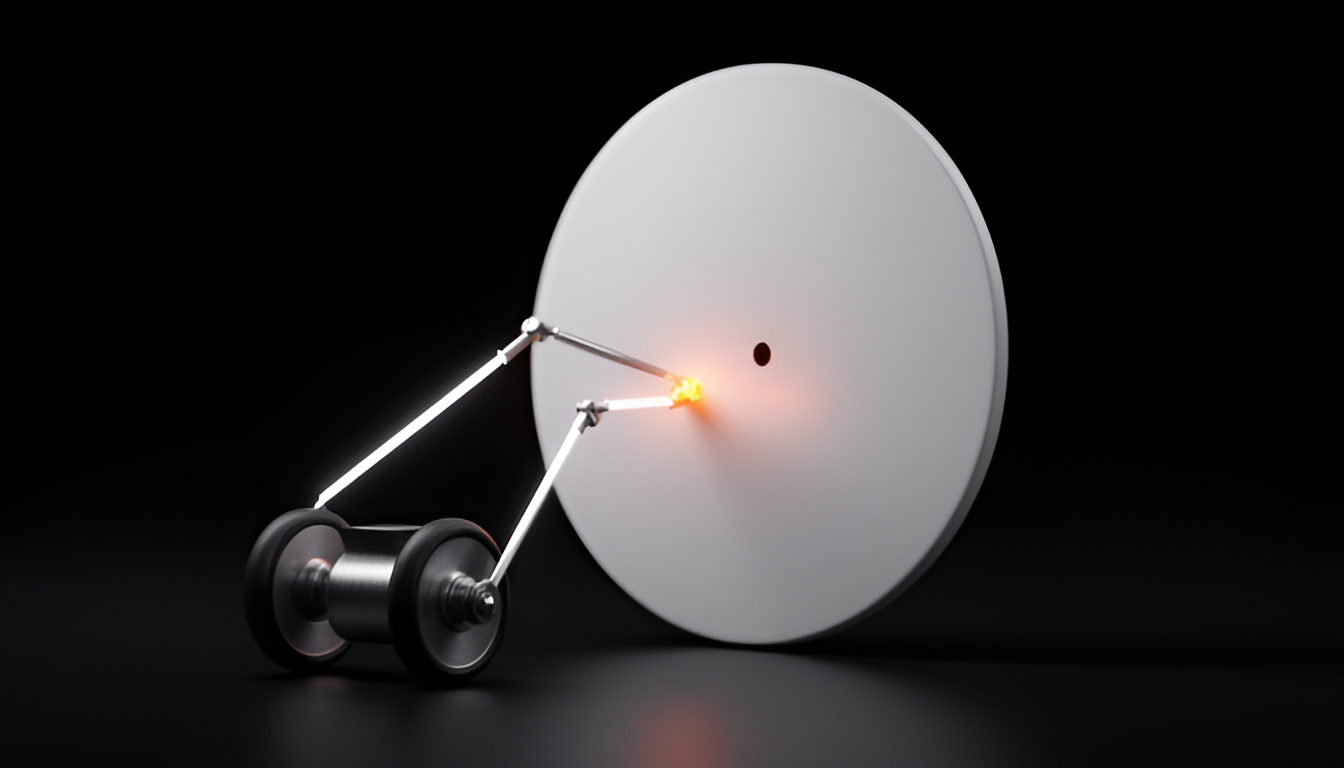
A 3,200 Euro Robot, 250 Demonstrations, Four VLAs: pi0 Cleaned a Toilet Seat 12 of 20 Times, pi0.5 5 of 20, SmolVLA and GR00T Zero
Hamburg, Hon Hai Research Institute and Northeastern University (arXiv:2611.15381, 11 November 2026) put two SO-101 arms on a TurtleBot 4 and fine-tuned four VLAs on the same 250 demonstrations, about 6.7 hours. pi0 reached 60% strict success, 90% with one human reset; pi0.5's open release 25%; SmolVLA and GR00T N1.7 0%. Our intervals show the pi0 to pi0.5 gap is p = 0.054 on 20 rollouts.
Fine-tuned on the same 250 teleoperated demonstrations, pi0 cleaned a smudge off a toilet seat in 12 of 20 rollouts and pi0.5 in 5 of 20. SmolVLA, which was pretrained mostly on community SO-100 and SO-101 data, scored 0 of 20 on an SO-101 robot. GR00T N1.7 failed all 5 of its rollouts. The study is arXiv:2611.15381, posted 11 November 2026 by Sven Schreiber and co-authors from the University of Hamburg, Hon Hai Research Institute and Northeastern University in China.
The robot costs about 3,200 euros: a TurtleBot 4 base at about 2,700 and a bimanual extension at about 500, which includes two SO-101 follower arms, two leader arms, cameras and 3D-printed parts. The printed parts take 71 h 53 min to print and cost an estimated 22.5 euros.
One task, one dataset, four policy families
The task has five consecutive subtasks: grab a soapy sponge and drive to the dirty spot, scrub with the rough side, flip the sponge with both arms, wipe with the soft side, put the sponge away and return. The flip is the only step that strictly needs two arms. Between trials the authors randomised toilet yaw within 45 degrees, table orientation, sponge position and the size (3 to 6 cm long) and position of a black food-colouring smudge. Lighting, toilet model and background were fixed.
The data: 250 demonstrations at 30 Hz in LeRobot format, three RGB views (one top camera, one per wrist), joint states of both arms and base velocities, with frames hand-labelled by subtask. 200 are standard teleoperation of about 1.5 minutes each; 50 are DAgger-style corrections of about 2 minutes each, collected by taking over from a pi0 trained on the first 200. That is about 400 minutes, or 6.7 hours (our arithmetic from the stated approximate lengths), with corrections making up 20% of episodes and about 25% of the time. Collection took two people: one on the leader arms, one on the keyboard for the base and recording.
All four models were fine-tuned through LeRobot. The authors stress that LeRobot's pi0.5 is the partially open release: the flow-matching action head trains and runs, but high-level subtask prediction from the original system was not released.
Results by policy
| Policy (LeRobot implementation) | Rollouts | Strict | Relaxed | With one human reset | Strict, 95% Wilson interval | Main failure reported | Source |
|---|---|---|---|---|---|---|---|
| pi0 | 20 | 60% | 70% | 90% | 38.7 to 78.1% | stuck under the seat; missed subtask transition | arXiv:2611.15381 v1, Section V-D and Fig. 6; interval ours |
| pi0 + SARM stage signals | 20 | 40% | 55% | 65% | 21.9 to 61.3% | worse than pi0 on every criterion | arXiv:2611.15381 v1, Section V-D and Fig. 6; interval ours |
| pi0.5 (open action head only) | 20 | 25% | 55% | 55% | 11.2 to 46.9% | stuck near the toilet, missed spot, dropped sponge at handover | arXiv:2611.15381 v1, Section V-D and Fig. 6; interval ours |
| pi0.5 + MEM short memory | 20 | 10% | 10% | 10% | 2.8 to 30.1% | same failures as pi0.5 | arXiv:2611.15381 v1, Section V-D and Fig. 6; interval ours |
| SmolVLA | 20 | 0% | 0% | 0% | 0 to 16.1% | did not localise the dirt, rarely reached the sponge | arXiv:2611.15381 v1, Section V-D and Fig. 6; interval ours |
| GR00T N1.7 | 5 | 0% | 0% | 0% | 0 to 43.4% | could not pick up the sponge | arXiv:2611.15381 v1, Section V-D and Fig. 6; interval ours |
Adding memory or stage signals made both models worse
Both pi0 and pi0.5 condition only on the latest observation, so the authors tried two ways to give them a sense of task progress. Explicit: SARM, fine-tuned on the subtask labels with five-fold cross-validation, feeding pi0 five subtask probabilities and an overall progress estimate. pi0 with SARM fell to 40% strict, 55% relaxed and 65% with a reset. Implicit: LeRobot's implementation of MEM short-horizon memory on pi0.5, six frames at a stride of 30 covering the previous six seconds. With no released pretrained weights for that component, it was trained only on these 250 demonstrations, and scored 10% on every criterion.
Our reading, a judgement: a memory module trained from scratch on 6.7 hours is not a test of memory. The SARM result is more informative, because its signals were produced out-of-fold during training and still hurt.
Twenty rollouts cannot separate pi0 from pi0.5 on strict success
The headline gap, 60% against 25%, is 12 of 20 against 5 of 20. Our Fisher exact test gives p = 0.054 for strict success and p = 0.514 for relaxed (14 of 20 against 11 of 20). The clearest separation is with one human reset, 18 of 20 against 11 of 20, p = 0.031. The 95% Wilson interval for pi0's strict rate is 38.7% to 78.1%; for pi0.5 it is 11.2% to 46.9%; they overlap.
The two zeros are firmer. SmolVLA at 0 of 20 has an upper bound of 16.1%. GR00T at 0 of 5 has an upper bound of 43.4%, which is wide, but the authors report it could not pick up the sponge at all. pi0 with SARM against pi0 is p = 0.343 on strict success, so the SARM penalty is also within noise on this sample.
What it means for small labs and data buyers
A complete mobile bimanual data rig now costs about 3,200 euros, and the arm half of it about 500. At that price the binding cost of a long-horizon task is the operator time: two people for about 6.7 hours of recorded demonstrations here, before setup, resets and failed takes, which the paper does not report.
Pretraining on the same arm did not transfer. SmolVLA's community SO-100 and SO-101 pretraining did not get it to the sponge in this task, while pi0, pretrained on other robots, finished 12 of 20. Our judgement: embodiment match in pretraining data is worth less than task structure and data quality in the fine-tuning set, at least for a mobile, bimanual, multi-stage task that the community data does not contain.
The DAgger slice deserves its own measurement. 50 of 250 episodes were corrections collected on pi0, and pi0 is the model that did best. The paper has no ablation without those 50 episodes, so it cannot say whether pi0's lead comes partly from training on recoveries from its own mistakes.
Newer is not automatically better when the release is partial. pi0.5 as shipped in LeRobot lacks the subtask prediction the original system used. A result like 25% against 60% says something about the open checkpoint, not about pi0.5 as described in its paper.
Check it yourself
Read https://arxiv.org/html/2611.15381v1. Costs are in Section III (about 3,200 euros total, 2,700 base, 500 extension, 22.5 euros of prints, Table I), data collection in Section V-B, policy configurations in V-C and all success rates in V-D and Fig. 6.
Rollout counts: 20 per policy, 5 for GR00T. Successes are rate times 20 (60% is 12). Wilson interval: centre (p + z^2 / 2n) / (1 + z^2 / n), half-width z * sqrt(p(1 - p) / n + z^2 / 4n^2) / (1 + z^2 / n), with z = 1.96. Fisher exact: scipy.stats.fisher_exact([[12, 8], [5, 15]]) returns p = 0.054; [[18, 2], [11, 9]] returns 0.031.
Hardware and stack: LeRobot (https://github.com/huggingface/lerobot) and the SO-ARM100 designs (https://github.com/TheRobotStudio/SO-ARM100). The project page is https://so101-turtlebot4.github.io/mobile-bimanual-cleaning/. We found no dataset or checkpoint link on it on 14 November 2026.
What would prove this wrong
If a rerun with at least 50 rollouts per policy on the same platform shows pi0.5 (open release) within 10 points of pi0 on strict success, the ranking here was sampling noise. Our prediction, a judgement: pi0 stays ahead by more than 15 points as long as the DAgger corrections were collected on pi0 alone.
If by 30 June 2027 a SmolVLA checkpoint fine-tuned on these or similar 250 demonstrations completes the full five-subtask task in at least 25% of 20 rollouts, the zero here reflects this training run, not the model family.
Sources
- Schreiber, Burdiek, Huber-Saffer, Li, Chen, Liu, Zhang, Low-Cost Mobile Bimanual Manipulation for Long-Horizon Toilet Cleaning, arXiv:2611.15381 (11 Nov 2026)
- arXiv:2611.15381 v1, HTML full text
- Project page, so101-turtlebot4.github.io
- LeRobot (Hugging Face)
- SO-ARM100 and SO-101 designs (TheRobotStudio)
Building or training robots?
We license manipulation datasets and run custom capture programs. Get in touch to see what fits.

A Closed-Form Weight Edit Took pi0.5 From 27 to 106 of 128 on a Misread Instruction, but Only When Written Into the VLM

V-JEPA 2's Predictor Adds 0.04 Top-1 Over Copying the Present on 27,000 Egocentric Trials. By Horizon, It Runs From Minus 0.05 at 1 s to Plus 0.16 at 3.5 s.
