
A 128K context window is really 82K for Bengali, and up to 4.5x worse under two other tokenizers
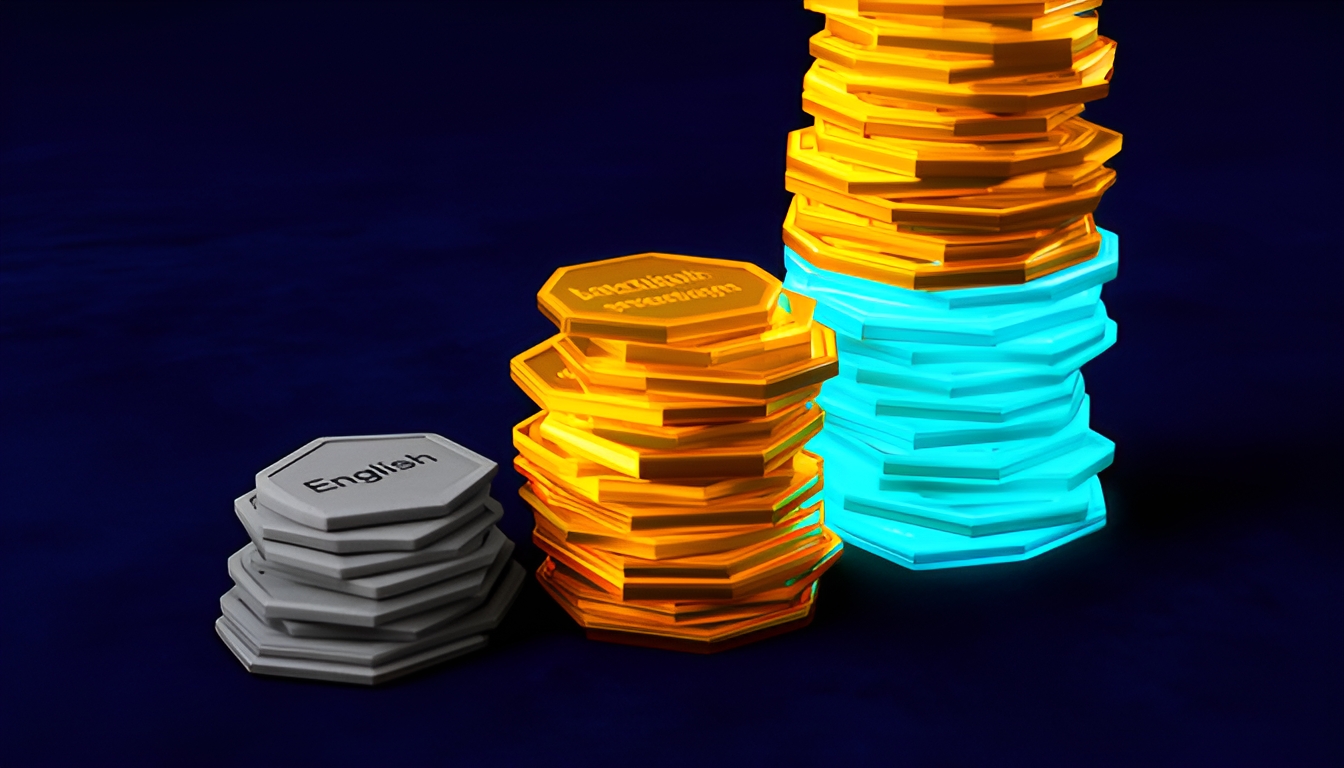
A 10 August 2026 paper, Measuring the Tokenization Premium (arXiv:2608.09046), audits what a fixed amount of text actually costs across languages, using a 120-item Python debugging corpus rather than generic prose. Bengali needs 1.56x as many GPT-4o tokens as English for the same content; Yoruba needs 2.37x, the highest premium measured under GPT-4o's tokenizer; and under the Qwen2.5 and Mistral-7B tokenizers, Bengali's premium rises to up to 4.5x. The practical effect: a nominal 128,000-token context window holds roughly 82,000 English-equivalent tokens of the same Bengali content.
The premium is not a pricing footnote, it is a third of the context window gone before the model reads a word
Tokenization cost is usually reported as a price multiplier: Bengali costs more per request because it takes more tokens to say the same thing. That framing treats the problem as a budget line. The 82,000-of-128,000 figure reframes it as a capacity problem: anything built around a fixed window, a long document, a multi-turn support chat, a full codebase pasted into a prompt, truncates roughly 36% sooner in Bengali than in English, for content of identical length and meaning, before the model has done anything.
The authors chose an applied task deliberately. Most tokenizer-fairness papers measure premiums on generic web text or Wikipedia, where premiums are already known to vary by script and morphology. This one runs the same 120 Python-debugging items, code plus natural-language explanation, through all three tokenizers in five languages, so the premium reported is specific to a task multilingual AI products actually ship: a coding tutor, a technical support agent, a debugging assistant. Our judgement: that choice is what makes the 82,000-token number usable by a product team, instead of a fact about Bengali text in the abstract.
What the paper measured, and when
"Measuring the Tokenization Premium: A Cost Audit for Underserved Language Communities," by Avijit Roy, Proma Roy and Hrishitva Patel, was submitted to arXiv on 10 August 2026 (arXiv:2608.09046v1, cs.CL) and accepted at an IJCAI 2026 workshop. The authors built a 120-item corpus of Python debugging tasks, code plus the natural-language explanation around it, in English, then translated it into Bengali, Hindi, Arabic, Tamil and Yoruba. Bengali and Hindi are the validated test languages; Arabic, Tamil and Yoruba are reported as exploratory. Each version was run through three tokenizers in production use: GPT-4o's o200k base, Qwen2.5-7B's tokenizer, and Mistral-7B's tokenizer, and the token count per language was compared to the English baseline on identical content.
The headline numbers, and what the abstract does and does not specify
| Quantity | Value | Source |
|---|---|---|
| Corpus | 120-item Python debugging corpus, 5 translated languages | arXiv:2608.09046 abstract |
| Tokenizers compared | GPT-4o o200k base, Qwen2.5-7B, Mistral-7B | arXiv:2608.09046 abstract |
| Bengali premium, GPT-4o | 1.56x English token count | arXiv:2608.09046 abstract |
| Yoruba premium, GPT-4o (highest measured) | 2.37x English token count | arXiv:2608.09046 abstract |
| Bengali premium, Qwen2.5 / Mistral-7B | up to 4.5x English token count | arXiv:2608.09046 abstract |
| 128K window, English-equivalent capacity for Bengali | approximately 82K tokens (GPT-4o) | arXiv:2608.09046 abstract |
| Hindi, Arabic, Tamil premiums | not reported in the abstract | arXiv:2608.09046 (full text would carry per-language table) |
| Which of Qwen2.5 / Mistral-7B produces the 4.5x figure | not broken out in the abstract | arXiv:2608.09046 |
| Venue | IJCAI 2026 workshop (accepted) | arXiv:2608.09046 listing |
All values taken directly from the arXiv:2608.09046v1 abstract, fetched 16 October 2026. Where a breakdown is not in the abstract, this table says so rather than estimating it.
Why a byte-pair tokenizer charges some scripts more, and why Latin-script Yoruba still loses
Script is a weak predictor on its own. Yoruba uses the same Latin letters GPT-4o's tokenizer was trained around, yet it scores a higher premium than Bengali, whose Brahmic script is visually and structurally farther from English. A byte-pair tokenizer's vocabulary is a frequency table built from its training mix, so a language is expensive whenever its sub-word patterns, whatever the script, were rare in that mix. That is why swapping tokenizers (from GPT-4o's o200k to Qwen2.5 or Mistral-7B) moves Bengali's premium from 1.56x past 4x: each vocabulary was built from a different corpus mix, so each one under-represents a different set of languages.
What this means for a team building or buying multilingual AI
A model comparison that only reports accuracy or BLEU-style quality scores is missing half the cost structure. Two products with identical per-token pricing and identical quality in Bengali are not equivalent if one uses a tokenizer that charges 1.56x and the other charges up to 4.5x for the same content: the second product's users get less usable context, pay more per conversation, and hit truncation sooner, for reasons invisible in a quality benchmark. For any product scoping multilingual support, API cost estimates and context-window sizing for non-English languages need the tokenizer-specific premium applied before launch, not discovered from a support ticket about truncated output.
The corpus choice also matters for anyone citing this kind of number. A premium measured on technical, code-adjacent text (the applied case here) will not automatically match a premium measured on conversational or legal text in the same language, because fragmentation depends on which sub-word patterns appear in the specific content, not only on the language.
Check it yourself
- Paper: arxiv.org/abs/2608.09046, "Measuring the Tokenization Premium: A Cost Audit for Underserved Language Communities," submitted 10 August 2026.
- Count tokens yourself for any string with OpenAI's public tokenizer (
tiktoken, encodingo200k_base) and compare an English sentence against its Bengali translation. - Qwen2.5 and Mistral-7B tokenizers are both open on Hugging Face (
Qwen/Qwen2.5-7B,mistralai/Mistral-7B-v0.1); load each withAutoTokenizerand repeat the same comparison to see the premium move.
What would prove this wrong
If the paper's full text (beyond the abstract we verified) reports per-tokenizer Bengali premiums that do not reach 4.5x under either Qwen2.5 or Mistral-7B individually, the "up to 4.5x" framing would overstate the worst single-tokenizer case, since the abstract states it only as a combined ceiling. We flag this explicitly: as of 16 October 2026 we verified the abstract's exact wording but did not pull the full-text per-tokenizer breakdown table. A reader checking the HTML or PDF version who finds Qwen2.5 and Mistral-7B individually below 4.5x should treat this article's framing of "up to 4.5x" as a combined range, not a claim that either tokenizer alone reaches it.
Sources
- Avijit Roy, Proma Roy, Hrishitva Patel, "Measuring the Tokenization Premium: A Cost Audit for Underserved Language Communities," arXiv:2608.09046, 10 August 2026. arxiv.org/abs/2608.09046